Leech Rebecca M, Worsley Anthony, Timperio Anna, McNaughton Sarah A
The Institute for Physical Activity and Nutrition (IPAN), School of Exercise and Nutrition Sciences, Deakin University, Geelong, Australia.
Int J Behav Nutr Phys Act. 2017 Jan 7;14(1):3. doi: 10.1186/s12966-016-0459-6.
There is some evidence that large energy intakes towards the end of the day are associated with adverse health outcomes, however, studies of temporal eating patterns across the day are rare. This study examines the temporal eating patterns of Australian adults using latent class analysis (LCA), as a novel approach.
Dietary data (n = 2402 men and n = 2840 women, ≥19 years) from two 24-h recalls collected during the 2011-12 Australian National Nutrition and Physical Activity Survey were analyzed. LCA was performed to identify distinct temporal eating patterns based on whether or not an eating occasion (EO) occurred within each hour of the day. F and adjusted-chi tests assessed differences in sociodemographic and eating patterns (e.g., meal, snack and EO frequency) between latent classes.
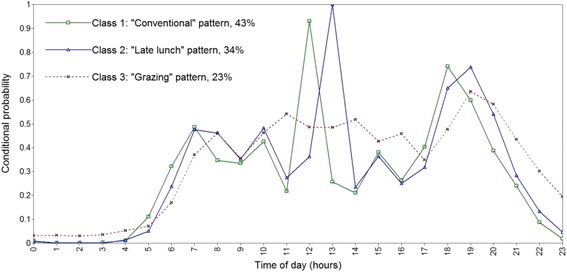
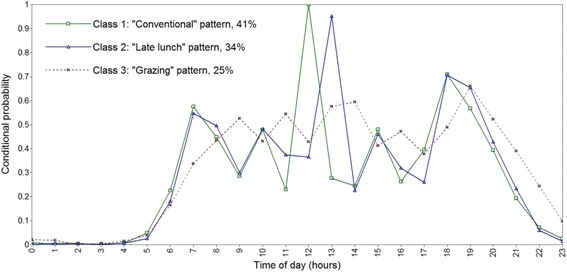
Three patterns, labelled "Conventional" (men: 43%, women: 41%), "Later lunch" (men: 34%, women: 34%) and "Grazing" (men: 23%, women: 25%) were identified. Men and women with a "Grazing" pattern were significantly younger (P < 0.001) and a higher proportion were from major cities (P < 0.01) and were not married (men only, P = 0.01), compared to the "Conventional" and "Later lunch" patterns. The "Grazing" pattern was also characterized by a higher EO frequency (P < 0.01) and snack frequency (P < 0.001) and consumption of a higher proportion of total energy intake from snacks but a lower proportion of total energy intake from meals (P < 0.001).
This study identified three distinct temporal eating patterns in adults that varied by age, EO frequency, snack frequency and energy intake pattern. LCA is a useful approach to capture differences in EO timing across the day. Future research should examine associations between temporal eating patterns and health.
有证据表明,临近一天结束时大量的能量摄入与不良健康结果相关,然而,关于全天时间性饮食模式的研究却很少。本研究采用潜在类别分析(LCA)这一新颖方法,对澳大利亚成年人的时间性饮食模式进行研究。
分析了2011 - 12年澳大利亚全国营养与身体活动调查期间收集的两次24小时饮食回忆数据(男性n = 2402人,女性n = 2840人,年龄≥19岁)。基于一天中每小时是否发生进食场合(EO),进行潜在类别分析以识别不同的时间性饮食模式。F检验和校正卡方检验评估了潜在类别之间社会人口统计学和饮食模式(如进餐、吃零食和EO频率)的差异。
识别出三种模式,分别标记为“传统型”(男性:43%,女性:41%)、“午餐较晚型”(男性:34%,女性:34%)和“随意进食型”(男性:23%,女性:25%)。与“传统型”和“午餐较晚型”模式相比,具有“随意进食型”模式的男性和女性明显更年轻(P < 0.001),来自大城市的比例更高(P < 0.01),且男性未婚比例更高(P = 0.01)。“随意进食型”模式还具有较高的EO频率(P < 0.01)和吃零食频率(P < 0.001),零食占总能量摄入的比例较高,但进餐占总能量摄入的比例较低(P < 0.001)。
本研究在成年人中识别出三种不同的时间性饮食模式,这些模式在年龄、EO频率、吃零食频率和能量摄入模式方面存在差异。潜在类别分析是一种捕捉全天EO时间差异的有用方法。未来的研究应探讨时间性饮食模式与健康之间的关联。