Doh Eui Jeong, Kim Jung-Hoon, Oh Seung Eun, Lee Guemsan
Department of Herbology, College of Korean Medicine, Wonkwang University, Iksan, 54538 Republic of Korea ; Center for Metabolic Function Regulation, Wonkwang University, Iksan, 54538 Republic of Korea.
Division of Pharmacology, School of Korean Medicine, Pusan National University, Yangsan, 50612 Republic of Korea.
Genes Genomics. 2017;39(1):101-109. doi: 10.1007/s13258-016-0476-5. Epub 2016 Oct 20.
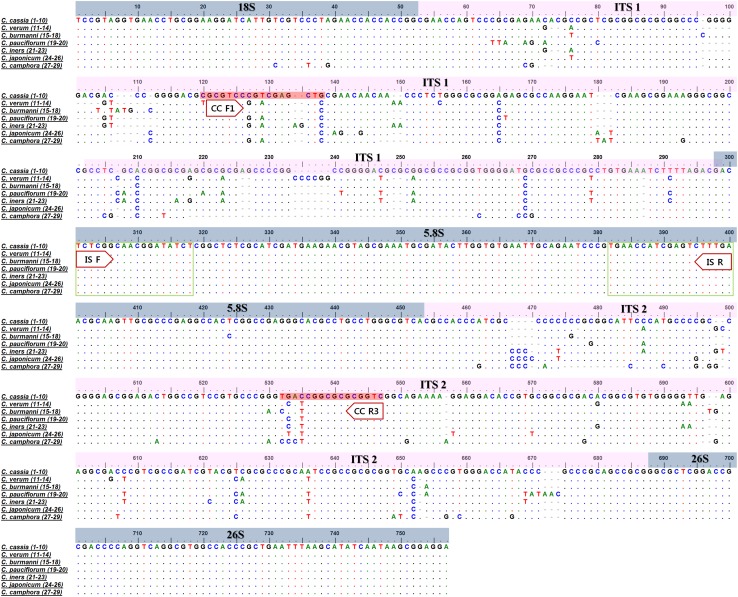
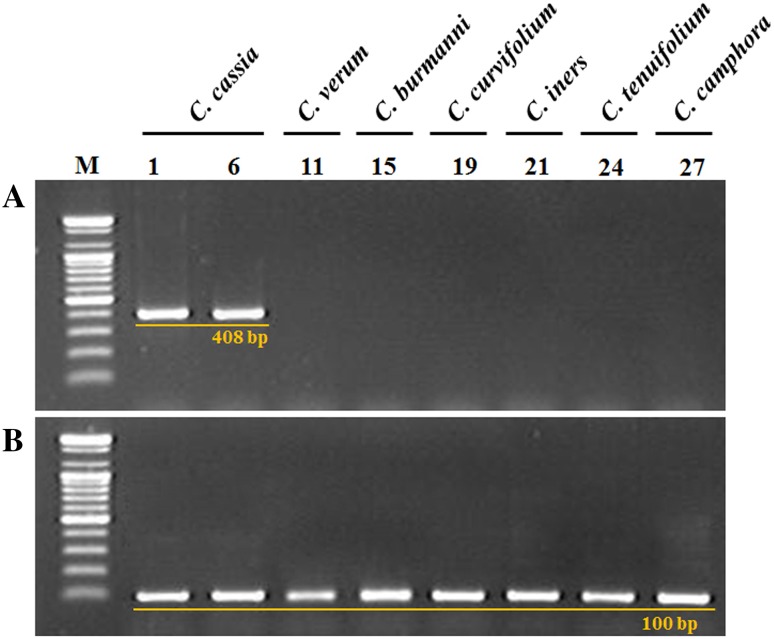
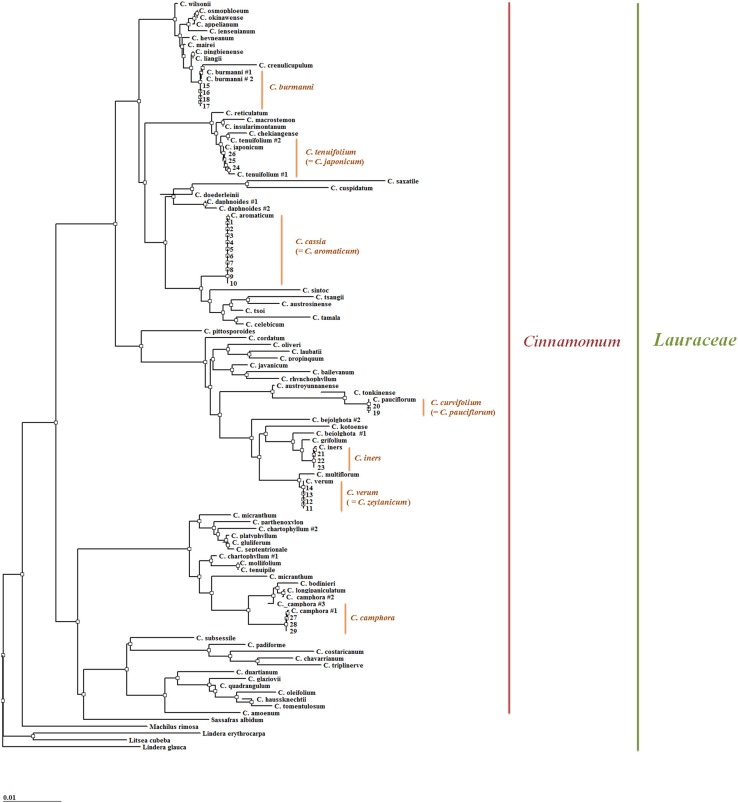
In this study, we identified and evaluated the genetic relationships among plants, which are used in traditional medicine. We also attempted to monitor the distribution of traditional medicines derived from by using DNA barcoding and a species-specific DNA marker. Plants of the genus , and in particular , are commonly used as medicinal herbs in the form of Cinnamomi Ramulus, Cinnamomi Cortex, and Cassiae Cortex Interior. However, it is difficult to distinguish among different species based on morphological features, and so to overcome this limitation, nucleotide sequences of the internal transcribed spacer (ITS) region of DNA were determined and compared. On the basis of the discrepancy in determined ITS sequences, a 408-bp product, amplified by the primer pair CC F1/CC R3, was developed as a -specific DNA marker. Using the developed DNA marker in combination with the ITS 2 nucleotide sequence, we monitored imported and commercially supplied medicinal products derived from plants in markets in Korean, China, and Japan. The results revealed that most of the specimens monitored were derived from .
在本研究中,我们鉴定并评估了用于传统医学的植物之间的遗传关系。我们还尝试通过使用DNA条形码和物种特异性DNA标记来监测源自这些植物的传统药物的分布。樟属植物,特别是肉桂、桂皮和桂心,通常以桂枝、桂皮和桂心的形式用作草药。然而,基于形态特征很难区分不同的樟属物种,因此为了克服这一限制,我们测定并比较了樟属植物DNA的内部转录间隔区(ITS)区域的核苷酸序列。基于所测定的ITS序列的差异,由引物对CC F1/CC R3扩增得到的一个408 bp的产物被开发为樟属特异性DNA标记。结合所开发的DNA标记和ITS 2核苷酸序列,我们监测了韩国、中国和日本市场上进口的和商业供应的源自樟属植物的药用产品。结果显示,所监测的大多数标本均源自肉桂。