Sarkar Sharmila, Patra Paramita, Mridha Kakali, Ghosh Sudip Kumar, Mukhopadhyay Asish, Thakurta Rajarshi Guha
Department of Psychiatry, Calcutta National Medical College, Kolkata, West Bengal, India.
Department of Dermatology, Calcutta National Medical College, Kolkata, West Bengal, India.
Indian J Psychiatry. 2016 Oct-Dec;58(4):378-382. doi: 10.4103/0019-5545.196720.
In many patients, emotional stress may exacerbate acne. Psychological problems such as social phobias, low self-esteem, or depression may also occur as a result of acne. The presence of acne may have some negative effect on the quality of life, self-esteem, and mood of the affected patients. While some studies have been undertaken about anxiety, depression, and personality patterns in patients with acne, only a few studies have been done to identify specific personality disorders in patients with acne. Furthermore, there is a dearth of data regarding the effect of personality disorder on the psychological states of the patients which prompted us to undertake the present study.
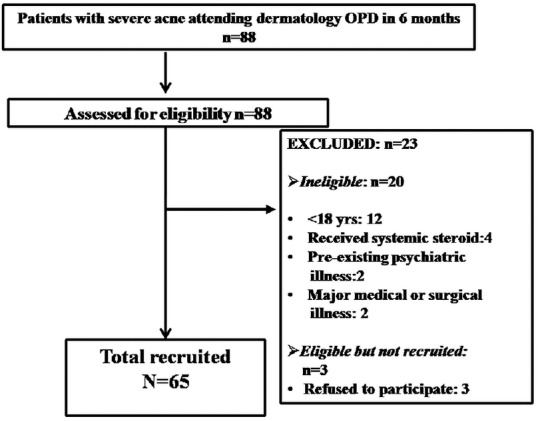
This was a descriptive cross-sectional study, undertaken in a Tertiary Care Teaching Hospital in Eastern India. Consecutive patients suffering from severe (Grade 3 and 4) acne, attending the Dermatology Outpatient Department, aged above 18 years were included to the study.
A total of 65 patients were evaluated with a mean age of 26 years. Personality disorder was present in 29.2% of patients. The diagnosed personality disorders were obsessive compulsive personality disorder ( = 9, 13.8%), anxious (avoidant) personality disorder ( = 6, 9.2%), and borderline personality disorder ( = 2, 3%), mixed personality disorder ( = 2, 3%). All patients with personality disorder had some psychiatric comorbidity. Patients having personality disorder had higher number of anxiety and depressive disorders which were also statistically significant.
The present study highlights that personality disorders and other psychiatric comorbidities are common in the setting of severe acne.
在许多患者中,情绪压力可能会加重痤疮。痤疮还可能导致社交恐惧症、自卑或抑郁等心理问题。痤疮的存在可能会对患者的生活质量、自尊和情绪产生一些负面影响。虽然已经有一些关于痤疮患者焦虑、抑郁和人格模式的研究,但只有少数研究致力于识别痤疮患者的特定人格障碍。此外,关于人格障碍对患者心理状态影响的数据匮乏,这促使我们开展本研究。
这是一项描述性横断面研究,在印度东部的一家三级护理教学医院进行。纳入了年龄在18岁以上、连续就诊于皮肤科门诊且患有重度(3级和4级)痤疮的患者。
共评估了65例患者,平均年龄为26岁。29.2%的患者存在人格障碍。诊断出的人格障碍有强迫型人格障碍(n = 9,13.8%)、焦虑(回避)型人格障碍(n = 6,9.2%)、边缘型人格障碍(n = 2,3%)、混合型人格障碍(n = 2,3%)。所有患有人格障碍的患者都有一些精神共病。患有人格障碍的患者焦虑症和抑郁症的发病率更高,且具有统计学意义。
本研究强调,在重度痤疮患者中,人格障碍和其他精神共病很常见。