Fan Hua, Chen Hao-Yu, Ma Hong-Jie, Chang Zheng, Yin Hai-Quan, Ng Danny Siu-Chun, Cheung Carol Y, Hu Shan, Xiang Xiang, Tang Shi-Bo, Li Shuang-Nong
Aier School of Ophthalmology, Central South University, Changsha, Hunan 410015, China.
Joint Shantou International Eye Center, Shantou, Guangdong 515000, China.
Chin Med J (Engl). 2017 Feb 20;130(4):445-451. doi: 10.4103/0366-6999.199844.
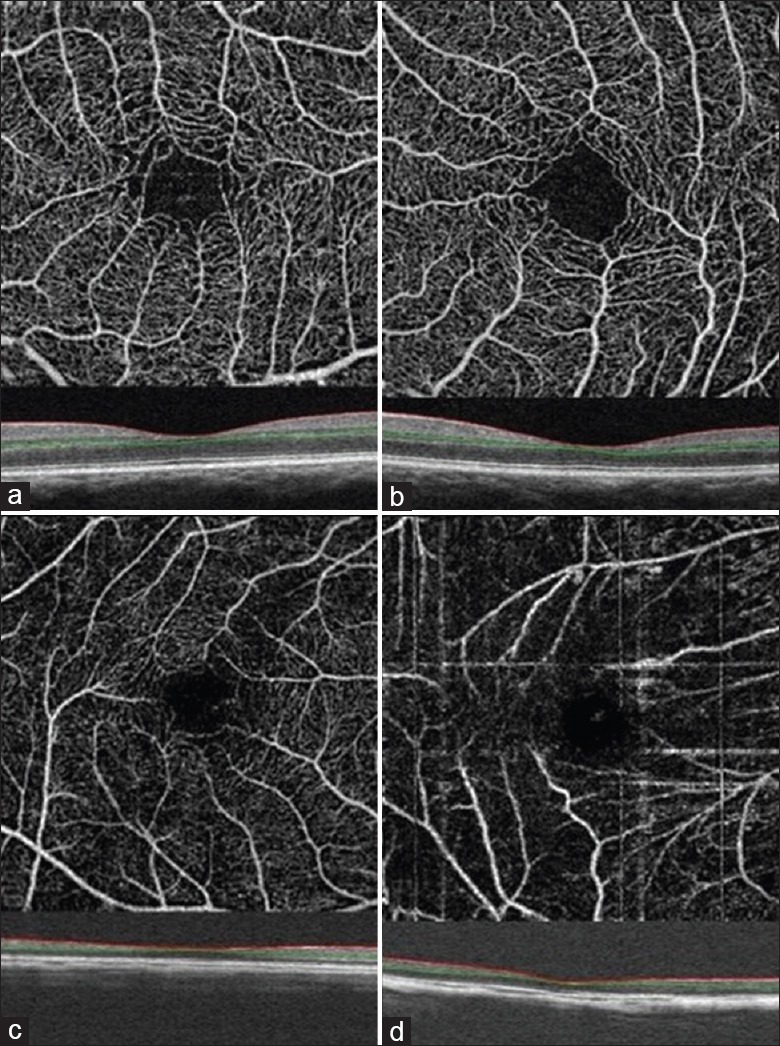
Morphological changes of the vasculature system in patients with myopia have been observed by Doppler ultrasound and fundus fluorescein angiography (FFA); however, these studies have limitations. Doppler ultrasound provides low-resolution images which are mainly obtained from visualized large vessels, and FFA is an invasive examination. Optic coherence tomography (OCT) angiography is a noninvasive, high-resolution measurement for vascular density. The purpose of this study was to investigate the change of vascular density in myopic eyes using OCT angiography.
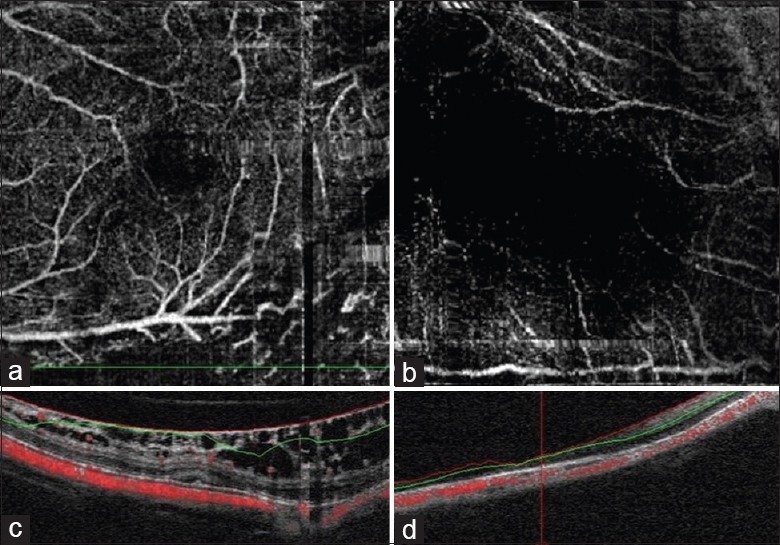
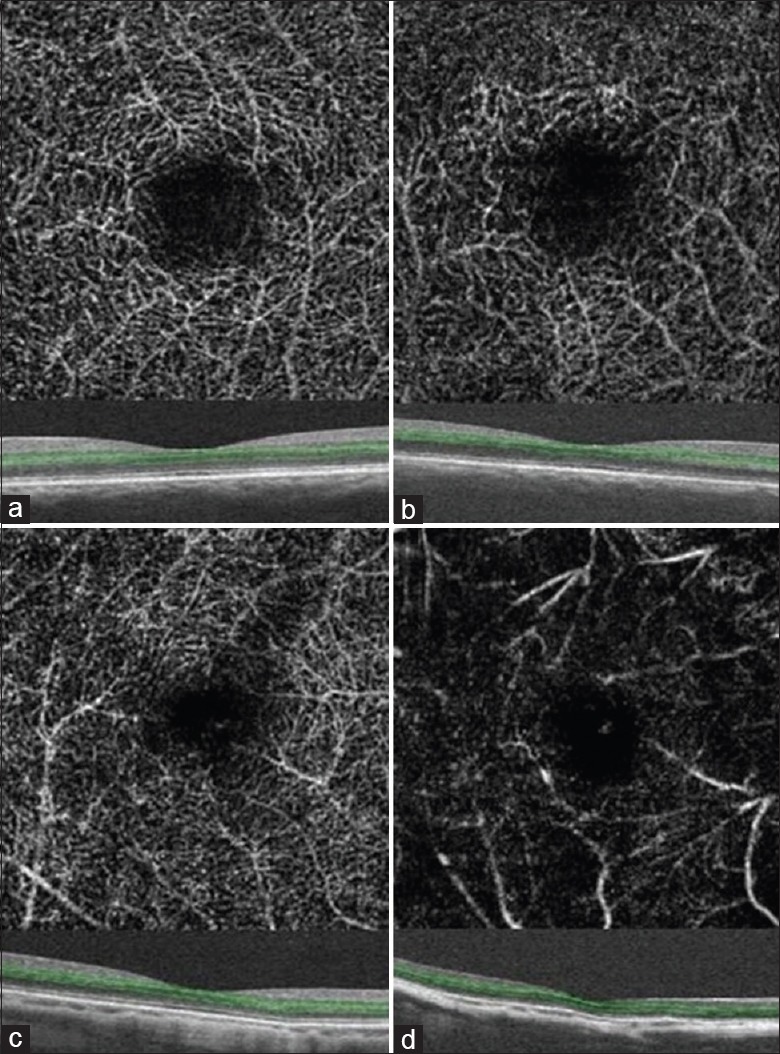
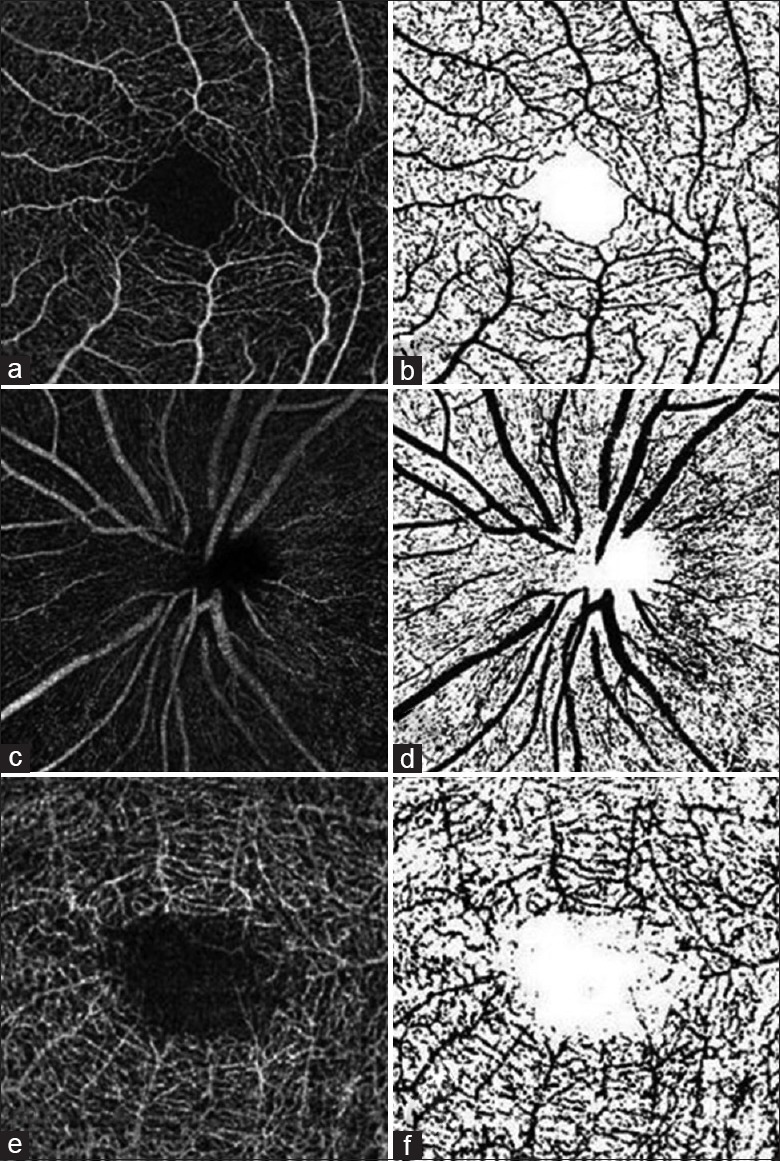
This cross-sectional study includes a total of 91 eyes from 47 participants including control, moderate, and high myopia that were evaluated by OCT angiography. Patients with myopia were recruited from the Refractive Department, Shenzhen Aier Eye Hospital, from August 5, 2015 to April 1, 2016. Emmetropic eyes were from healthy volunteers. The vascular density at macula and optic disc regions, ganglion cell complex (GCC) thickness, and retinal nerve fiber layer (RNFL) thickness were measured. Their relationships with axial length (AL) and refractive error were analyzed. One-way analysis of variance (ANOVA), Pearson's correlation, and generalized estimating equation were used for statistical analysis.
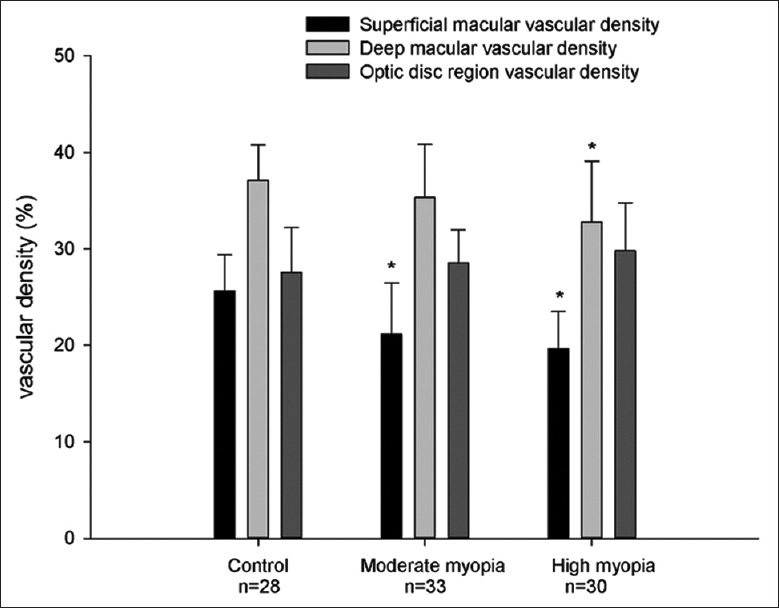
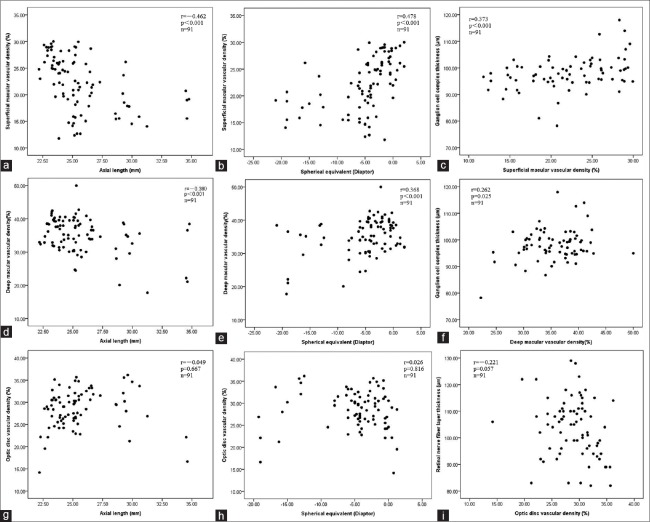
Both superficial and deep macular vascular density were highest in control (25.64% ± 3.76% and 37.12% ± 3.66%, respectively), then in moderate myopia (21.15% ± 5.33% and 35.35% ± 5.50%, respectively), and lowest in high myopia group (19.64% ± 3.87% and 32.81% ± 6.29%, respectively) (F = 13.74 and 4.57, respectively; both P < 0.001). Both superficial (β = -0.850 and 0.460, respectively) and deep (β = -0.766 and 0.396, respectively) macular vascular density were associated with AL and spherical equivalent (all P < 0.001). Superficial macular vascular density was associated with GCC thickness (β = 0.244, P = 0.040), independent of spherical equivalent. The vascular density in optic disc region had no difference among the three groups, and it was not associated with AL, spherical equivalent, or RNFL thickness.
Our results suggested that with the increase of myopia, the vascular density decreased in macular region, but not in optic disc region.
通过多普勒超声和眼底荧光血管造影(FFA)已观察到近视患者血管系统的形态学变化;然而,这些研究存在局限性。多普勒超声提供的是低分辨率图像,主要从可视化的大血管获取,而FFA是一种侵入性检查。光学相干断层扫描(OCT)血管造影是一种用于血管密度的非侵入性、高分辨率测量方法。本研究的目的是使用OCT血管造影研究近视眼血管密度的变化。
这项横断面研究共纳入了47名参与者的91只眼睛,包括对照组、中度近视组和高度近视组,均通过OCT血管造影进行评估。2015年8月5日至2016年4月1日期间,从深圳爱尔眼科医院屈光科招募近视患者。正视眼来自健康志愿者。测量黄斑和视盘区域的血管密度、神经节细胞复合体(GCC)厚度以及视网膜神经纤维层(RNFL)厚度。分析它们与眼轴长度(AL)和屈光不正的关系。采用单因素方差分析(ANOVA)、Pearson相关性分析和广义估计方程进行统计分析。
对照组黄斑浅层和深层血管密度最高(分别为25.64%±3.76%和37.12%±3.66%),其次是中度近视组(分别为21.15%±5.33%和35.35%±5.50%),高度近视组最低(分别为19.64%±3.87%和32.81%±6.29%)(F分别为13.74和4.57;P均<0.001)。黄斑浅层(β分别为-0.850和0.460)和深层(β分别为-0.766和0.396)血管密度均与眼轴长度和等效球镜相关(P均<0.001)。黄斑浅层血管密度与GCC厚度相关(β = 0.244;P = 0.040),独立于等效球镜。视盘区域血管密度在三组之间无差异,且与眼轴长度、等效球镜或RNFL厚度均无关。
我们的结果表明,随着近视程度增加,黄斑区域血管密度降低,但视盘区域未降低。