Kato Yoshitake, Nakakura Shunsuke, Asaoka Ryo, Matsuya Kanae, Fujio Yuki, Kiuchi Yoshiaki
Department of Ophthalmology, Saneikai Tsukazaki Hospital, Himeji, Japan.
Department of Ophthalmology, The University of Tokyo, Tokyo, Japan.
PLoS One. 2017 Feb 21;12(2):e0171941. doi: 10.1371/journal.pone.0171941. eCollection 2017.
Modern cataract surgery is generally considered to bring about modest and sustained intraocular pressure (IOP) reduction. However, the pathophysiological mechanism for this remains unclear. Moreover, a change in ocular biomechanical properties after surgery can affect the measurement of IOP. The aim of the study is to investigate ocular biomechanics, before and following cataract surgery, using Corvis ST tonometry (CST).
Fifty-nine eyes of 59 patients with cataract were analyzed. IOP with Goldmann applanation tonometry (IOP-G), axial length, corneal curvature and CST parameters were measured before cataract surgery and, up to 3 months, following surgery. Since CST parameters are closely related to IOP-G, linear modeling was carried out to investigate whether there was a change in CST measurements following cataract surgery, adjusted for a change in IOP-G.
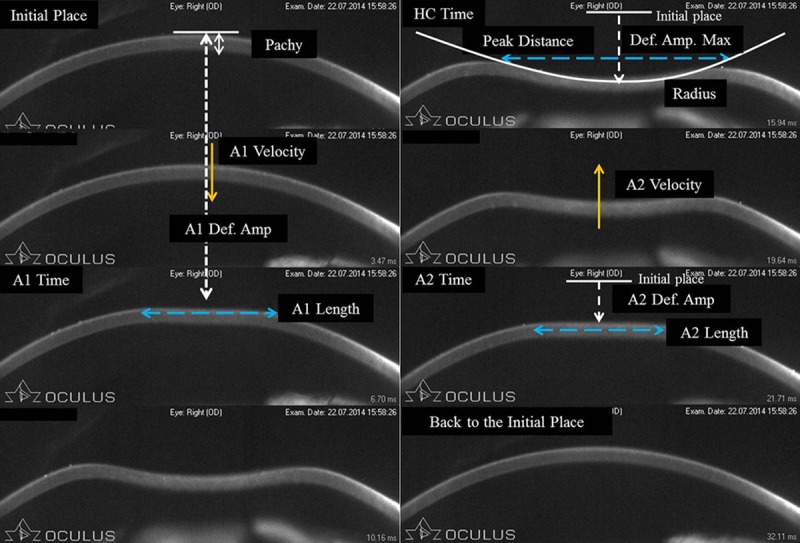
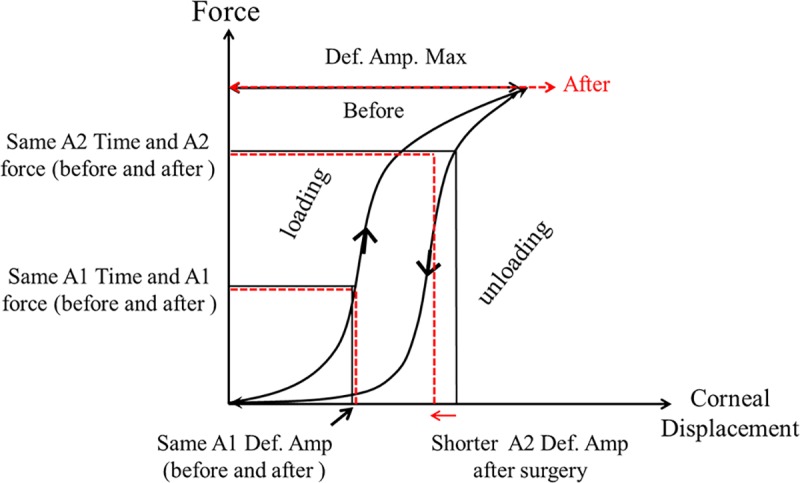
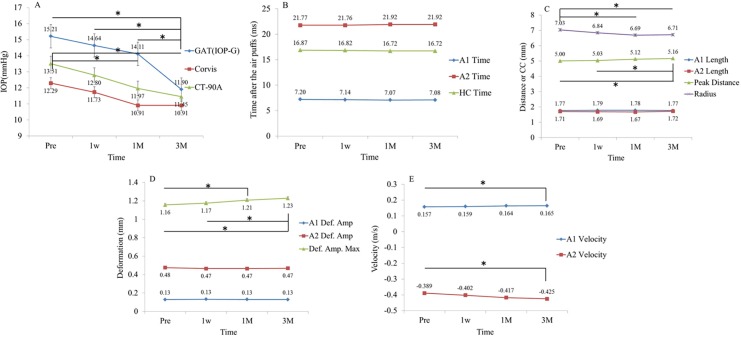
IOP-G significantly decreased after surgery (mean±standard deviation: 11.8±3.1 mmHg) compared to pre-surgery (15.2±4.3 mmHg, P<0.001). Peak distance (the distance between the two surrounding peaks of the cornea at the highest concavity), maximum deformation amplitude (the movement of the corneal apex from the start of deformation to the highest concavity) and A1/A2 velocity (the corneal velocity during inward or outward movement) significantly increased after cataract surgery (P<0.05) while radius (the central curvature radius at the highest concavity) was significantly smaller following cataract surgery (P<0.05). Linear modeling supported many of these findings, suggesting that peak distance, maximum deformation amplitude and A2 velocity were increased, whereas A2 deformation amplitude and highest concavity time were decreased (after adjustment for IOP change), following cataract surgery.
Corneal biomechanical properties, as measured with CST, were observed to change significantly following cataract surgery.
Japan Clinical Trials Registry UMIN000014370.
现代白内障手术通常被认为能使眼压(IOP)适度且持续降低。然而,其病理生理机制仍不清楚。此外,手术后眼部生物力学特性的改变会影响眼压测量。本研究的目的是使用Corvis ST眼压计(CST)研究白内障手术前后的眼部生物力学。
分析了59例白内障患者的59只眼。在白内障手术前以及术后长达3个月测量了Goldmann压平眼压计测量的眼压(IOP-G)、眼轴长度、角膜曲率和CST参数。由于CST参数与IOP-G密切相关,因此进行了线性建模,以研究在调整IOP-G变化后白内障手术后CST测量值是否有变化。
与手术前(15.2±4.3 mmHg)相比,手术后IOP-G显著降低(平均值±标准差:11.8±3.1 mmHg,P<0.001)。白内障手术后,峰值距离(角膜最高凹陷处两个周边峰值之间的距离)、最大变形幅度(角膜顶点从变形开始到最高凹陷处的移动)和A1/A2速度(向内或向外移动期间的角膜速度)显著增加(P<0.05),而半径(最高凹陷处的中央曲率半径)在白内障手术后显著变小(P<0.05)。线性建模支持了许多这些发现,表明白内障手术后,峰值距离、最大变形幅度和A2速度增加,而A2变形幅度和最高凹陷时间减少(在调整眼压变化后)。
观察到用CST测量的角膜生物力学特性在白内障手术后发生了显著变化。
日本临床试验注册中心UMIN000014370。