Tanaka Ryosuke, Yotsumoto Yuko
Department of Life Sciences, The University of Tokyo Tokyo, Japan.
Front Psychol. 2017 Feb 14;8:187. doi: 10.3389/fpsyg.2017.00187. eCollection 2017.
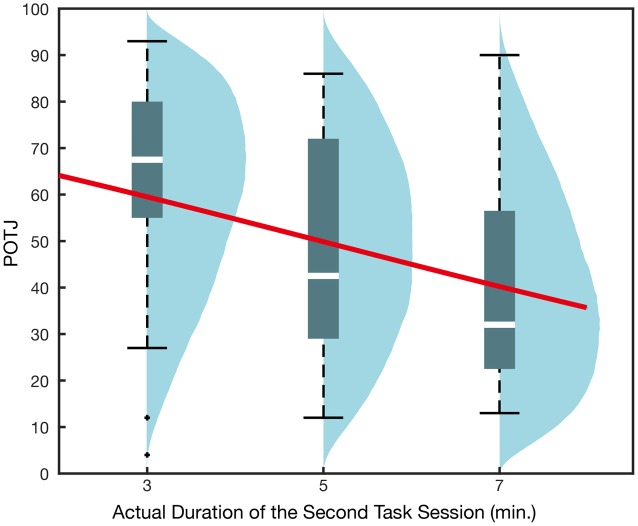
Time seems to pass quickly sometimes or slowly at other times. While this belief is prevalent, the psychological bases of such judgments on speed of time have remained unclear. In this study, we tested following two hypotheses: (1) the passage of time judgment (POTJ) is a function of the discrepancy between felt duration and temporal expectation of events and (2) POTJ is based on two distinct components: comparison of expected and felt durations and online anticipation of the end of an event. In four experiments, participants engaged in N-back tasks for several minutes and rated their POTJ during the tasks. Their temporal expectations were manipulated by providing them with false instructions on task durations. The results consistently supported the hypotheses and confirmed the idea that temporal expectation plays an important role in POTJ. In addition, the current findings might explain our daily temporal experiences such as "time flies when you are having fun."
时间有时似乎过得很快,有时又过得很慢。尽管这种观念很普遍,但对于时间流逝速度的此类判断的心理基础仍不明确。在本研究中,我们检验了以下两个假设:(1)时间流逝判断(POTJ)是事件的感知时长与时间预期之间差异的函数;(2)POTJ基于两个不同的成分:预期时长与感知时长的比较以及对事件结束的即时预期。在四项实验中,参与者进行了几分钟的n-back任务,并在任务过程中对他们的POTJ进行评分。通过向他们提供关于任务时长的错误指示来操纵他们的时间预期。结果一致支持了这些假设,并证实了时间预期在POTJ中起重要作用这一观点。此外,当前的研究结果可能解释了我们日常的时间体验,比如“当你玩得开心时,时间飞逝”。