Goetz Michal, Schwabova Jaroslava Paulasova, Hlavka Zdenek, Ptacek Radek, Surman Craig Bh
Department of Child Psychiatry, Second Faculty of Medicine, Motol University Hospital.
Department of Neurology.
Neuropsychiatr Dis Treat. 2017 Mar 21;13:873-880. doi: 10.2147/NDT.S125169. eCollection 2017.
Attention-deficit hyperactivity disorder (ADHD) is linked to the presence of motor deficiencies, including balance deficits. The cerebellum serves as an integrative structure for balance control and is also involved in cognition, including timing and anticipatory regulation. Cerebellar development may be delayed in children and adolescents with ADHD, and inconsistent reaction time is commonly seen in ADHD. We hypothesized that dynamic balance deficits would be present in children with ADHD and they would correlate with attention and cerebellar functions.
Sixty-two children with ADHD and no other neurological conditions and 62 typically developing (TD) children were examined with five trials of the Phyaction Balance Board, an electronic balancing platform. Cerebellar clinical symptoms were evaluated using an international ataxia rating scale. Conners' Continuous Performance Test was used to evaluate patterns of reaction.
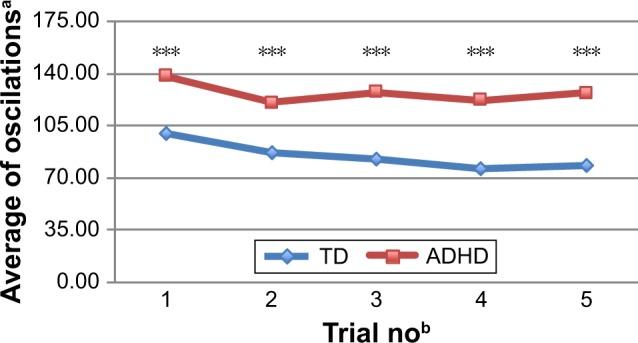
Children with ADHD had poorer performance on balancing tasks, compared to TD children (<0.001). They exhibited significantly greater sway amplitudes than TD children (<0.001) in all of the five balancing trials. The effect size of the difference between the groups increased continuously from the first to the last trial. Balance score in both groups was related to the variation in the reaction time, including reaction time standard error ( =0.25; =0.0409, respectively, =0.31; =0.0131) and Variability of Standard Error ( =0.28; =0.0252, respectively, =0.41; <0.001). The burden of cerebellar symptoms was strongly related to balance performance in both groups ( =0.50, <0.001; =0.49, =0.001).
This study showed that ADHD may be associated with poor dynamic balance control. Furthermore, we showed that maintaining balance correlates with neuropsychological measures of consistency of reaction time. Balance deficits and impaired cognitive functioning could reflect a common cerebellar dysfunction in ADHD children.
注意力缺陷多动障碍(ADHD)与运动缺陷有关,包括平衡缺陷。小脑是平衡控制的整合结构,也参与认知,包括时间和预期调节。ADHD儿童和青少年的小脑发育可能延迟,ADHD患者中反应时间不一致很常见。我们假设ADHD儿童存在动态平衡缺陷,且这些缺陷与注意力和小脑功能相关。
对62名无其他神经疾病的ADHD儿童和62名发育正常(TD)的儿童使用电子平衡平台Phyaction平衡板进行了五次测试。使用国际共济失调评定量表评估小脑临床症状。使用康纳斯连续操作测试评估反应模式。
与TD儿童相比,ADHD儿童在平衡任务上表现更差(<0.001)。在所有五次平衡测试中,他们的摇摆幅度均显著大于TD儿童(<0.001)。两组之间差异的效应大小从第一次测试到最后一次测试持续增加。两组的平衡分数均与反应时间的变化有关,包括反应时间标准误差(分别为=0.25;=0.0409,=0.31;=0.0131)和标准误差变异性(分别为=0.28;=0.0252,=0.41;<0.001)。两组中小脑症状的负担均与平衡表现密切相关(=0.50,<0.001;=0.49,=0.001)。
本研究表明ADHD可能与动态平衡控制不佳有关。此外,我们表明保持平衡与反应时间一致性的神经心理学测量相关。平衡缺陷和认知功能受损可能反映了ADHD儿童常见的小脑功能障碍。