Genuis Shelagh K, Birkholz Detlef, Genuis Stephen J
Department of Emergency Medicine, Faculty of Medicine, University of Alberta, Edmonton, AB, Canada.
University of Alberta, Edmonton, AB, Canada.
Biomed Res Int. 2017;2017:3676089. doi: 10.1155/2017/3676089. Epub 2017 Mar 8.
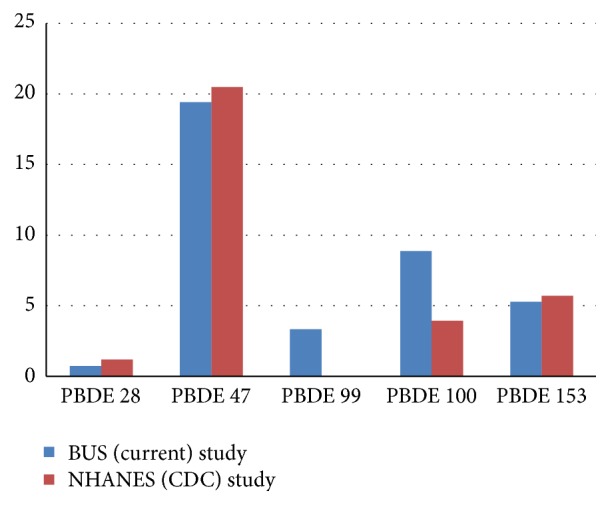
Commonly used as flame retardants, polybrominated diphenyl ethers (PBDEs) are routinely detected in the environment, animals, and humans. Although these persistent organic pollutants are increasingly recognized as having serious health implications, particularly for children, this is the first study, to our knowledge, to investigate an intervention for human elimination of bioaccumulated PBDEs. To determine the efficacy of blood, urine, and perspiration as PBDE biomonitoring mediums; assess excretion of five common PBDE congeners (28, 47, 99, 100, and 153) in urine and perspiration; and explore the potential of induced sweating for decreasing bioaccumulated PBDEs. PBDE congeners were not found in urine samples; findings focus on blood and perspiration. 80% of participants tested positive in one or more body fluids for PBDE 28, 100% for PBDE 47, 95% for PBDE 99, and 90% for PBDE 100 and PBDE 153. Induced perspiration facilitated excretion of the five congeners, with different rates of excretion for different congeners. Blood testing provides only a partial understanding of human PBDE bioaccumulation; testing of both blood and perspiration provides a better understanding. This study provides important baseline evidence for regular induced perspiration as a potential means for therapeutic PBDE elimination. Fetotoxic and reproductive effects of PBDE exposure highlight the importance of further detoxification research.
多溴二苯醚(PBDEs)通常用作阻燃剂,在环境、动物和人类中经常被检测到。尽管这些持久性有机污染物越来越被认为对健康有严重影响,尤其是对儿童,但据我们所知,这是第一项研究人类消除生物累积的多溴二苯醚的干预措施的研究。目的是确定血液、尿液和汗液作为多溴二苯醚生物监测介质的有效性;评估尿液和汗液中五种常见多溴二苯醚同系物(28、47、99、100和153)的排泄情况;并探索诱导出汗减少生物累积的多溴二苯醚的潜力。尿液样本中未发现多溴二苯醚同系物;研究重点是血液和汗液。80%的参与者一种或多种体液中多溴二苯醚28检测呈阳性,多溴二苯醚47为100%,多溴二苯醚99为95%,多溴二苯醚100和多溴二苯醚153为90%。诱导出汗促进了这五种同系物的排泄,不同同系物的排泄速率不同。血液检测只能部分了解人体多溴二苯醚的生物累积情况;血液和汗液检测能提供更好的了解。这项研究为定期诱导出汗作为治疗性消除多溴二苯醚的潜在手段提供了重要的基线证据。多溴二苯醚暴露对胎儿的毒性和生殖影响凸显了进一步进行解毒研究的重要性。