Zhang Lu, Xu Bin, Wu Tao, Yang Yanfang, Fan Lianxue, Wen Muxuan, Sui Jiaxin
College of Horticulture, Northeast Agricultural University, 59 Mucai street, 150030, Harbin, People's Republic of China.
College of Agro-grassland Science, Nanjing Agricultural University, 1 Weigang, 210095, Nanjing, People's Republic of China.
BMC Genomics. 2017 Apr 11;18(1):288. doi: 10.1186/s12864-017-3677-7.
The accumulation of anthocyanin in horticultural crops not only improves their stress tolerances but also their nutritional values. Many key regulatory and structural genes in anthocyanin biosynthesis have been identified in model plants, but limited information is available for non-model plant species featured with colored leaves. In this study, two Pak Choi varieties with green or purple leaves were selected to analyze the anthocyanin biosynthesis through RNA-Seq.
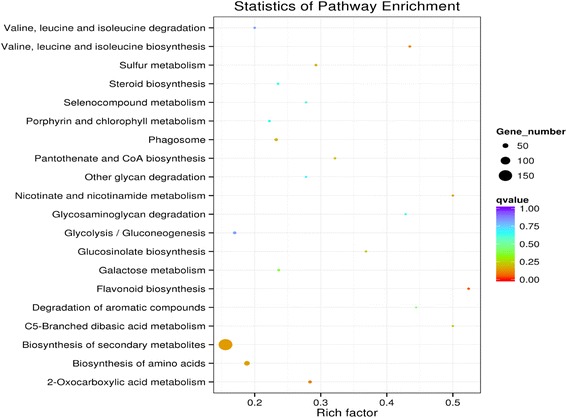
A total of 2475 unigenes were differentially expressed between these tested varieties, including 1303 down-regulated and 1172 up-regulated genes in the purple-leafed one. The reliability of the RNA-Seq was further confirmed by using real-time quantitative PCR. Kyoto Encyclopedia of Genes and Genomes enrichment analysis of the differentially expressed genes revealed 'flavonoid biosynthesis' was the only enriched pathway in the purple-leafed variety: In the pathway of phenylpropanoid metabolism, Bra017210, Bra039777, and Bra021637 were expressed at higher levels in the purple-leafed variety; among the early anthocyanin biosynthetic genes, Bra037747 transcripts were only detected in the purple-leafed variety but not in the green-leafed one; among the late anthocyanin biosynthetic genes, Bra027457, Bra013652, Bra019350, Bra003021, Bra035004, and Bra038445 were all up-regulated in purple-leafed variety; and genes encoding anthocyanin-related transcription factors, such as Bra016164, and genes encoding anthocyanin transportation, such as GST F12, were also identified as up-regulated ones in the purple-leafed variety.
The current result provided a valuable insight into the anthocyanin accumulation in the purple-leafed variety of Pak Choi and a bioinformatic resource for further functional identification of key allelic genes determining the difference of anthocyanin content between Pak Choi varieties.
园艺作物中花青素的积累不仅能提高其抗逆性,还能提升其营养价值。在模式植物中已鉴定出许多花青素生物合成的关键调控基因和结构基因,但关于具有彩色叶片的非模式植物物种的信息有限。在本研究中,选择了两个绿叶或紫叶的小白菜品种,通过RNA测序分析花青素的生物合成。
在这些测试品种之间总共2475个单基因差异表达,其中紫叶品种中有1303个基因下调,1172个基因上调。通过实时定量PCR进一步证实了RNA测序的可靠性。对差异表达基因的京都基因与基因组百科全书富集分析表明,“类黄酮生物合成”是紫叶品种中唯一富集的途径:在苯丙烷代谢途径中,Bra017210、Bra039777和Bra021637在紫叶品种中表达水平较高;在早期花青素生物合成基因中,仅在紫叶品种中检测到Bra037747转录本,而在绿叶品种中未检测到;在晚期花青素生物合成基因中,Bra027457、Bra013652、Bra019350、Bra003021、Bra035004和Bra038445在紫叶品种中均上调;并且编码花青素相关转录因子的基因,如Bra016164,以及编码花青素转运的基因,如GST F12,也被鉴定为紫叶品种中的上调基因。
目前的结果为紫叶小白菜品种中花青素的积累提供了有价值的见解,并为进一步功能鉴定决定小白菜品种间花青素含量差异的关键等位基因提供了生物信息资源。