Ahmad Rizwan, Ahmad Niyaz, Naqvi Atta Abbas, Shehzad Adeeb, Al-Ghamdi Mastour Safer
Natural Products and Alternative Medicines, College of Clinical Pharmacy, University of Dammam, Dammam, Saudi Arabia.
Department of Pharmaceutics, College of Clinical Pharmacy, University of Dammam, Dammam, Saudi Arabia.
J Tradit Complement Med. 2016 May 21;7(2):195-204. doi: 10.1016/j.jtcme.2016.05.002. eCollection 2017 Apr.
This review article underlines individual Traditional Islamic and Arabic plant (TAI) and their role in treating cancer. The aim of the study is to specifically evaluate the progress of herbs, Arabic and Islamic traditional herbs in particular, applied in cancer treatment, so far.
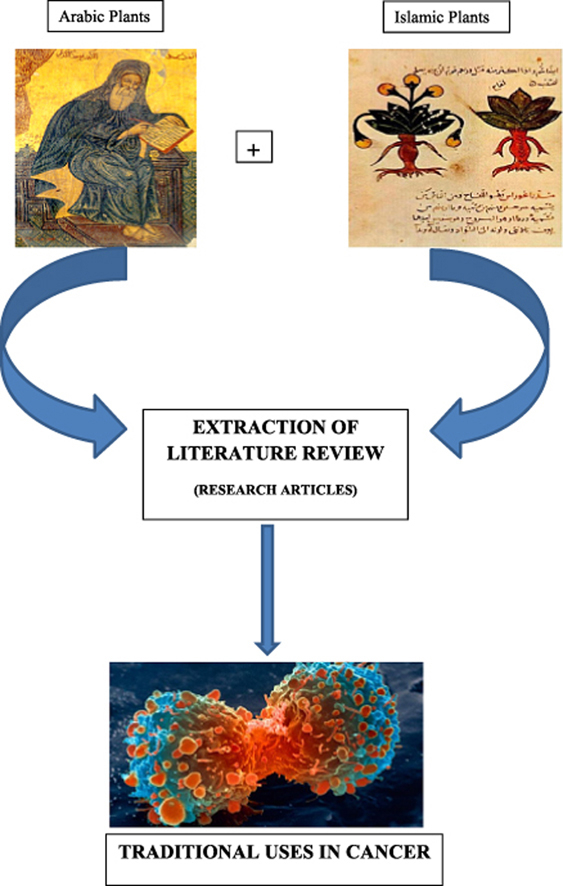
Islamic and Arabic plants were selected and identified through different literature survey using "Google scholar", "Web of science", "Scopus" and "PubMed". Each plant, from identified Arabic and Islamic plants list, was search individually for the most cited articles in the aforementioned databases using the keywords, "Anticancer", "Uses in cancer treatment", "Ethno pharmacological importance in cancer" etc.
The current review about Islamic and Arabic plants illuminates the importance of Islamic and Arabic plants and their impact in treating cancer. There is a long list of Islamic and Arabic plants used in cancer as mentioned in review with enormous amount of literature. Each plant has been investigated for its anticancer potential. The literature survey as mentioned in table shows; these plants are widely utilized in cancer as a whole, a part thereof or in the form of isolated chemical constituent.
This review strongly supports the fact; Arabic and Islamic traditional plants have emerged as a good source of complementary and alternative medicine in treating cancer. Traditional Arab-Islamic herbal-based medicines might be promising for new cancer therapeutics with low toxicity and minimal side effects. The plants used are mostly in crude form and still needs advance research for the isolation of phytochemicals and establishing its cellular and molecular role in treating cancer.
这篇综述文章强调了个别传统伊斯兰和阿拉伯植物(TAI)及其在癌症治疗中的作用。该研究的目的是具体评估迄今为止应用于癌症治疗的草药,特别是阿拉伯和伊斯兰传统草药的进展情况。
通过使用“谷歌学术”“科学网”“Scopus”和“PubMed”进行不同的文献调研,挑选并鉴定出伊斯兰和阿拉伯植物。从已鉴定的阿拉伯和伊斯兰植物列表中,使用关键词“抗癌”“癌症治疗中的用途”“癌症中的民族药理学重要性”等,在上述数据库中分别搜索每一种植物被引用最多的文章。
当前关于伊斯兰和阿拉伯植物的综述阐明了伊斯兰和阿拉伯植物的重要性及其在癌症治疗中的影响。综述中提到有一长串用于癌症治疗的伊斯兰和阿拉伯植物,并有大量相关文献。每种植物都已针对其抗癌潜力进行了研究。如表中所述的文献调研显示,这些植物作为一个整体、其一部分或以分离化学成分的形式广泛应用于癌症治疗。
本综述有力地支持了这一事实:阿拉伯和伊斯兰传统植物已成为治疗癌症的补充和替代医学的良好来源。基于阿拉伯 - 伊斯兰传统草药的药物可能有望成为低毒性、副作用最小的新型癌症治疗药物。所使用的植物大多为粗提物形式,仍需要进一步研究以分离植物化学物质,并确定其在癌症治疗中的细胞和分子作用。