Westerterp Klaas R
Department of Human Biology, Maastricht University Medical Centre, PO Box 616, 6200 MD, Maastricht, The Netherlands.
Eur J Appl Physiol. 2017 Jul;117(7):1277-1285. doi: 10.1007/s00421-017-3641-x. Epub 2017 May 15.
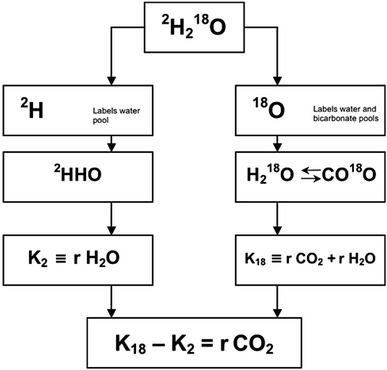
The doubly labelled water method for the assessment of energy expenditure was first published in 1955, application in humans started in 1982, and it has become the gold standard for human energy requirement under daily living conditions. The method involves enriching the body water of a subject with heavy hydrogen (H) and heavy oxygen (O), and then determining the difference in washout kinetics between both isotopes, being a function of carbon dioxide production. In practice, subjects get a measured amount of doubly labelled water (H O) to increase background enrichment of body water for O of 2000 ppm with at least 180 ppm and background enrichment of body water for H of 150 ppm with 120 ppm. Subsequently, the difference between the apparent turnover rates of the hydrogen and oxygen of body water is assessed from blood-, saliva-, or urine samples, collected at the start and end of the observation interval of 1-3 weeks. Samples are analyzed for O and H with isotope ratio mass spectrometry. The doubly labelled water method is the indicated method to measure energy expenditure in any environment, especially with regard to activity energy expenditure, without interference with the behavior of the subjects. Applications include the assessment of energy requirement from total energy expenditure, validation of dietary assessment methods and validation of physical activity assessment methods with doubly labelled water measured energy expenditure as reference, and studies on body mass regulation with energy expenditure as a determinant of energy balance.
用于评估能量消耗的双标记水法于1955年首次发表,1982年开始应用于人体,现已成为日常生活条件下人体能量需求的金标准。该方法包括用重氢(H)和重氧(O)富集受试者的身体水分,然后确定两种同位素之间洗脱动力学的差异,这是二氧化碳产生的函数。在实际操作中,受试者摄入一定量的双标记水(H₂¹⁸O),以使身体水分中¹⁸O的本底富集增加至2000 ppm,至少增加180 ppm,使身体水分中H的本底富集增加至150 ppm,增加120 ppm。随后,从在1至3周的观察期开始和结束时采集的血液、唾液或尿液样本中评估身体水分中氢和氧的表观周转率之间的差异。用同位素比率质谱法分析样本中的¹⁸O和H。双标记水法是测量任何环境下能量消耗的指定方法,特别是在活动能量消耗方面,且不会干扰受试者的行为。其应用包括根据总能量消耗评估能量需求、以双标记水测量的能量消耗为参考验证饮食评估方法和身体活动评估方法,以及以能量消耗作为能量平衡决定因素的体重调节研究。