Dunford E K, Popkin B M
Carolina Population Center, The University of North Carolina at Chapel Hill, Chapel Hill, USA.
Food Policy Division, The George Institute for Global Health, Sydney Medical School, University of Sydney, Sydney, Australia.
Pediatr Obes. 2018 Apr;13(4):247-255. doi: 10.1111/ijpo.12220. Epub 2017 May 15.
Previous studies have indicated that snacking is contributing to increased calorie intake of American children and that the energy density of snacks in US diets has increased in recent decades.
Examine short-term and long-term trends in the energy density and food sources of snacks for US children from 1977 to 2014, and examine whether trends differ between socio-demographic groups.
We used data collected from eight nationally representative surveys of food intake in 49,952 US children age 2-18 years, between 1977 and 2014. Overall patterns of snacking, trends in energy intake from snacking, trends in food and beverage sources and energy density of snacks across race-ethnic, age, gender, education and income groups were examined.
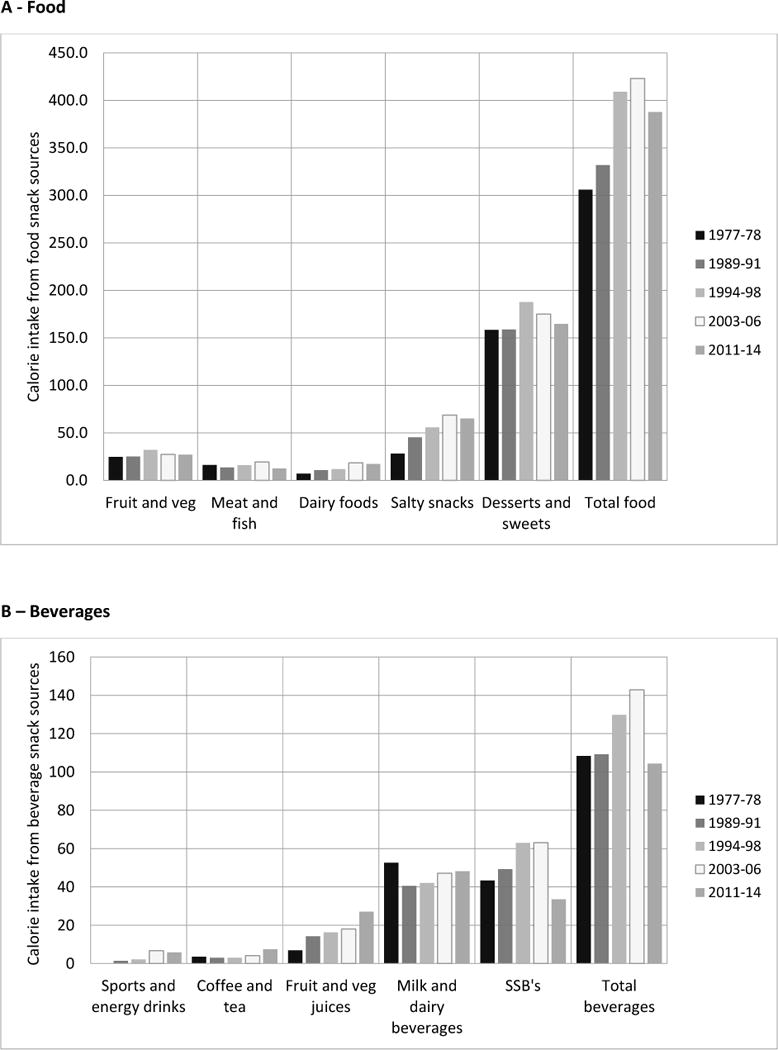
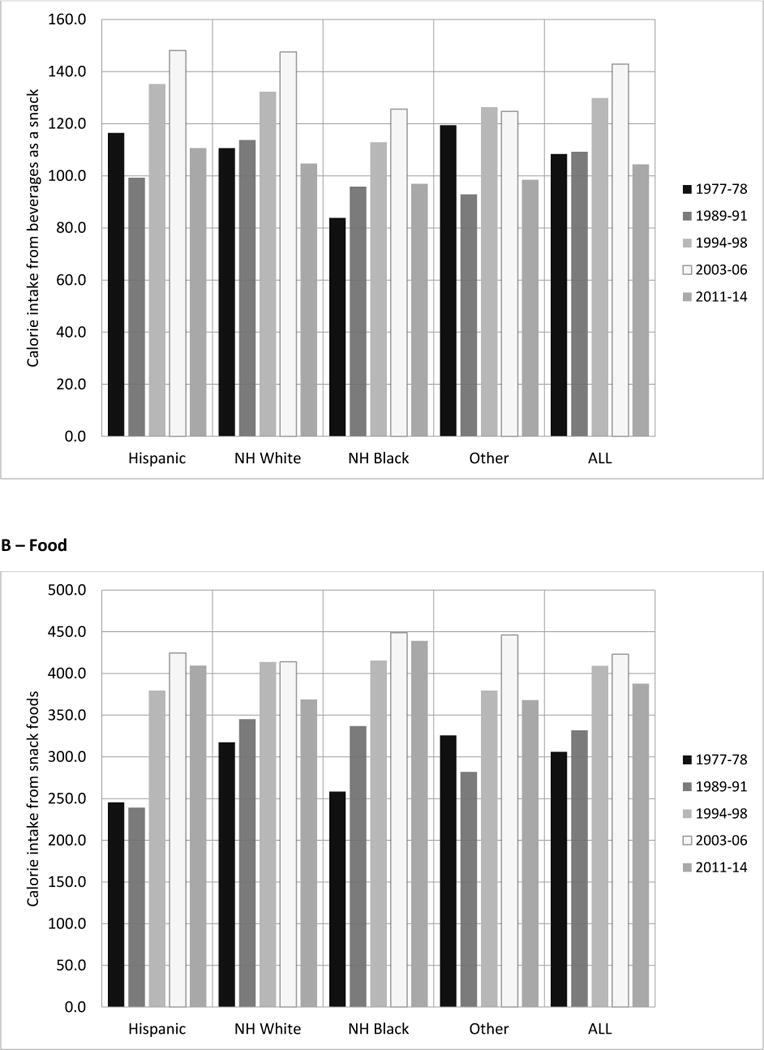
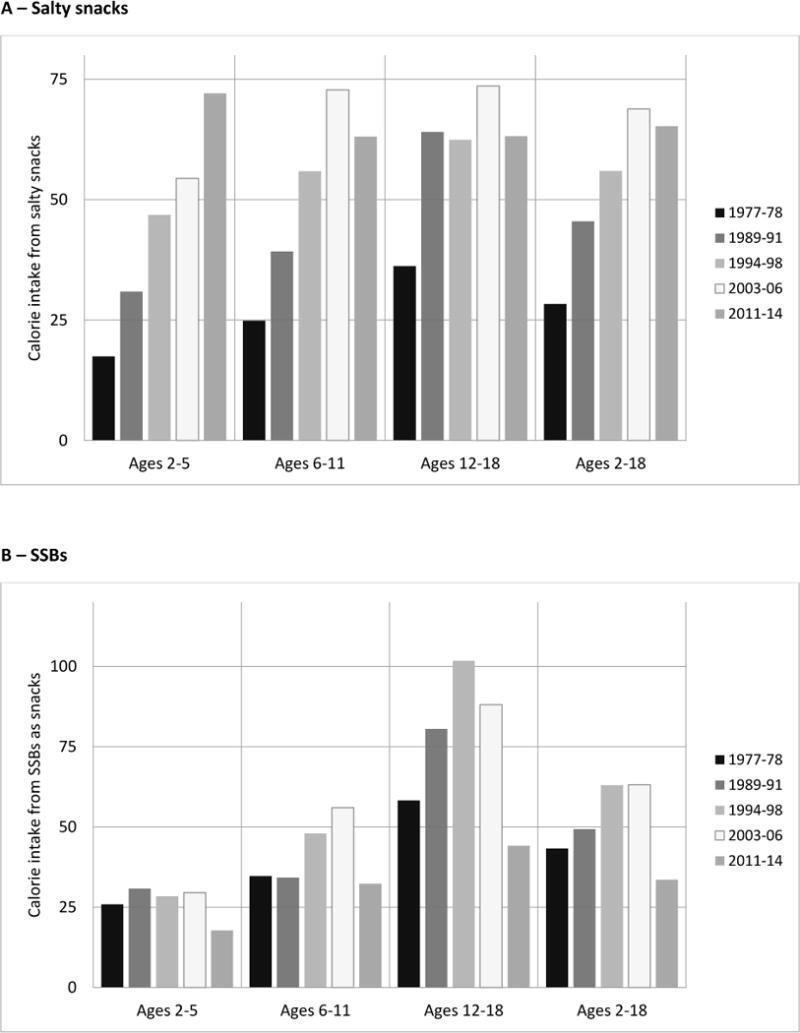
In all socio-demographic groups, there was a significant increase in per capita energy intake deriving from snacks from 1977 to 2014 (P < 0.01). Salty snack intake doubled over the study period, and sugar-sweetened beverage intake decreased overall from 1977 to 2014 but increased in Non-Hispanic Blacks. Non-Hispanic Blacks had the largest increase in per capita intake from foods as a snack from 1977 to 2014. Children in the lowest poverty level and household education groups had more than 100% increase in calorie intake from snacks from 1977 to 2014.
We found that snacking behaviour in the USA differs between race-ethnic, household education, gender and income groups, yet snacking remains a significant component of children's diets and the foods consumed at these snacks are not the types of foods recommended by the US dietary guidelines.
先前的研究表明,吃零食导致美国儿童卡路里摄入量增加,且近几十年来美国饮食中零食的能量密度有所上升。
研究1977年至2014年美国儿童零食的能量密度和食物来源的短期和长期趋势,并研究社会人口统计学群体之间的趋势是否存在差异。
我们使用了1977年至2014年间从八项具有全国代表性的美国2至18岁儿童食物摄入量调查中收集的数据。研究了零食的总体模式、零食能量摄入趋势、食物和饮料来源趋势以及不同种族、年龄、性别、教育程度和收入群体零食的能量密度。
在所有社会人口统计学群体中,1977年至2014年人均零食能量摄入量显著增加(P<0.01)。在研究期间,咸味零食摄入量翻倍,含糖饮料摄入量总体上从1977年至2014年有所下降,但在非西班牙裔黑人中有所增加。1977年至2014年,非西班牙裔黑人作为零食的食物人均摄入量增加最多。贫困水平和家庭教育程度最低的群体的儿童,1977年至2014年零食卡路里摄入量增加了100%以上。
我们发现,美国不同种族、家庭教育、性别和收入群体的零食行为存在差异,但零食仍然是儿童饮食的重要组成部分,这些零食所消费的食物并非美国饮食指南所推荐的类型。