• 文献检索
  • 文档翻译
  • 深度研究
  • 学术资讯
  • Suppr Zotero 插件Zotero 插件
  • 邀请有礼
  • 套餐&价格
  • 历史记录
应用&插件
Suppr Zotero 插件Zotero 插件浏览器插件Mac 客户端Windows 客户端微信小程序
定价
高级版会员购买积分包购买API积分包
服务
文献检索文档翻译深度研究API 文档MCP 服务
关于我们
关于 Suppr公司介绍联系我们用户协议隐私条款
关注我们

Suppr 超能文献

核心技术专利:CN118964589B侵权必究
粤ICP备2023148730 号-1Suppr @ 2026

文献检索

告别复杂PubMed语法,用中文像聊天一样搜索,搜遍4000万医学文献。AI智能推荐,让科研检索更轻松。

立即免费搜索

文件翻译

保留排版,准确专业,支持PDF/Word/PPT等文件格式,支持 12+语言互译。

免费翻译文档

深度研究

AI帮你快速写综述,25分钟生成高质量综述,智能提取关键信息,辅助科研写作。

立即免费体验

基于迭代学习框架的人体活动识别可穿戴传感器数据分类。

Wearable Sensor Data Classification for Human Activity Recognition Based on an Iterative Learning Framework.

机构信息

Department of Computer Science and Engineering, Université du Québec en Outaouais, Gatineau, QC J8Y 3G5, Canada.

出版信息

Sensors (Basel). 2017 Jun 7;17(6):1287. doi: 10.3390/s17061287.

DOI:10.3390/s17061287
PMID:28590422
原文链接:https://pmc.ncbi.nlm.nih.gov/articles/PMC5492798/
Abstract

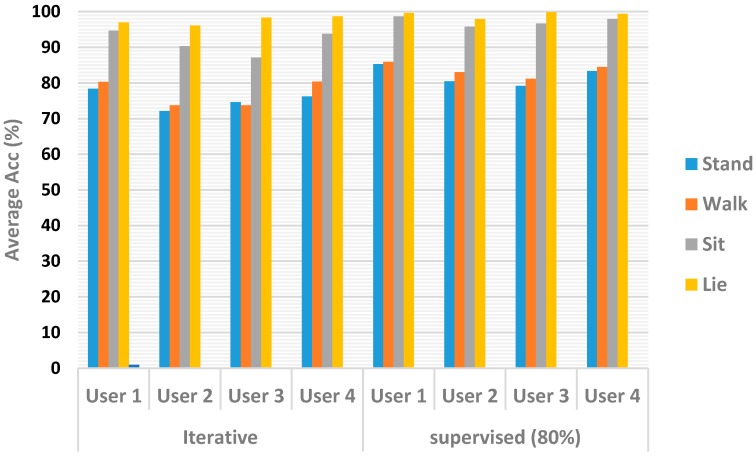
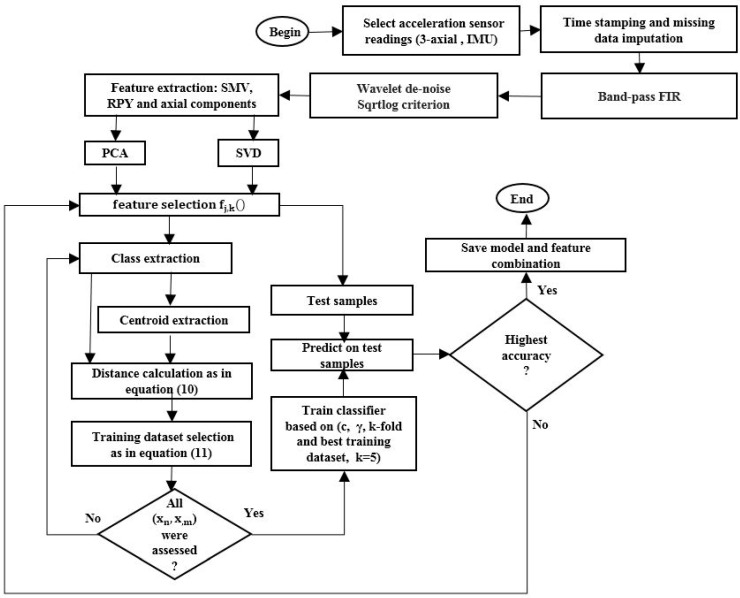
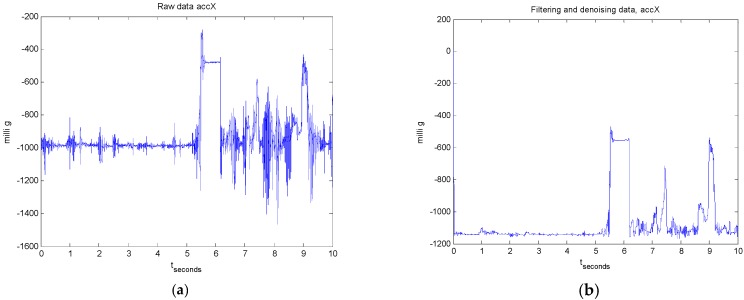
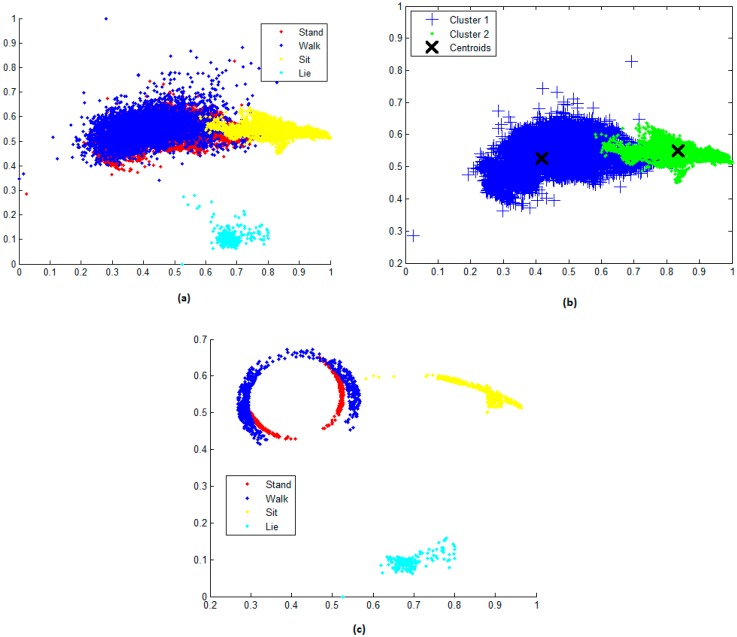
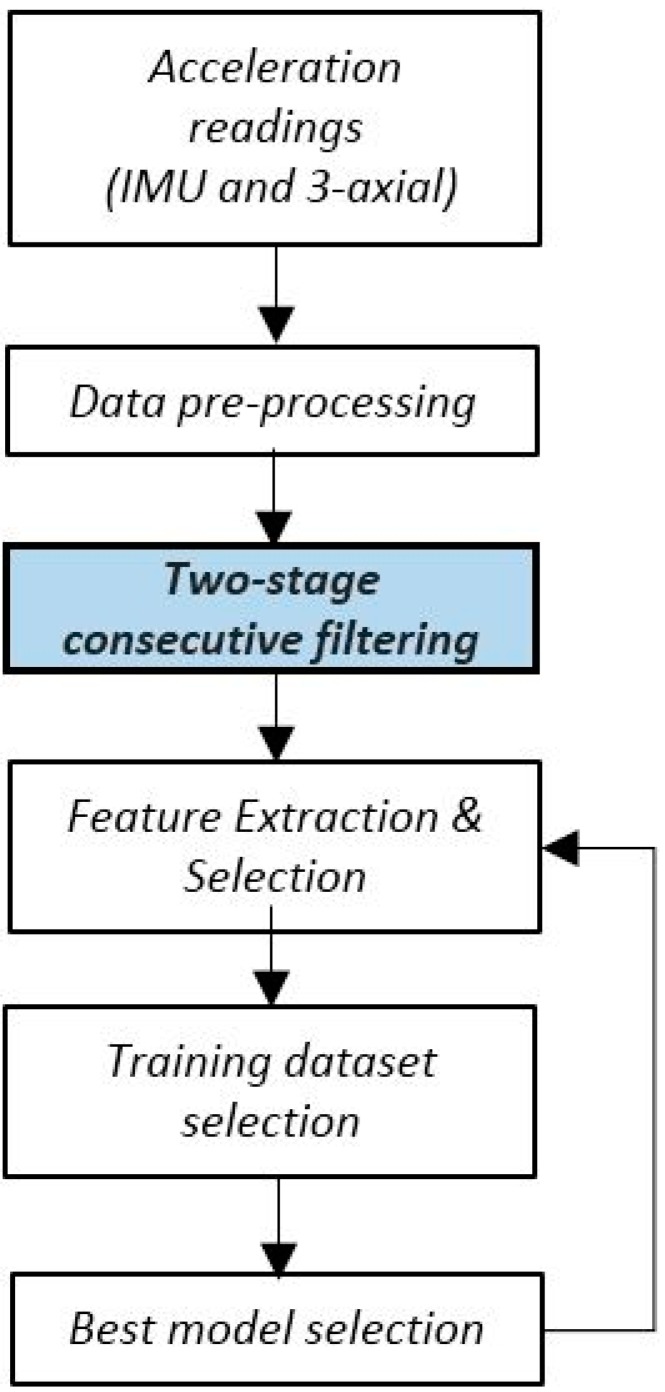
The design of multiple human activity recognition applications in areas such as healthcare, sports and safety relies on wearable sensor technologies. However, when making decisions based on the data acquired by such sensors in practical situations, several factors related to sensor data alignment, data losses, and noise, among other experimental constraints, deteriorate data quality and model accuracy. To tackle these issues, this paper presents a data-driven iterative learning framework to classify human locomotion activities such as walk, stand, lie, and sit, extracted from the Opportunity dataset. Data acquired by twelve 3-axial acceleration sensors and seven inertial measurement units are initially de-noised using a two-stage consecutive filtering approach combining a band-pass Finite Impulse Response (FIR) and a wavelet filter. A series of statistical parameters are extracted from the kinematical features, including the principal components and singular value decomposition of roll, pitch, yaw and the norm of the axial components. The novel interactive learning procedure is then applied in order to minimize the number of samples required to classify human locomotion activities. Only those samples that are most distant from the centroids of data clusters, according to a measure presented in the paper, are selected as candidates for the training dataset. The newly built dataset is then used to train an SVM multi-class classifier. The latter will produce the lowest prediction error. The proposed learning framework ensures a high level of robustness to variations in the quality of input data, while only using a much lower number of training samples and therefore a much shorter training time, which is an important consideration given the large size of the dataset.

摘要

多个人类活动识别应用程序的设计,如医疗保健、运动和安全等,都依赖于可穿戴传感器技术。然而,当基于这些传感器在实际情况下获取的数据做出决策时,与传感器数据对齐、数据丢失和噪声等实验限制相关的几个因素会降低数据质量和模型准确性。为了解决这些问题,本文提出了一种数据驱动的迭代学习框架,用于对从机会数据集提取的人类运动活动(如行走、站立、躺卧和坐下)进行分类。最初,使用结合了带通有限脉冲响应(FIR)滤波器和小波滤波器的两级连续滤波方法对来自 12 个三轴加速度传感器和 7 个惯性测量单元的数据进行去噪。从运动学特征中提取了一系列统计参数,包括滚动、俯仰、偏航的主成分和奇异值分解,以及轴向分量的范数。然后应用新的交互学习过程来最小化分类人类运动活动所需的样本数量。根据本文提出的度量标准,只有那些与数据簇质心最远的样本才被选为训练数据集的候选样本。然后使用新构建的数据集来训练 SVM 多类分类器。后者将产生最低的预测误差。所提出的学习框架确保了对输入数据质量变化的高度鲁棒性,同时只使用了更少数量的训练样本,因此训练时间更短,这在考虑到数据集的大型规模时非常重要。
https://cdn.ncbi.nlm.nih.gov/pmc/blobs/1600/5492798/a99d01331f0f/sensors-17-01287-g011.jpg
https://cdn.ncbi.nlm.nih.gov/pmc/blobs/1600/5492798/883e8daaeb36/sensors-17-01287-g001.jpg
https://cdn.ncbi.nlm.nih.gov/pmc/blobs/1600/5492798/ce4bf9458bf0/sensors-17-01287-g002.jpg
https://cdn.ncbi.nlm.nih.gov/pmc/blobs/1600/5492798/cdfeab986d75/sensors-17-01287-g003.jpg
https://cdn.ncbi.nlm.nih.gov/pmc/blobs/1600/5492798/6764b62d59f6/sensors-17-01287-g004.jpg
https://cdn.ncbi.nlm.nih.gov/pmc/blobs/1600/5492798/e2e54e403918/sensors-17-01287-g005.jpg
https://cdn.ncbi.nlm.nih.gov/pmc/blobs/1600/5492798/866d2b36e8eb/sensors-17-01287-g006.jpg
https://cdn.ncbi.nlm.nih.gov/pmc/blobs/1600/5492798/93fbfda518c8/sensors-17-01287-g007.jpg
https://cdn.ncbi.nlm.nih.gov/pmc/blobs/1600/5492798/43a22487e31d/sensors-17-01287-g008.jpg
https://cdn.ncbi.nlm.nih.gov/pmc/blobs/1600/5492798/b1805bc1b1e4/sensors-17-01287-g009.jpg
https://cdn.ncbi.nlm.nih.gov/pmc/blobs/1600/5492798/b029e75bf98b/sensors-17-01287-g010.jpg
https://cdn.ncbi.nlm.nih.gov/pmc/blobs/1600/5492798/a99d01331f0f/sensors-17-01287-g011.jpg
https://cdn.ncbi.nlm.nih.gov/pmc/blobs/1600/5492798/883e8daaeb36/sensors-17-01287-g001.jpg
https://cdn.ncbi.nlm.nih.gov/pmc/blobs/1600/5492798/ce4bf9458bf0/sensors-17-01287-g002.jpg
https://cdn.ncbi.nlm.nih.gov/pmc/blobs/1600/5492798/cdfeab986d75/sensors-17-01287-g003.jpg
https://cdn.ncbi.nlm.nih.gov/pmc/blobs/1600/5492798/6764b62d59f6/sensors-17-01287-g004.jpg
https://cdn.ncbi.nlm.nih.gov/pmc/blobs/1600/5492798/e2e54e403918/sensors-17-01287-g005.jpg
https://cdn.ncbi.nlm.nih.gov/pmc/blobs/1600/5492798/866d2b36e8eb/sensors-17-01287-g006.jpg
https://cdn.ncbi.nlm.nih.gov/pmc/blobs/1600/5492798/93fbfda518c8/sensors-17-01287-g007.jpg
https://cdn.ncbi.nlm.nih.gov/pmc/blobs/1600/5492798/43a22487e31d/sensors-17-01287-g008.jpg
https://cdn.ncbi.nlm.nih.gov/pmc/blobs/1600/5492798/b1805bc1b1e4/sensors-17-01287-g009.jpg
https://cdn.ncbi.nlm.nih.gov/pmc/blobs/1600/5492798/b029e75bf98b/sensors-17-01287-g010.jpg
https://cdn.ncbi.nlm.nih.gov/pmc/blobs/1600/5492798/a99d01331f0f/sensors-17-01287-g011.jpg

相似文献

1
Wearable Sensor Data Classification for Human Activity Recognition Based on an Iterative Learning Framework.基于迭代学习框架的人体活动识别可穿戴传感器数据分类。
Sensors (Basel). 2017 Jun 7;17(6):1287. doi: 10.3390/s17061287.
2
Ablation Analysis to Select Wearable Sensors for Classifying Standing, Walking, and Running.用于分类站立、行走和跑步的可穿戴传感器的消融分析。
Sensors (Basel). 2020 Dec 30;21(1):194. doi: 10.3390/s21010194.
3
w-HAR: An Activity Recognition Dataset and Framework Using Low-Power Wearable Devices.w-HAR:一个使用低功耗可穿戴设备的活动识别数据集和框架。
Sensors (Basel). 2020 Sep 18;20(18):5356. doi: 10.3390/s20185356.
4
A Comprehensive Analysis on Wearable Acceleration Sensors in Human Activity Recognition.可穿戴加速度传感器在人体活动识别中的综合分析
Sensors (Basel). 2017 Mar 7;17(3):529. doi: 10.3390/s17030529.
5
Activity Recognition Invariant to Sensor Orientation with Wearable Motion Sensors.使用可穿戴运动传感器实现对传感器方向不变的活动识别。
Sensors (Basel). 2017 Aug 9;17(8):1838. doi: 10.3390/s17081838.
6
A Wearable Inertial Sensor Approach for Locomotion and Localization Recognition on Physical Activity.基于可穿戴惯性传感器的身体活动中运动和定位识别方法。
Sensors (Basel). 2024 Jan 23;24(3):735. doi: 10.3390/s24030735.
7
Wearable Sensor-Based Human Activity Recognition Method with Multi-Features Extracted from Hilbert-Huang Transform.基于可穿戴传感器的人体活动识别方法,该方法从希尔伯特-黄变换中提取多特征。
Sensors (Basel). 2016 Dec 2;16(12):2048. doi: 10.3390/s16122048.
8
Improving activity recognition using a wearable barometric pressure sensor in mobility-impaired stroke patients.使用可穿戴气压传感器改善行动不便的中风患者的活动识别。
J Neuroeng Rehabil. 2015 Aug 25;12:72. doi: 10.1186/s12984-015-0060-2.
9
Sensor Data Acquisition and Multimodal Sensor Fusion for Human Activity Recognition Using Deep Learning.使用深度学习进行人体活动识别的传感器数据采集和多模态传感器融合。
Sensors (Basel). 2019 Apr 10;19(7):1716. doi: 10.3390/s19071716.
10
Feature Representation and Data Augmentation for Human Activity Classification Based on Wearable IMU Sensor Data Using a Deep LSTM Neural Network.基于穿戴式 IMU 传感器数据的深度学习 LSTM 神经网络的人体活动分类的特征表示和数据增强。
Sensors (Basel). 2018 Aug 31;18(9):2892. doi: 10.3390/s18092892.

引用本文的文献

1
Generisch-Net: A Generic Deep Model for Analyzing Human Motion with Wearable Sensors in the Internet of Health Things.通用网络:一种用于在健康物联网中分析人类运动的通用深度模型。
Sensors (Basel). 2024 Sep 24;24(19):6167. doi: 10.3390/s24196167.
2
Research on the Application of Multi-Source Information Fusion in Multiple Gait Pattern Transition Recognition.多源信息融合在多种步态模式转换识别中的应用研究。
Sensors (Basel). 2022 Nov 6;22(21):8551. doi: 10.3390/s22218551.
3
Development and validation of smartwatch-based activity recognition models for rigging crew workers on cable logging operations.

本文引用的文献

1
How Accurately Can Your Wrist Device Recognize Daily Activities and Detect Falls?你的腕部设备识别日常活动和检测跌倒的准确性如何?
Sensors (Basel). 2016 Jun 1;16(6):800. doi: 10.3390/s16060800.
2
Sensor positioning for activity recognition using wearable accelerometers.使用可穿戴加速度计进行活动识别的传感器定位。
IEEE Trans Biomed Circuits Syst. 2011 Aug;5(4):320-9. doi: 10.1109/TBCAS.2011.2160540.
3
A survey of body sensor networks.人体传感器网络调查。
基于智能手表的伐木作业索具工人活动识别模型的开发与验证。
PLoS One. 2021 May 12;16(5):e0250624. doi: 10.1371/journal.pone.0250624. eCollection 2021.
4
A Study of Accelerometer and Gyroscope Measurements in Physical Life-Log Activities Detection Systems.在物理生活日志活动检测系统中,对加速度计和陀螺仪测量的研究。
Sensors (Basel). 2020 Nov 21;20(22):6670. doi: 10.3390/s20226670.
5
Supervised Machine Learning Applied to Wearable Sensor Data Can Accurately Classify Functional Fitness Exercises Within a Continuous Workout.应用于可穿戴传感器数据的监督式机器学习能够在连续锻炼过程中准确分类功能性健身练习。
Front Bioeng Biotechnol. 2020 Jul 7;8:664. doi: 10.3389/fbioe.2020.00664. eCollection 2020.
6
A User-Adaptive Algorithm for Activity Recognition Based on K-Means Clustering, Local Outlier Factor, and Multivariate Gaussian Distribution.基于 K-Means 聚类、局部离群因子和多元高斯分布的活动识别自适应算法。
Sensors (Basel). 2018 Jun 6;18(6):1850. doi: 10.3390/s18061850.
Sensors (Basel). 2013 Apr 24;13(5):5406-47. doi: 10.3390/s130505406.
4
A review of wearable sensors and systems with application in rehabilitation.可穿戴传感器及系统综述及其在康复中的应用。
J Neuroeng Rehabil. 2012 Apr 20;9:21. doi: 10.1186/1743-0003-9-21.
5
Direct measurement of human movement by accelerometry.通过加速度测量法直接测量人体运动。
Med Eng Phys. 2008 Dec;30(10):1364-86. doi: 10.1016/j.medengphy.2008.09.005. Epub 2008 Nov 8.