Blagrove Marcus S C, Caminade Cyril, Waldmann Elisabeth, Sutton Elizabeth R, Wardeh Maya, Baylis Matthew
Department of Epidemiology and Population Health, Institute of Infection and Global Health, University of Liverpool, Liverpool, United Kingdom.
National Institute of Health Research Health Protection Research Unit in Emerging and Zoonotic Infections, University of Liverpool, Liverpool, United Kingdom.
PLoS Negl Trop Dis. 2017 Jun 15;11(6):e0005604. doi: 10.1371/journal.pntd.0005604. eCollection 2017 Jun.
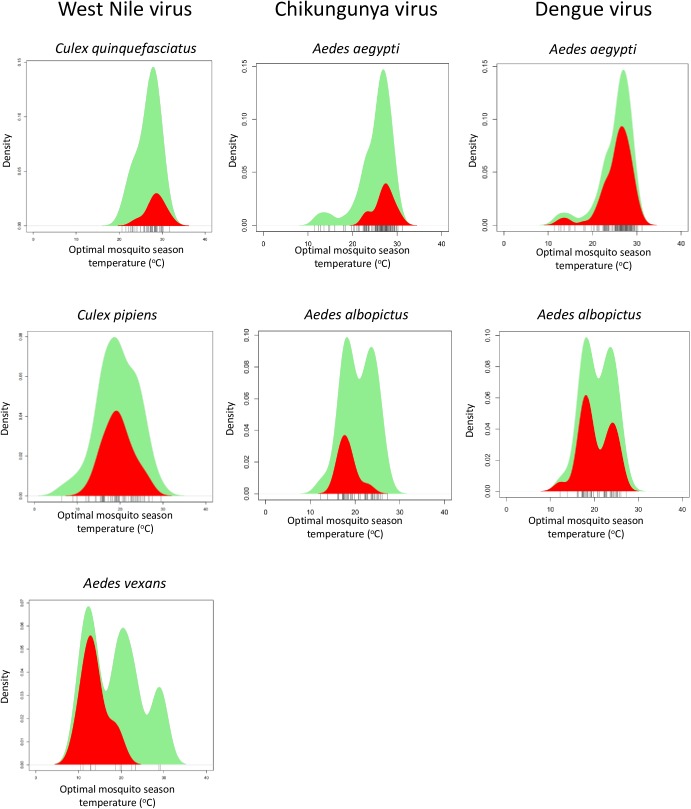
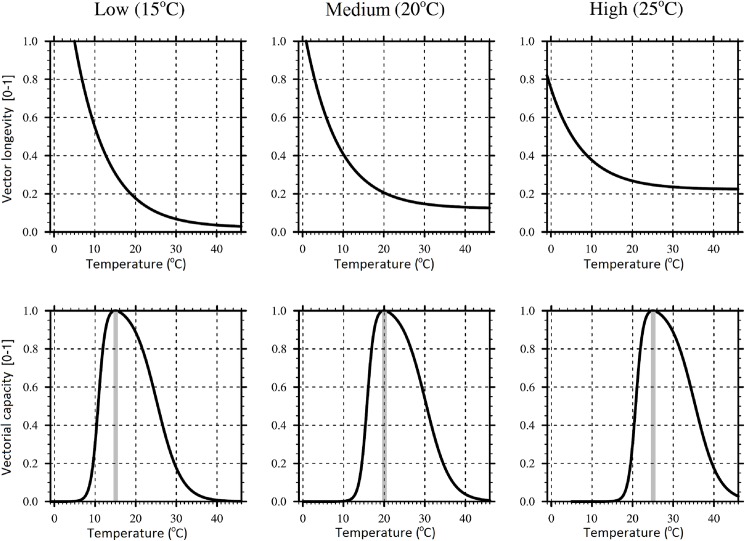
Mosquito-borne viruses have been estimated to cause over 100 million cases of human disease annually. Many methodologies have been developed to help identify areas most at risk from transmission of these viruses. However, generally, these methodologies focus predominantly on the effects of climate on either the vectors or the pathogens they spread, and do not consider the dynamic interaction between the optimal conditions for both vector and virus. Here, we use a new approach that considers the complex interplay between the optimal temperature for virus transmission, and the optimal climate for the mosquito vectors. Using published geolocated data we identified temperature and rainfall ranges in which a number of mosquito vectors have been observed to co-occur with West Nile virus, dengue virus or chikungunya virus. We then investigated whether the optimal climate for co-occurrence of vector and virus varies between "warmer" and "cooler" adapted vectors for the same virus. We found that different mosquito vectors co-occur with the same virus at different temperatures, despite significant overlap in vector temperature ranges. Specifically, we found that co-occurrence correlates with the optimal climatic conditions for the respective vector; cooler-adapted mosquitoes tend to co-occur with the same virus in cooler conditions than their warmer-adapted counterparts. We conclude that mosquitoes appear to be most able to transmit virus in the mosquitoes' optimal climate range, and hypothesise that this may be due to proportionally over-extended vector longevity, and other increased fitness attributes, within this optimal range. These results suggest that the threat posed by vector-competent mosquito species indigenous to temperate regions may have been underestimated, whilst the threat arising from invasive tropical vectors moving to cooler temperate regions may be overestimated.
据估计,蚊媒病毒每年导致超过1亿例人类疾病。人们已经开发出许多方法来帮助确定这些病毒传播风险最高的地区。然而,一般来说,这些方法主要关注气候对媒介或它们传播的病原体的影响,而没有考虑媒介和病毒最佳条件之间的动态相互作用。在这里,我们采用了一种新方法,该方法考虑了病毒传播的最佳温度与蚊媒最佳气候之间的复杂相互作用。利用已发表的地理定位数据,我们确定了一些蚊媒与西尼罗河病毒、登革热病毒或基孔肯雅病毒同时出现时的温度和降雨范围。然后,我们研究了对于同一种病毒,适应“较温暖”和“较凉爽”环境的媒介,其媒介与病毒同时出现的最佳气候是否有所不同。我们发现,尽管媒介温度范围有显著重叠,但不同的蚊媒在不同温度下与同一种病毒同时出现。具体而言,我们发现同时出现与各媒介的最佳气候条件相关;适应较凉爽环境的蚊子往往比适应较温暖环境的蚊子在更凉爽的条件下与同一种病毒同时出现。我们得出结论,蚊子似乎在其最佳气候范围内最能传播病毒,并推测这可能是由于在这个最佳范围内媒介寿命成比例地过度延长以及其他适应性增强的特性。这些结果表明,温带地区本土有传播能力的蚊种所构成的威胁可能被低估了,而热带入侵媒介向较凉爽温带地区迁移所带来的威胁可能被高估了。