Guillaumet-Adkins Amy, Yañez Yania, Peris-Diaz Manuel D, Calabria Ines, Palanca-Ballester Cora, Sandoval Juan
CNAG-CRG, Centre for Genomic Regulation (CRG), Barcelona Institute of Science and Technology (BIST), Barcelona, Spain.
Pediatric Oncology Unit, Hospital Universitari i Politècnic La Fe, Avda Fernando Abril Martorell, 46026 Valencia, Spain.
Oxid Med Cell Longev. 2017;2017:9175806. doi: 10.1155/2017/9175806. Epub 2017 Jul 20.
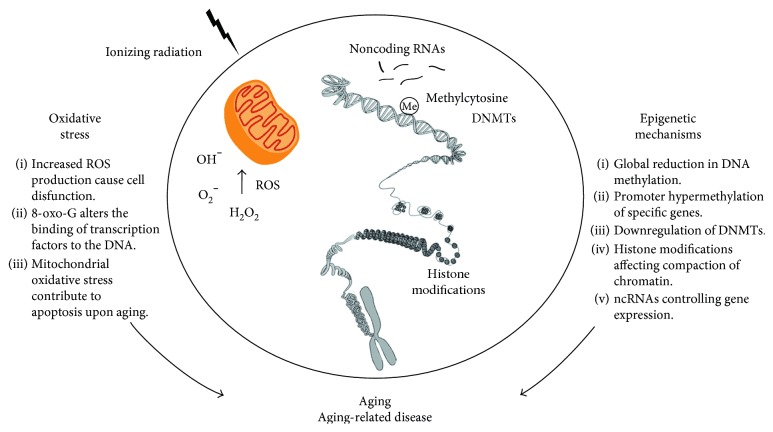
Aging is a multifactorial process characterized by the progressive loss of physiological functions, leading to an increased vulnerability to age-associated diseases and finally to death. Several theories have been proposed to explain the nature of aging. One of the most known identifies the free radicals produced by the mitochondrial metabolism as the cause of cellular and DNA damage. However, there are also several evidences supporting that epigenetic modifications, such as DNA methylation, noncoding RNAs, and histone modifications, play a critical role in the molecular mechanism of aging. In this review, we explore the significance of these findings and argue how the interlinked effects of oxidative stress and epigenetics can explain the cause of age-related declines.
衰老 是一个多因素过程,其特征是生理功能逐渐丧失,导致对与年龄相关疾病的易感性增加,最终导致死亡。已经提出了几种理论来解释衰老的本质。其中最著名的一种理论认为,线粒体代谢产生的自由基是细胞和DNA损伤的原因。然而,也有若干证据支持表观遗传修饰,如DNA甲基化、非编码RNA和组蛋白修饰,在衰老的分子机制中起关键作用。在本综述中,我们探讨了这些发现的意义,并论证了氧化应激和表观遗传学的相互关联效应如何能够解释与年龄相关衰退的原因。