Daniels Kevin, Watson David, Gedikli Cigdem
Employment Systems and Institutions Group, Norwich Business School, University of East Anglia, Norwich NR4 7TJ, UK.
What Works for Well-Being Centre, London WC1X 0JL, UK.
Int J Environ Res Public Health. 2017 Aug 16;14(8):918. doi: 10.3390/ijerph14080918.
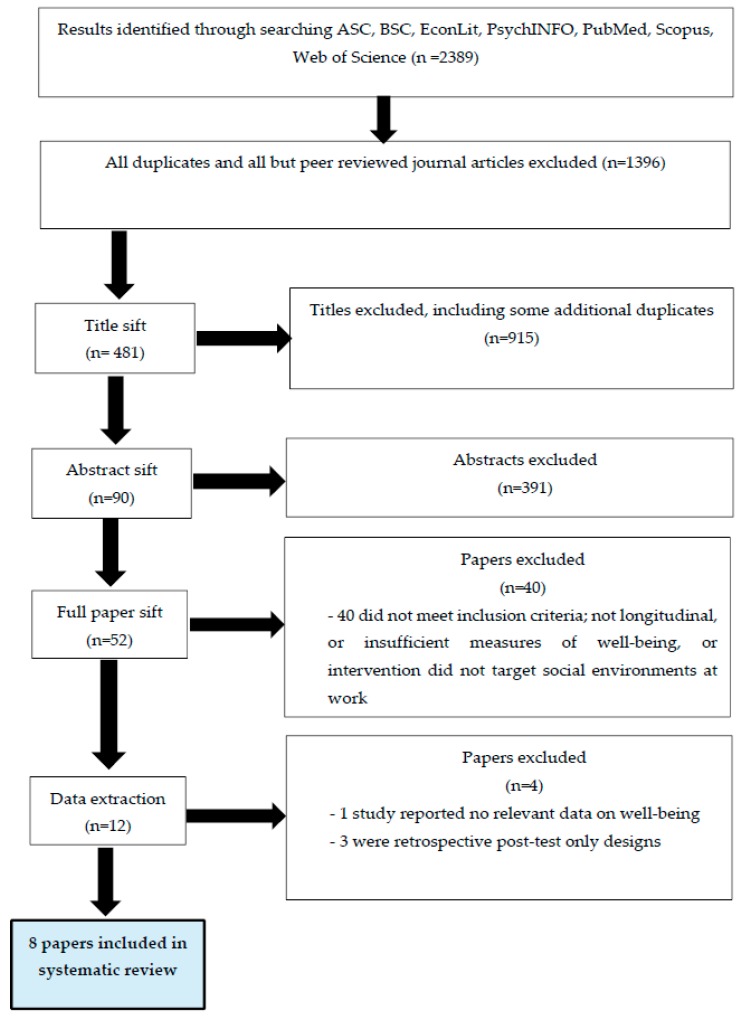
There is consistent evidence that a good social environment in the workplace is associated with employee well-being. However, there has been no specific review of interventions to improve well-being through improving social environments at work. We conducted a systematic review of such interventions, and also considered performance as an outcome. We found eight studies of interventions. Six studies were of interventions that were based on introducing shared social activities into workgroups. Six out of the six studies demonstrated improvements in well-being across the sample (five studies), or for an identifiable sub-group (one study). Four out of the five studies demonstrated improvements in social environments, and four out of the five studies demonstrated improvements in indicators of performance. Analysis of implementation factors indicated that the interventions based on shared activities require some external facilitation, favorable worker attitudes prior to the intervention, and several different components. We found two studies that focused on improving fairness perceptions in the workplace. There were no consistent effects of these interventions on well-being or performance. We conclude that there is some evidence that interventions that increase the frequency of shared activities between workers can improve worker well-being and performance. We offer suggestions for improving the evidence base.
有一致的证据表明,工作场所良好的社会环境与员工福祉相关。然而,尚未有针对通过改善工作中的社会环境来提高福祉的干预措施进行的具体综述。我们对这类干预措施进行了系统综述,并将绩效作为一个结果来考量。我们找到了八项关于干预措施的研究。六项研究的干预措施是基于在工作小组中引入共享社会活动。这六项研究中的六项表明,整个样本(五项研究)或某个可识别的子群体(一项研究)的福祉有所改善。五项研究中的四项表明社会环境有所改善,五项研究中的四项表明绩效指标有所改善。对实施因素的分析表明,基于共享活动的干预措施需要一些外部促进、干预前员工的积极态度以及几个不同的组成部分。我们找到了两项专注于改善工作场所公平感认知的研究。这些干预措施对福祉或绩效没有一致的影响。我们得出结论,有一些证据表明,增加员工之间共享活动频率的干预措施可以改善员工福祉和绩效。我们为改善证据基础提供了建议。