Department of Biomedical and Biotechnological Sciences, University of Catania, 95123 Catania, Italy.
CIBER-ESP, 28029 Madrid, Spain.
Int J Environ Res Public Health. 2020 Feb 25;17(5):1468. doi: 10.3390/ijerph17051468.
: Current scientific literature suggests healthy dietary patterns may have less environmental impact than current consumption patterns, but most of the studies rely on theoretical modeling. The aim of this study was to assess the impact on resources (land, water, and energy) use and greenhouse gas (GHG) emissions of healthy dietary patterns in a sample of Italian adults.
Participants ( = 1806) were recruited through random sampling in the city of Catania, southern Italy. Dietary consumption was assessed through a validated food frequency questionnaire (FFQ); dietary patterns were calculated through dietary scores. The specific environmental footprints of food item production/processing were obtained from various available life-cycle assessments; a sustainability score was created based on the impact of the four environmental components calculated.
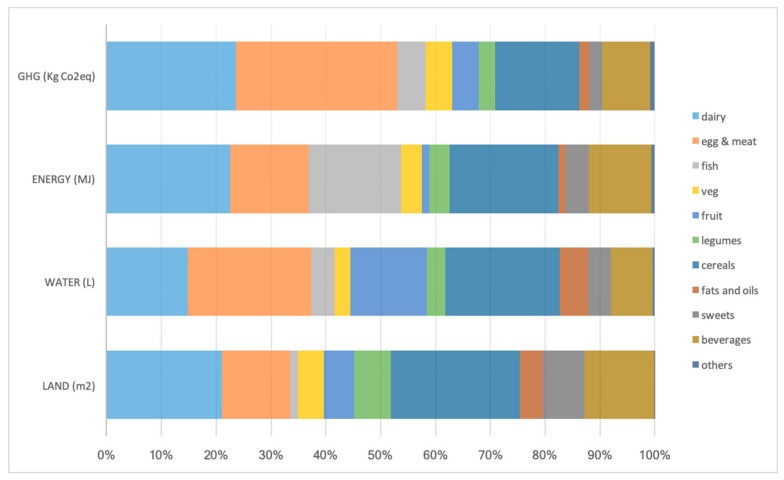
The contribution of major food groups to the environmental footprint showed that animal products (dairy, egg, meat, and fish) represented more than half of the impact on GHG emissions and energy requirements; meat products were the stronger contributors to GHG emissions and water use, while dairy products to energy use, and cereals to land use. All patterns investigated, with the exception of the Dietary Approach to Stop Hypertension (DASH), were linearly associated with the sustainability score. Among the components, higher adherence to the Mediterranean diet and Alternate Diet Quality Index (AHEI) was associated with lower GHG emissions, dietary quality index-international (DQI-I) with land use, while Nordic diet with land and water use.
In conclusion, the adoption of healthy dietary patterns involves less use of natural resources and GHG emissions, representing eco-friendlier options in Italian adults.
当前的科学文献表明,健康的饮食模式对环境的影响可能小于当前的消费模式,但大多数研究依赖于理论模型。本研究旨在评估健康饮食模式对资源(土地、水和能源)利用和温室气体(GHG)排放的影响,该研究样本来自意大利的成年人。
通过在意大利南部城市卡塔尼亚的随机抽样招募参与者(n=1806)。通过验证后的食物频率问卷(FFQ)评估饮食摄入;通过饮食评分计算饮食模式。通过各种可用的生命周期评估获取食品生产/加工的特定环境足迹;基于计算的四个环境组成部分的影响创建可持续性评分。
主要食物组对环境足迹的贡献表明,动物产品(奶制品、蛋类、肉类和鱼类)占 GHG 排放和能源需求的一半以上;肉类产品是 GHG 排放和水利用的主要贡献者,而奶制品是能源利用的主要贡献者,谷物是土地利用的主要贡献者。除了高血压饮食法(DASH)之外,所有研究的模式都与可持续性评分呈线性相关。在这些成分中,对地中海饮食和替代饮食质量指数(AHEI)的更高遵循与较低的 GHG 排放、国际饮食质量指数(DQI-I)与土地利用有关,而北欧饮食与土地和水利用有关。
总之,在意大利成年人中,采用健康的饮食模式涉及较少的自然资源和 GHG 排放,代表了更环保的选择。