Villena Oswaldo C, Terry Ivana, Iwata Kayoko, Landa Edward R, LaDeau Shannon L, Leisnham Paul T
Department of Environmental Science and Technology, University of Maryland, College Park, MD, United States of America.
Graduate School of Agriculture, Kyoto University, Kyoto, Japan.
PeerJ. 2017 Sep 5;5:e3756. doi: 10.7717/peerj.3756. eCollection 2017.
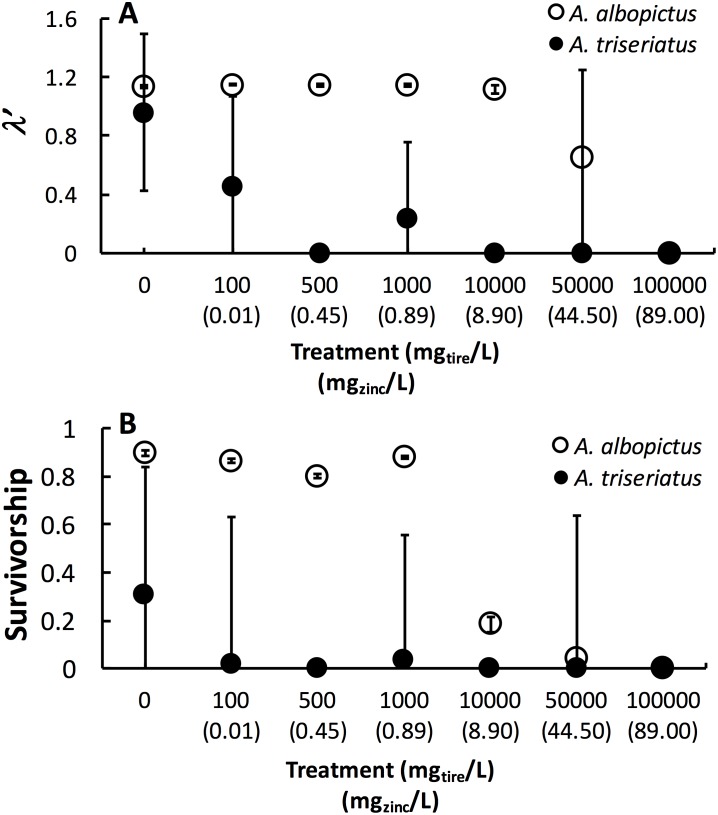
Discarded vehicle tire casings are an important artificial habitat for the developmental stages of numerous vector mosquitoes. Discarded vehicle tires degrade under ultraviolet light and leach numerous soluble metals (e.g., barium, cadmium, zinc) and organic substances (e.g., benzothiazole and its derivatives [BZTs], polyaromatic hydrocarbons [PAHs]) that could affect mosquito larvae that inhabit the tire casing. This study examined the relationship between soluble zinc, a common marker of tire leachate, on mosquito densities in tire habitats in the field, and tested the effects of tire leachate on the survival and development of newly hatched and larvae in a controlled laboratory dose-response experiment. In the field, zinc concentrations were as high as 7.26 mg/L in a single tire and averaged as high as 2.39 (SE ± 1.17) mg/L among tires at a single site. (37/42 tires, 81.1%) and (23/42, 54.8%) were the most widespread mosquito species, co-occurred in over half (22/42, 52.4%) of all tires, and was only collected without in one tire. was more strongly negatively associated with zinc concentration than and another common mosquito, which was found in 17 tires. In the laboratory experiment, per capita rate of population change (') was over 1.0, indicating positive population growth, from 0-8.9 mg/L zinc concentration (0-10,000 mg/L tire leachate), but steeply declined to zero from 44.50-89.00 mg/L zinc (50,000-100,000 mg/L tire leachate). In contrast, ' declined at the lower concentration of 0.05 mg/L zinc (100 mg/L tire leachate), and was zero at 0.45, 8.90, 44.50, and 89.00 mg/L zinc (500, 10,000, 50,000 and 100,000 mg/L tire leachate). These results indicate that tire leachate can have severe negative effects on populations of container-utilizing mosquitoes at concentrations commonly found in the field. Superior tolerance to tire leachate of compared to and possibly other native mosquito species, may have facilitated the replacement of these native species as has invaded North America and other regions around the world.
废弃的汽车轮胎外胎是众多病媒蚊子发育阶段的重要人工栖息地。废弃的汽车轮胎在紫外线下会降解,并渗出多种可溶性金属(如钡、镉、锌)和有机物质(如苯并噻唑及其衍生物[BZTs]、多环芳烃[PAHs]),这些物质可能会影响栖息在轮胎外胎中的蚊子幼虫。本研究调查了轮胎渗滤液的常见标志物可溶性锌与野外轮胎栖息地蚊子密度之间的关系,并在可控的实验室剂量反应实验中测试了轮胎渗滤液对新孵化幼虫的存活和发育的影响。在野外,单个轮胎中的锌浓度高达7.26毫克/升,单个地点的轮胎中锌浓度平均高达2.39(标准误±1.17)毫克/升。埃及伊蚊(37/42个轮胎,81.1%)和白纹伊蚊(23/42个,54.8%)是分布最广的蚊子种类,在超过一半(22/42个,52.4%)的轮胎中共存,而致倦库蚊仅在一个轮胎中被采集到,且没有与埃及伊蚊或白纹伊蚊共存。埃及伊蚊与锌浓度的负相关比白纹伊蚊和另一种常见蚊子致倦库蚊更强,致倦库蚊在17个轮胎中被发现。在实验室实验中,埃及伊蚊的人均种群变化率(r)在锌浓度为0至8.9毫克/升(0至10,000毫克/升轮胎渗滤液)时超过1.0,表明种群呈正增长,但在锌浓度为44.50至89.00毫克/升(50,000至100,000毫克/升轮胎渗滤液)时急剧降至零。相比之下,白纹伊蚊的r在锌浓度较低的0.05毫克/升(100毫克/升轮胎渗滤液)时下降,在锌浓度为0.45、8.90、44.50和89.00毫克/升(500、10,000、50,000和100,000毫克/升轮胎渗滤液)时为零。这些结果表明,轮胎渗滤液在野外常见的浓度下会对利用容器的蚊子种群产生严重的负面影响。与白纹伊蚊和可能的其他本地蚊子种类相比,埃及伊蚊对轮胎渗滤液具有更高的耐受性,这可能促进了其在入侵北美和世界其他地区时取代这些本地物种。