Department of Food and Nutritional Sciences, School of Chemistry, Food and Pharmacy, University of Reading, Reading, UK.
Health Sciences Research Centre, University of Roehampton, London, UK.
Mol Nutr Food Res. 2018 Jan;62(2). doi: 10.1002/mnfr.201700499. Epub 2017 Dec 29.
Wholegrain has been associated with reduced chronic disease mortality, with oat intake particularly notable for lowering blood cholesterol and glycemia. To better understand the complex nutrient profile of oats, we studied urinary excretion of phenolic acids and avenanthramides after ingestion of oat bran in humans.
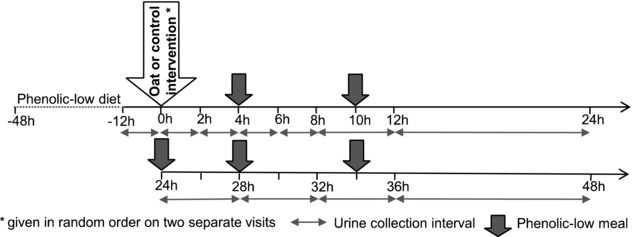
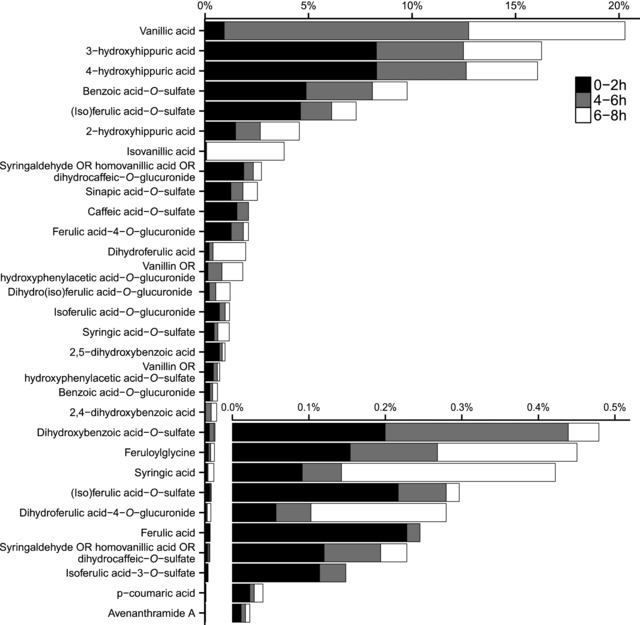
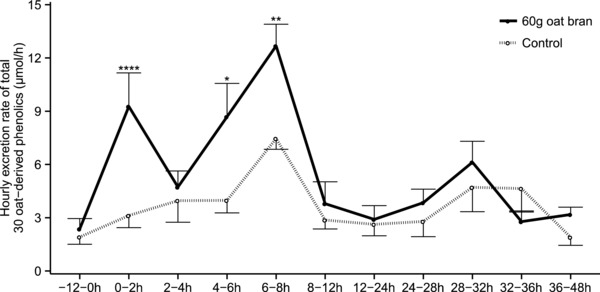
After a 2-d (poly)phenol-low diet, seven healthy men provided urine 12 h before and 48 h after consuming 60 g oat bran (7.8 μmol avenanthramides, 139.2 μmol phenolic acids) or a phenolic-low (traces of phenolics) control in a crossover design. Analysis by ultra-high performance liquid chromatography (UPLC)-MS/MS showed that oat bran intake resulted in an elevation in urinary excretion of 30 phenolics relative to the control, suggesting that they are oat bran-derived. Mean excretion levels were elevated between 0-2 and 4-8 h, following oat bran intake, and amounted to a total of 33.7 ± 7.3 μmol total excretion (mean recovery: 22.9 ± 5.0%), relative to control. The predominant metabolites included: vanillic acid, 4- and 3-hydroxyhippuric acids, and sulfate-conjugates of benzoic and ferulic acids, which accounted collectively for two thirds of total excretion.
Oat bran phenolics follow a relatively rapid urinary excretion, with 30 metabolites excreted within 8 h of intake. These levels of excretion suggest that bound phenolics are, in part, rapidly released by the microbiota.
全谷物与降低慢性病死亡率有关,燕麦摄入尤其显著降低血液胆固醇和血糖。为了更好地了解燕麦复杂的营养特性,我们研究了人摄入燕麦麸后尿液中酚酸和燕麦蒽酰胺的排泄情况。
在 2 天(多)酚低饮食后,7 名健康男性在摄入 60 克燕麦麸(7.8 μmol 燕麦蒽酰胺,139.2 μmol 酚酸)或交叉设计中酚低(痕量酚类)对照前 12 小时和 48 小时提供尿液。超高效液相色谱-质谱/质谱(UPLC-MS/MS)分析表明,与对照相比,摄入燕麦麸可使尿液中 30 种酚类物质的排泄量升高,提示这些酚类物质来源于燕麦麸。与对照相比,摄入燕麦麸后 0-2 小时和 4-8 小时之间,尿液中排泄水平升高,排泄总量达到 33.7±7.3 μmol 总排泄量(平均回收率:22.9±5.0%)。主要代谢物包括:香草酸、4-和 3-羟基 hippuric 酸以及苯甲酸和阿魏酸的硫酸盐结合物,这些代谢物共占总排泄量的三分之二。
燕麦麸酚类物质的排泄相对较快,摄入后 8 小时内可排泄 30 种代谢物。这些排泄水平表明,结合酚类物质部分是由微生物群迅速释放的。