Salehi Hossein, Mehrasa Mohammad, Nasri-Nasrabadi Bijan, Doostmohammadi Mohsen, Seyedebrahimi Reihaneh, Davari Navid, Rafienia Mohammad, Hosseinabadi Mehdi E, Agheb Maria, Siavash Mansour
Department of Anatomical Sciences, School of Medicine, Isfahan University of Medical Sciences, Isfahan, Iran.
Department of Biotechnology, Faculty of Advanced Sciences and Technologies, University of Isfahan, Isfahan, Iran.
J Res Med Sci. 2017 Sep 26;22:110. doi: 10.4103/jrms.JRMS_1037_16. eCollection 2017.
Wound healing is a complex biological process. Some injuries lead to chronic nonhealing ulcers, and healing process is a challenge to both the patient and the medical team. We still look forward an appropriate wound dressing.
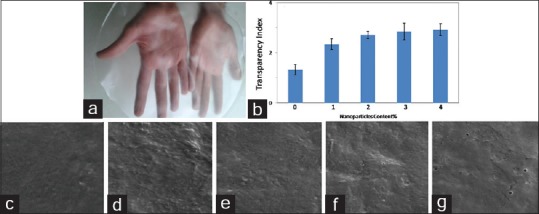
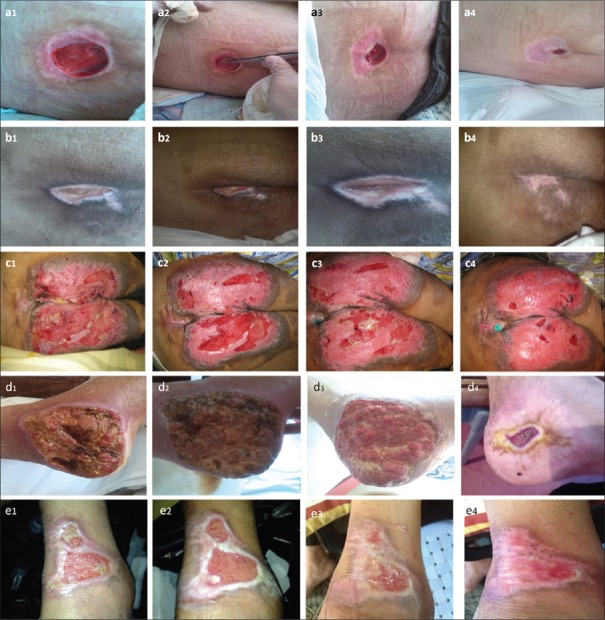
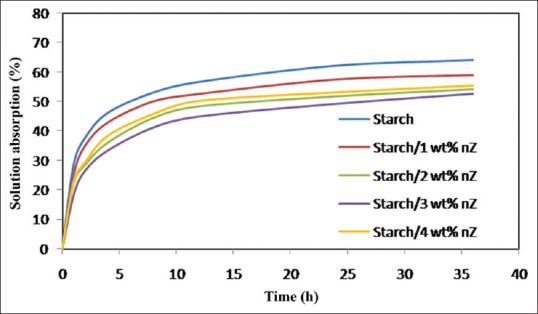
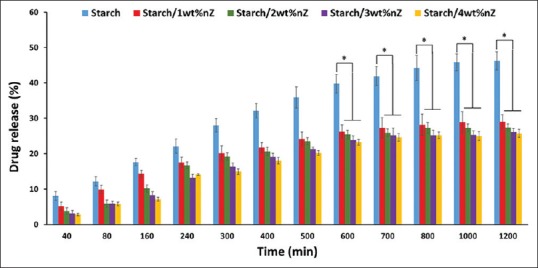
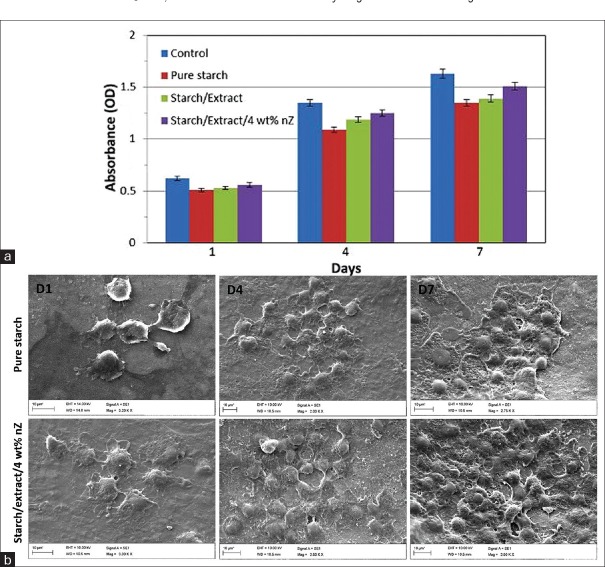
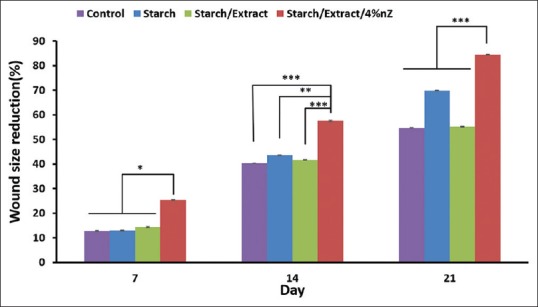
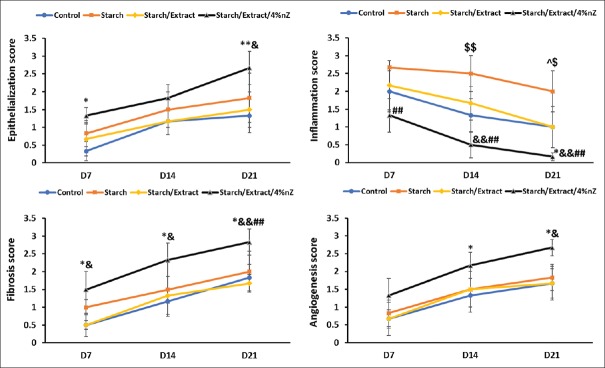
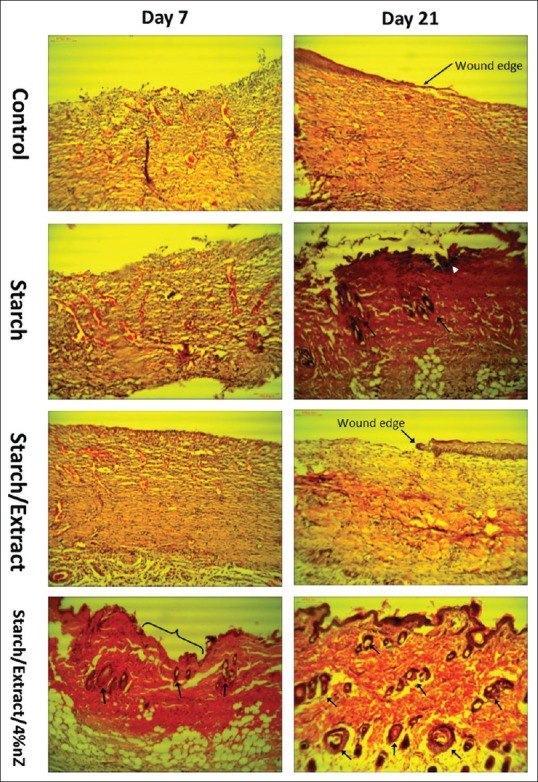
In this study, starch-based nanocomposite hydrogel scaffolds reinforced by zeolite nanoparticles (nZ) were prepared for wound dressing. In addition, a herbal drug (chamomile extract) was added into the matrix to accelerate healing process. To estimate the cytocompatibility of hydrogel dressings, fibroblast mouse cells (L929) were cultured on scaffolds. Then, 3-(4, 5-dimethylthiazol-2-yl)-2, 5-diphenyltetrazolium-bromide assay test and interaction of cells and scaffolds were evaluated. For evaluating healing process, 48 male rats were randomly divided into four groups of four animals each (16 rats at each step). The ulcers of the first group were treated with the same size of pure hydrogels. The second group received a bandage with the same size of hydrogel/extract/4 wt% nZ (hydrogel NZE). The third group was treated with chamomile extract, and the fourth group was considered as control without taking any medicament. Finally, the dressings were applied on the chronic refractory ulcers of five patients.
After successful surface morphology and cytocompatibility tests, the animal study was carried out. There was a significant difference between starch/extract/4 wt% nZ and other groups on wound size decrement after day 7 ( < 0.05). At the clinical pilot study step, the refractory ulcers of all five patients were healed without any hypersensitivity reaction.
Starch-based hydrogel/zeolite dressings may be safe and effective for chronic refractory ulcers.
伤口愈合是一个复杂的生物学过程。一些损伤会导致慢性不愈合溃疡,愈合过程对患者和医疗团队来说都是一项挑战。我们仍在期待一种合适的伤口敷料。
在本研究中,制备了由沸石纳米颗粒(nZ)增强的淀粉基纳米复合水凝胶支架用于伤口敷料。此外,将一种草药药物(洋甘菊提取物)添加到基质中以加速愈合过程。为评估水凝胶敷料的细胞相容性,将成纤维细胞小鼠细胞(L929)培养在支架上。然后,进行3 -(4,5 - 二甲基噻唑 - 2 - 基)- 2,5 - 二苯基四氮唑溴盐试验并评估细胞与支架的相互作用。为评估愈合过程,将48只雄性大鼠随机分为四组,每组四只动物(每个步骤16只大鼠)。第一组的溃疡用相同大小的纯水解凝胶治疗。第二组接受相同大小的水凝胶/提取物/4 wt% nZ(水凝胶NZE)绷带。第三组用洋甘菊提取物治疗,第四组作为对照组不使用任何药物。最后,将敷料应用于五名患者的慢性难治性溃疡。
在成功进行表面形态和细胞相容性测试后,开展了动物研究。在第7天后,淀粉/提取物/4 wt% nZ组与其他组在伤口尺寸减小方面存在显著差异(<0.05)。在临床初步研究阶段,所有五名患者的难治性溃疡均愈合,且无任何过敏反应。
淀粉基水凝胶/沸石敷料对慢性难治性溃疡可能是安全有效的。