Wang Jimin, Askerka Mikhail, Brudvig Gary W, Batista Victor S
Department of Molecular Biophysics and Biochemistry, Yale University, New Haven, Connecticut 06520-8114, United States.
Department of Chemistry, Yale University, New Haven, Connecticut 06520-8107, United States.
ACS Energy Lett. 2017 Oct 13;2(10):2299-2306. doi: 10.1021/acsenergylett.7b00750. Epub 2017 Sep 7.
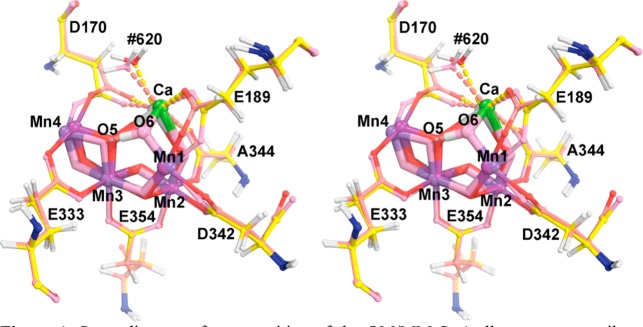
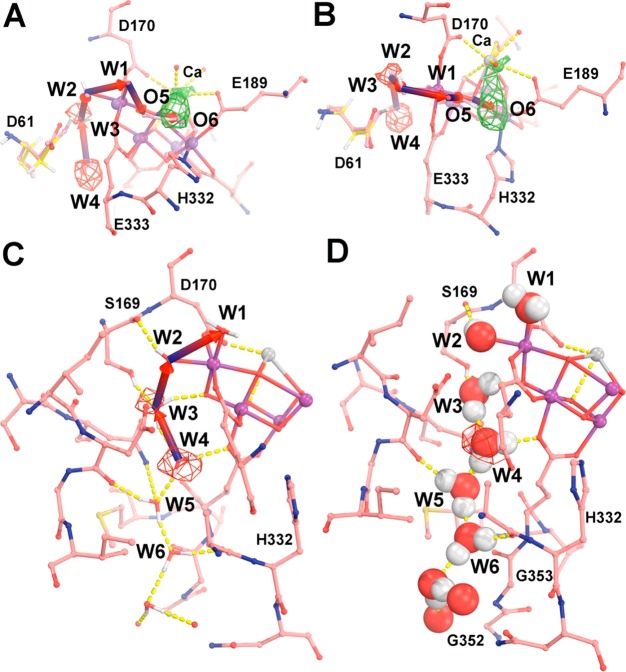
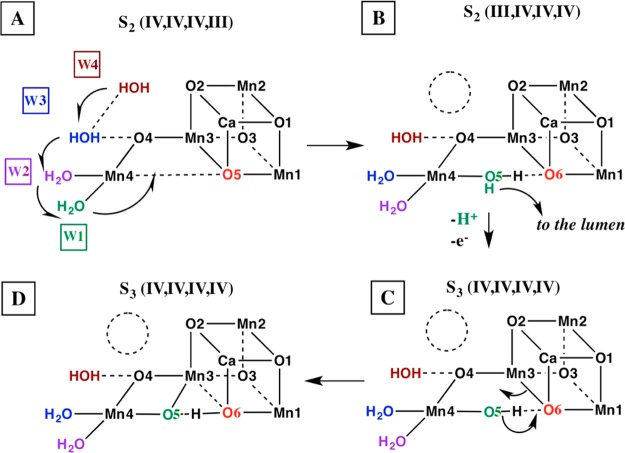
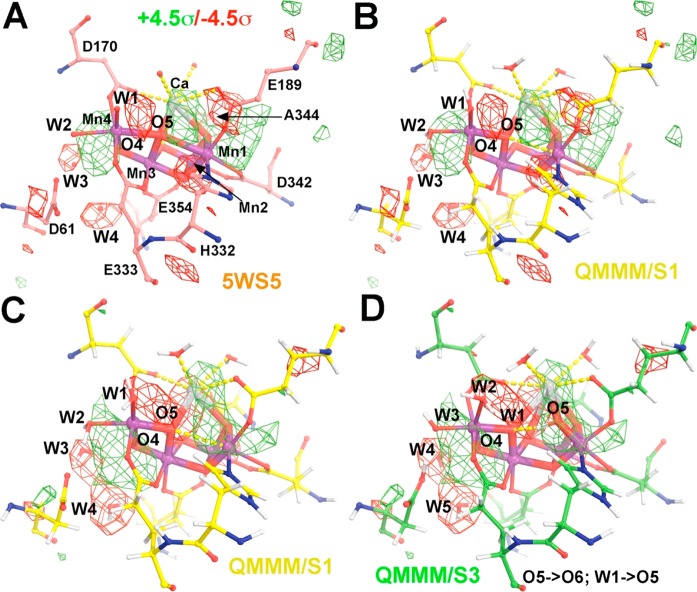
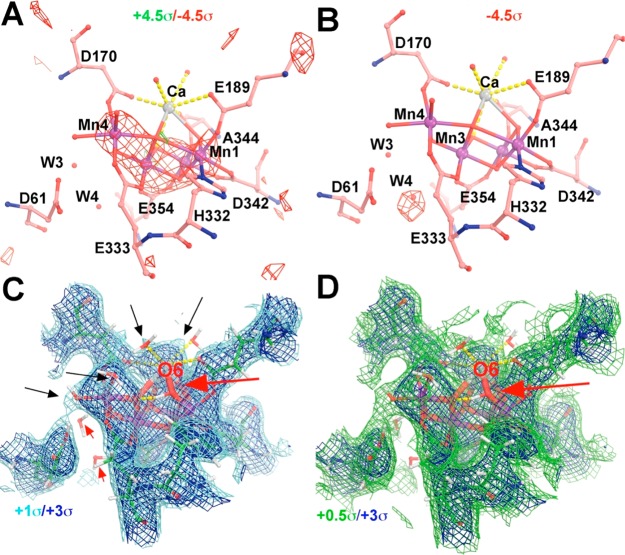
Photosystem II (PSII) oxidizes water to produce oxygen through a four-step photocatalytic cycle. Understanding PSII structure-function relations is important for the development of biomimetic photocatalytic systems. The quantum mechanics/molecular mechanics (QM/MM) analysis of substrate water binding to the oxygen-evolving complex (OEC) has suggested a rearrangement of water ligands in a carousel mechanism around a key Mn center. Here, we find that the most recently reported X-ray free-electron laser (XFEL) crystallographic data obtained for the dark-stable S state and the doubly flashed S state at 2.25 Å resolution support the carousel mechanism. The features in the XFEL data and QM/MM model-simulated difference Fourier maps suggest that water displacement may occur from the so-called "narrow" channel, resulting in binding of a new water molecule to the OEC, and thus provide new insights into the nature of rearrangements of water ligands along the catalytic cycle before O=O bond formation.
光系统II(PSII)通过四步光催化循环氧化水以产生氧气。理解PSII的结构-功能关系对于仿生光催化系统的开发很重要。对底物水与析氧复合物(OEC)结合的量子力学/分子力学(QM/MM)分析表明,水配体围绕关键的锰中心以旋转木马机制进行重排。在这里,我们发现最近报道的以2.25埃分辨率获得的暗稳定S态和双闪光S态的X射线自由电子激光(XFEL)晶体学数据支持旋转木马机制。XFEL数据和QM/MM模型模拟的差分傅里叶图中的特征表明,水可能从所谓的“狭窄”通道位移,导致新的水分子与OEC结合,从而为O=O键形成之前水配体沿催化循环的重排性质提供了新的见解。