Department of Food and Nutrition, Brian Korea 21 PLUS Project, College of Human Ecology, Yonsei University, Seoul 03722, Korea.
Int J Mol Sci. 2017 Oct 25;18(11):2239. doi: 10.3390/ijms18112239.
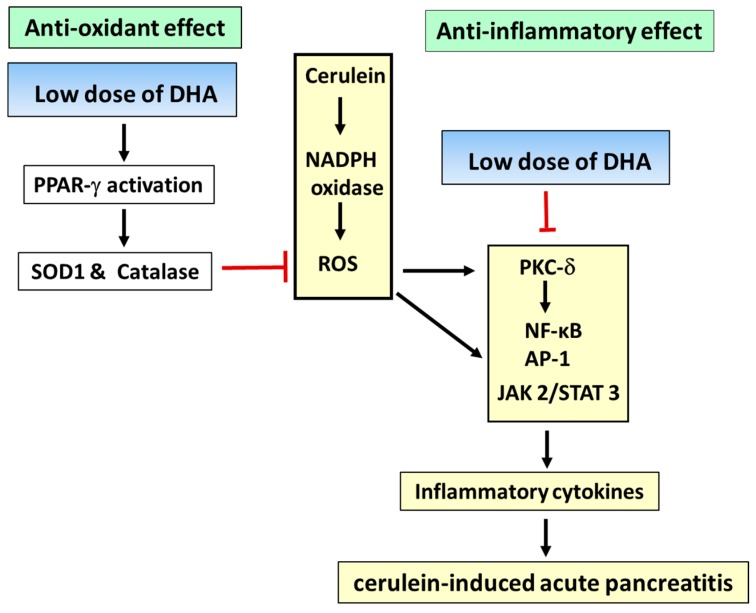
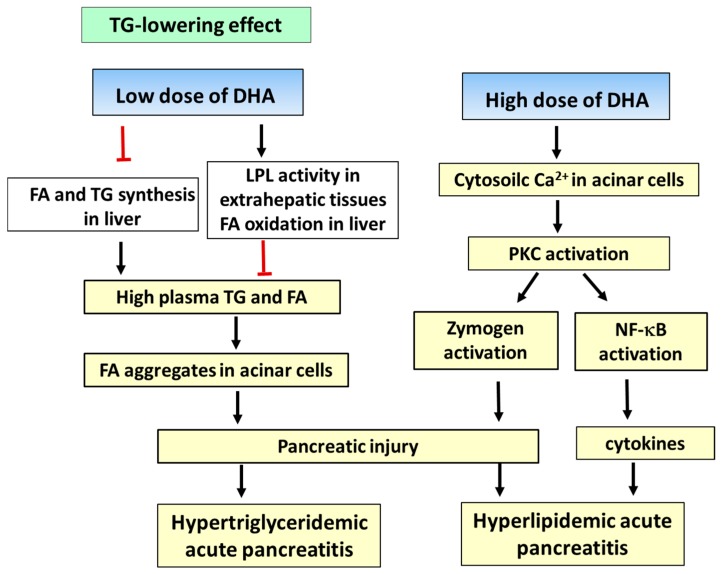
Acute pancreatitis refers to the sudden inflammation of the pancreas. It is associated with premature activation and release of digestive enzymes into the pancreatic interstitium and systemic circulation, resulting in pancreatic tissue autodigestion and multiple organ dysfunction, as well as with increased cytokine production, ultimately leading to deleterious local and systemic effects. Although mechanisms involved in pathogenesis of acute pancreatitis have not been completely elucidated, oxidative stress is regarded as a major risk factor. In human acute pancreatitis, lipid peroxide levels in pancreatic tissues increase. Docosahexaenoic acid (DHA), an omega-3 polyunsaturated fatty acid (C22:6n-3), exerts anti-inflammatory and antioxidant effects on various cells. Previous studies have shown that DHA activates peroxisome proliferator-activated receptor-γ and induces catalase, which inhibits oxidative stress-mediated inflammatory signaling required for cytokine expression in experimental acute pancreatitis using cerulein. Cerulein, a cholecystokinin analog, induces intra-acinar activation of trypsinogen in the pancreas, which results in human acute pancreatitis-like symptoms. Therefore, DHA supplementation may be beneficial for preventing or inhibiting acute pancreatitis development. Since DHA reduces serum triglyceride levels, addition of DHA to lipid-lowering drugs like statins has been investigated to reduce hypertriglyceridemic acute pancreatitis. However, high DHA concentrations increase cytosolic Ca, which activates protein kinase C and may induce hyperlipidemic acute pancreatitis. In this review, effect of DHA on cerulein-induced and hypertriglyceridemic acute pancreatitis has been discussed. The relation of high concentration of DHA to hyperlipidemic acute pancreatitis has been included.
急性胰腺炎是指胰腺的突然炎症。它与消化酶过早激活和释放到胰腺间质和全身循环有关,导致胰腺组织自溶和多器官功能障碍,以及细胞因子产生增加,最终导致有害的局部和全身效应。尽管急性胰腺炎的发病机制尚未完全阐明,但氧化应激被认为是一个主要的危险因素。在人类急性胰腺炎中,胰腺组织中的脂质过氧化物水平增加。二十二碳六烯酸(DHA),一种ω-3 多不饱和脂肪酸(C22:6n-3),对各种细胞具有抗炎和抗氧化作用。先前的研究表明,DHA 激活过氧化物酶体增殖物激活受体-γ并诱导过氧化氢酶,从而抑制细胞因子表达所需的氧化应激介导的炎症信号,在使用鹅去氧胆酸诱导的实验性急性胰腺炎中。鹅去氧胆酸是一种胆囊收缩素类似物,可诱导胰腺腺泡内胰蛋白酶原的激活,导致人类类似急性胰腺炎的症状。因此,DHA 补充可能有益于预防或抑制急性胰腺炎的发展。由于 DHA 降低血清甘油三酯水平,因此研究了向降脂药物(如他汀类药物)中添加 DHA 以降低高甘油三酯血症性急性胰腺炎。然而,高浓度的 DHA 增加细胞质 Ca,激活蛋白激酶 C,并可能诱导高脂血症性急性胰腺炎。在这篇综述中,讨论了 DHA 对鹅去氧胆酸诱导和高甘油三酯血症性急性胰腺炎的影响。包括了高浓度 DHA 与高脂血症性急性胰腺炎的关系。