Liu Yanan, Hwang Hyo-Jeong, Ryu Hyesook, Lee You-Suk, Kim Hyun-Sook, Park Hyunjin
Department of Food and Nutrition, College of Human Ecology, Sookmyung Women's University, Chungpa-Dong 2-Ka, Yongsan-Ku, Seoul 04310, Korea.
ICAN Nutrition Education and Research, 20, Gukjegeumyung-ro, Yeongdeungpo-gu, Seoul 07327, Korea.
Nutr Res Pract. 2017 Dec;11(6):479-486. doi: 10.4162/nrp.2017.11.6.479. Epub 2017 Nov 22.
BACKGROUND/OBJECTIVES: Timing of almond intake during a day may result differently in the perspectives of body composition and changes of lipid profile. The current study was conducted to compare the effects of daily almond intake as a preload versus as a snack on body composition, blood lipid profile, and oxidative and inflammation indicators among young Korean adults aged 20-39 years old.
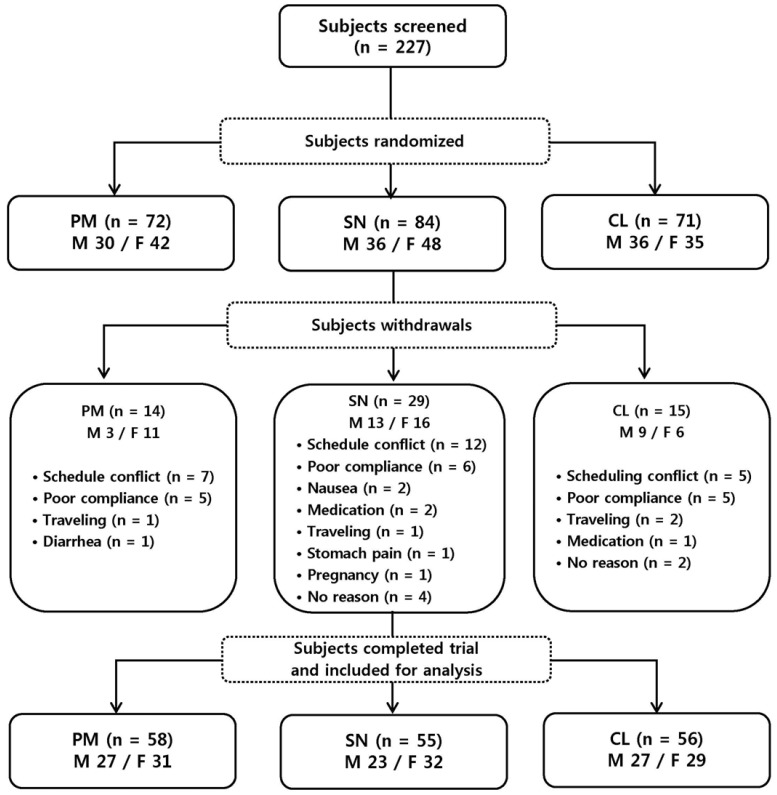
SUBJECTS/METHODS: Participants were randomly assigned to one of three groups: a pre-meal almond group (PM), a snack almond group (SN) in which participants were instructed to consume 56 g of almonds either as a preload before meals or as a snack between meals, respectively, and a control group (CL) in which participants were provided high-carbohydrate iso-caloric control food. Measurements were performed at baseline, weeks 8 and 16.
A total of 169 (M 77/F 92) out of the 227 participants completed the study between June 2014 and June 2015 (n = 58 for PM; 55 for SN; and 56 for CL). A significant decrease in body fat mass was observed in the PM group at both weeks 8 and 16 compared with the CL. There were significant intervention effects on changes of body fat mass ( = 0.025), body fat percentages ( = 0.019), and visceral fat levels ( < 0.001). Consuming almonds as a daily snack reduced the levels of total cholesterol ( = 0.043) and low-density lipoprotein (LDL) cholesterol ( = 0.011) without changing high-density lipoprotein (HDL) cholesterol compared with the CL.
Almond consumption as a preload modified body fat percentages, whereas snacking on almonds between meals improved blood lipid profiles. This trial was registered at ClinicalTrials.gov as NCT03014531.
背景/目的:一天中杏仁摄入的时间在身体成分和血脂谱变化方面可能会产生不同的结果。本研究旨在比较20至39岁韩国年轻成年人中,每日将杏仁作为餐前负荷与作为零食摄入对身体成分、血脂谱以及氧化和炎症指标的影响。
受试者/方法:参与者被随机分配到三组之一:餐前杏仁组(PM)、零食杏仁组(SN),分别指导参与者将56克杏仁作为餐前负荷或餐间零食食用,以及对照组(CL),为参与者提供高碳水化合物等热量的对照食物。在基线、第8周和第16周进行测量。
227名参与者中有169名(男性77名/女性92名)在2014年6月至2015年6月期间完成了研究(PM组58名;SN组55名;CL组56名)。与CL组相比,PM组在第8周和第16周时身体脂肪量均显著下降。在身体脂肪量变化(P = 0.025)、体脂百分比变化(P = 0.019)和内脏脂肪水平变化(P < 0.001)方面存在显著的干预效果。与CL组相比,每日将杏仁作为零食食用可降低总胆固醇水平(P = 0.043)和低密度脂蛋白(LDL)胆固醇水平(P = 0.011),而高密度脂蛋白(HDL)胆固醇水平不变。
将杏仁作为餐前负荷食用可改变体脂百分比,而餐间食用杏仁零食可改善血脂谱。该试验已在ClinicalTrials.gov上注册,注册号为NCT03014531。