Sbardelotto Mari L, Pedroso Giulia S, Pereira Fernanda T, Soratto Helen R, Brescianini Stella Ms, Effting Pauline S, Thirupathi Anand, Nesi Renata T, Silveira Paulo Cl, Pinho Ricardo A
Laboratory of Exercise Biochemistry and Physiology, Graduate Program in Health Sciences, Health Sciences Unit, Universidade do Extremo Sul Catarinense, Criciúma, Santa Catarina, Brazil.
Aging Dis. 2017 Dec 1;8(6):887-898. doi: 10.14336/AD.2017.0209. eCollection 2017 Dec.
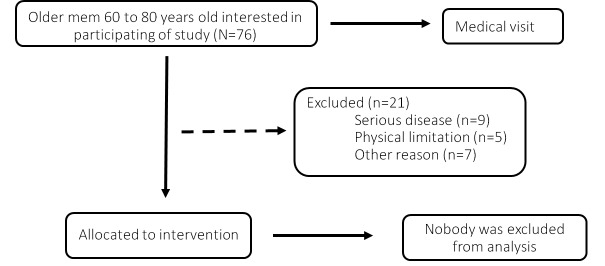
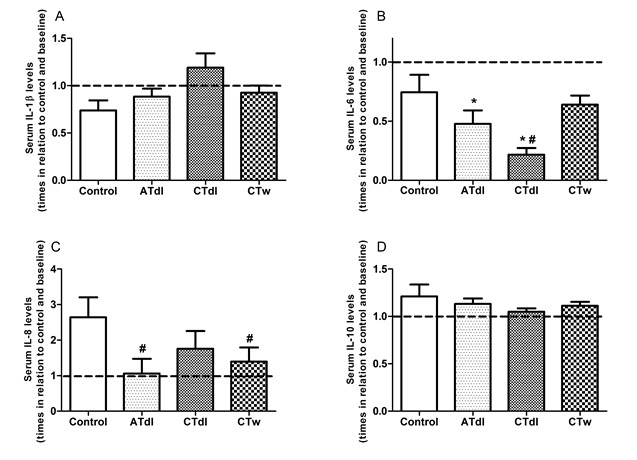
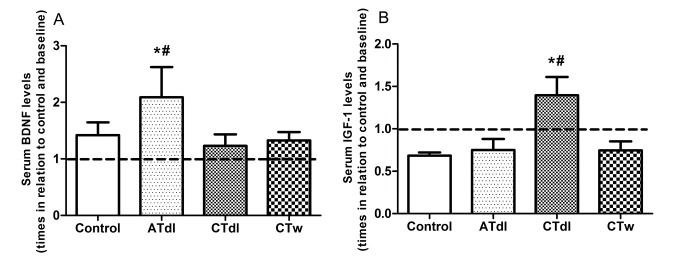
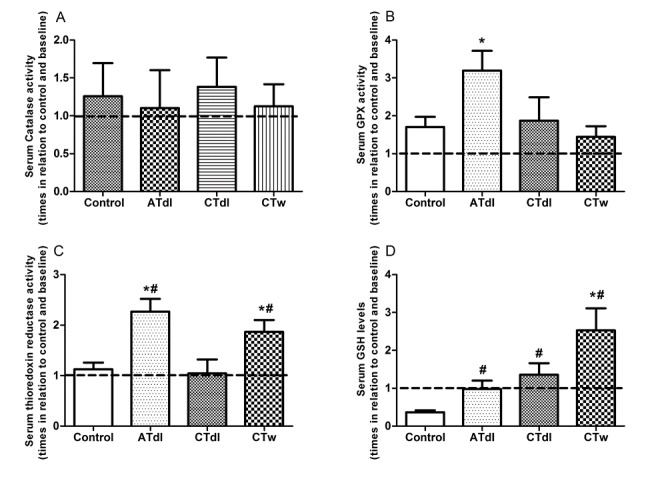
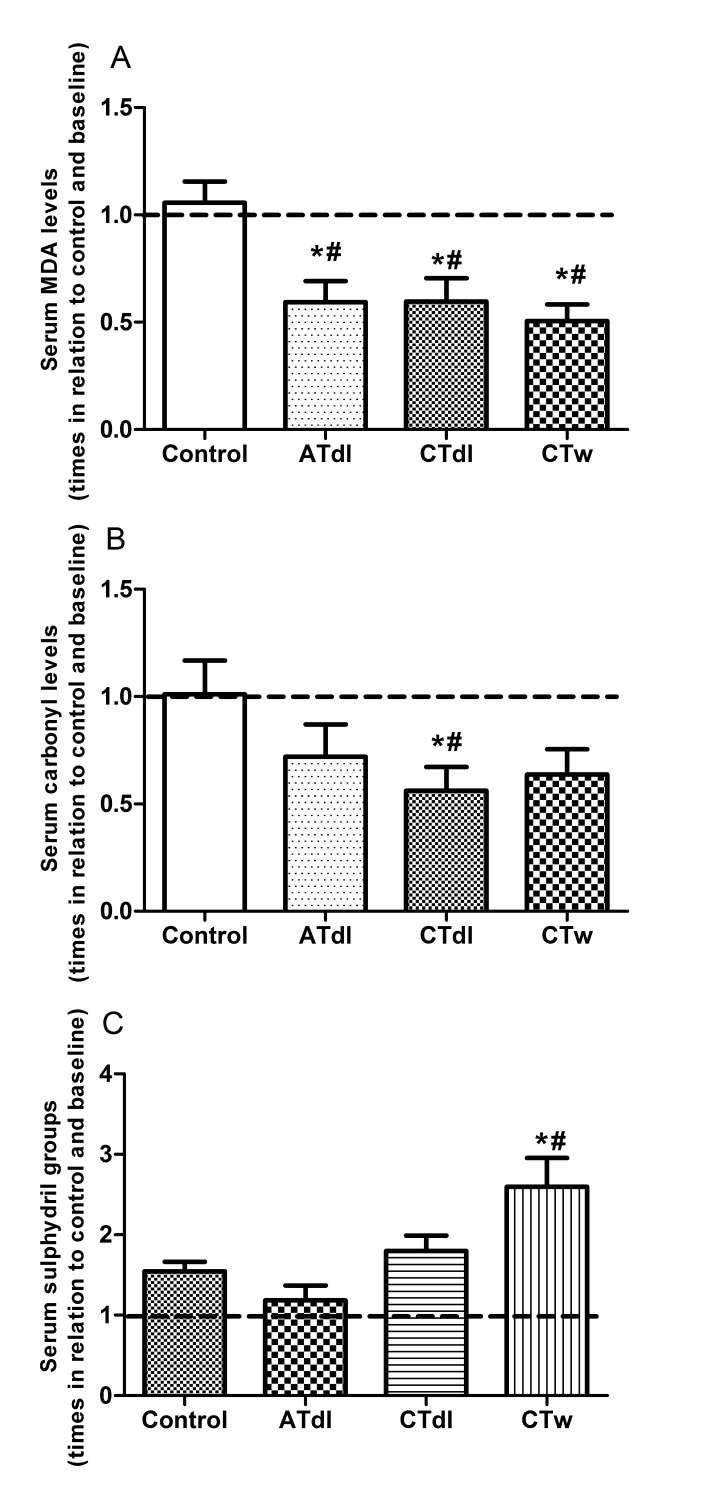
Regular exercise can decrease the deleterious effects of aging and limit the development and progression of chronic disease in elderly people, depending on the type, intensity, frequency, and duration of exercise. This study aimed to investigate the potential protective effects of different physical training programs on oxidative stress parameters and inflammatory and neurotrophic mediators in the serum of elderly men. Healthy male volunteers [60 to 80 years; n=55] were divided into four groups: control [Ctr, n=14], aerobic training on dry land [ATdl, n=12]; and combined training on dry land [CTdl, n=12] or in water [CTw, n=17]. The training protocols were performed over 8 weeks, three times per week. Each 1 h session included 5 min warming-up exercise, 50 min specific training [aerobic, strength, or combined], and 5 min stretching. Blood samples were drawn 72 h before [baseline] the beginning of the 8 weeks' protocol and 48 h after the last training session, processed, and the serum was aliquoted and stored at -70 °C until biochemical assessment of oxidative damage, antioxidant system and neurotrophic, growth and inflammatory factors. Elevated BDNF or IGF-1 levels were observed in the ATdl or CTdl groups, respectively. Overall oxidative stress parameters were improved including reduced lipid oxidative damage and increased thioredoxin reductase and glutathione peroxidase activities and total glutathione. Significant decreases in the inflammatory mediators IL-6 and IL-8 were observed; IL-6 was more susceptible to the effects of type of physical training. Thus, the effects of training in elderly men vary in an exercise type-dependent manner.
规律运动可以减轻衰老的有害影响,并限制老年人慢性病的发展和进程,这取决于运动的类型、强度、频率和持续时间。本研究旨在调查不同体育训练方案对老年男性血清中氧化应激参数、炎症和神经营养介质的潜在保护作用。健康男性志愿者[60至80岁;n = 55]被分为四组:对照组[Ctr,n = 14]、陆地有氧运动组[ATdl,n = 12];陆地综合训练组[CTdl,n = 12]或水中综合训练组[CTw,n = 17]。训练方案持续8周,每周进行三次。每次1小时的训练包括5分钟热身运动、50分钟特定训练(有氧、力量或综合训练)和5分钟拉伸。在8周训练方案开始前72小时(基线)和最后一次训练课后48小时采集血样,进行处理,将血清分装并储存在-70°C直至对氧化损伤、抗氧化系统以及神经营养、生长和炎症因子进行生化评估。分别在ATdl组或CTdl组中观察到脑源性神经营养因子(BDNF)或胰岛素样生长因子-1(IGF-1)水平升高。整体氧化应激参数得到改善,包括脂质氧化损伤减少、硫氧还蛋白还原酶和谷胱甘肽过氧化物酶活性增加以及总谷胱甘肽增加。观察到炎症介质白细胞介素-6(IL-6)和白细胞介素-8(IL-8)显著降低;IL-6对体育训练类型的影响更敏感。因此,老年男性的训练效果因运动类型而异。