Roig Francisco J, González-Candelas Fernando, Sanjuán Eva, Fouz Belén, Feil Edward J, Llorens Carlos, Baker-Austin Craig, Oliver James D, Danin-Poleg Yael, Gibas Cynthia J, Kashi Yechezkel, Gulig Paul A, Morrison Shatavia S, Amaro Carmen
Estructura de Investigación Interdisciplinar en Biotecnología y Biomedicina BIOTECMED, University of Valencia, Valencia, Spain.
Departmento de Microbiología y Ecología, Universidad de Valencia, Valencia, Spain.
Front Microbiol. 2018 Jan 5;8:2613. doi: 10.3389/fmicb.2017.02613. eCollection 2017.
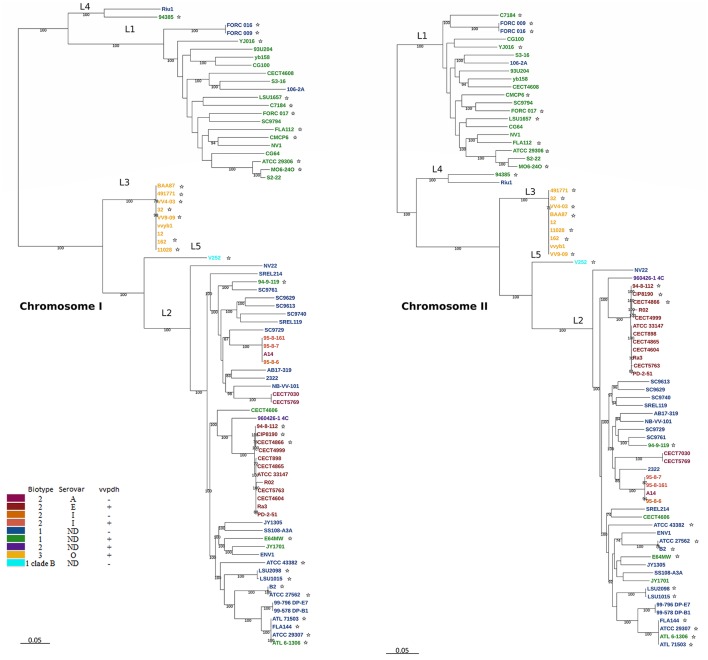
(Vv) is a multi-host pathogenic species currently subdivided into three biotypes (Bts). The three Bts are human-pathogens, but only Bt2 is also a fish-pathogen, an ability that is conferred by a transferable virulence-plasmid (pVvbt2). Here we present a phylogenomic analysis from the core genome of 80 Vv strains belonging to the three Bts recovered from a wide range of geographical and ecological sources. We have identified five well-supported phylogenetic groups or lineages (L). L1 comprises a mixture of clinical and environmental Bt1 strains, most of them involved in human clinical cases related to raw seafood ingestion. L2 is formed by a mixture of Bt1 and Bt2 strains from various sources, including diseased fish, and is related to the aquaculture industry. L3 is also linked to the aquaculture industry and includes Bt3 strains exclusively, mostly related to wound infections or secondary septicemia after farmed-fish handling. Lastly, L4 and L5 include a few strains of Bt1 associated with specific geographical areas. The phylogenetic trees for ChrI and II are not congruent to one another, which suggests that inter- and/or intra-chromosomal rearrangements have been produced along Vv evolution. Further, the phylogenetic trees for each chromosome and the virulence plasmid were also not congruent, which also suggests that pVvbt2 has been acquired independently by different clones, probably in fish farms. From all these clones, the one with zoonotic capabilities (Bt2-Serovar E) has successfully spread worldwide. Based on these results, we propose a new updated classification of the species based on phylogenetic lineages rather than on Bts, as well as the inclusion of all Bt2 strains in a pathovar with the particular ability to cause fish vibriosis, for which we suggest the name "piscis."
创伤弧菌(Vv)是一种多宿主致病物种,目前分为三种生物型(Bt)。这三种Bt都是人类病原体,但只有Bt2也是鱼类病原体,这种能力由一种可转移的毒力质粒(pVvbt2)赋予。在此,我们展示了对80株属于三种Bt的Vv菌株核心基因组的系统发育分析,这些菌株来自广泛的地理和生态来源。我们确定了五个得到充分支持的系统发育组或谱系(L)。L1包括临床和环境Bt1菌株的混合物,其中大多数与食用生海鲜相关的人类临床病例有关。L2由来自各种来源(包括患病鱼类)的Bt1和Bt2菌株混合形成,与水产养殖业有关。L3也与水产养殖业有关,仅包括Bt3菌株,大多与养殖鱼类处理后的伤口感染或继发性败血症有关。最后,L4和L5包括一些与特定地理区域相关的Bt1菌株。一号和二号染色体的系统发育树彼此不一致,这表明在创伤弧菌的进化过程中发生了染色体间和/或染色体内的重排。此外,每条染色体和毒力质粒的系统发育树也不一致,这也表明pVvbt2可能在养鱼场中由不同克隆独立获得。在所有这些克隆中,具有人畜共患病能力的克隆(Bt2 - 血清型E)已成功在全球传播。基于这些结果,我们提出了一种基于系统发育谱系而非生物型的该物种新的更新分类,以及将所有Bt2菌株纳入一个具有引起鱼类弧菌病特殊能力的致病变种,我们建议将其命名为“piscis”。