USC Roski Eye Institute, Department of Ophthalmology, Keck School of Medicine of the University of Southern California, Los Angeles, California; Department of Preventive Medicine, Keck School of Medicine of the University of Southern California, Los Angeles, California.
USC Roski Eye Institute, Department of Ophthalmology, Keck School of Medicine of the University of Southern California, Los Angeles, California.
Am J Ophthalmol. 2018 Apr;188:51-59. doi: 10.1016/j.ajo.2018.01.013. Epub 2018 Jan 31.
To determine whether measures of intraocular pressure (IOP) variation are independently associated with the risk of developing open-angle glaucoma (OAG).
A population-based, longitudinal study.
A total of 3666 Latinos free of OAG at the baseline of the Los Angeles Latino Eye Study were followed up 4 years later. Maximum IOP, standard deviation (SD) of IOP, range of IOP, and mean IOP were derived from 6 readings obtained at the 2 visits. OAG diagnosis at each visit was based on the consensus of experts who had access to all clinical examination data from that visit. Multivariate logistic regression was performed.
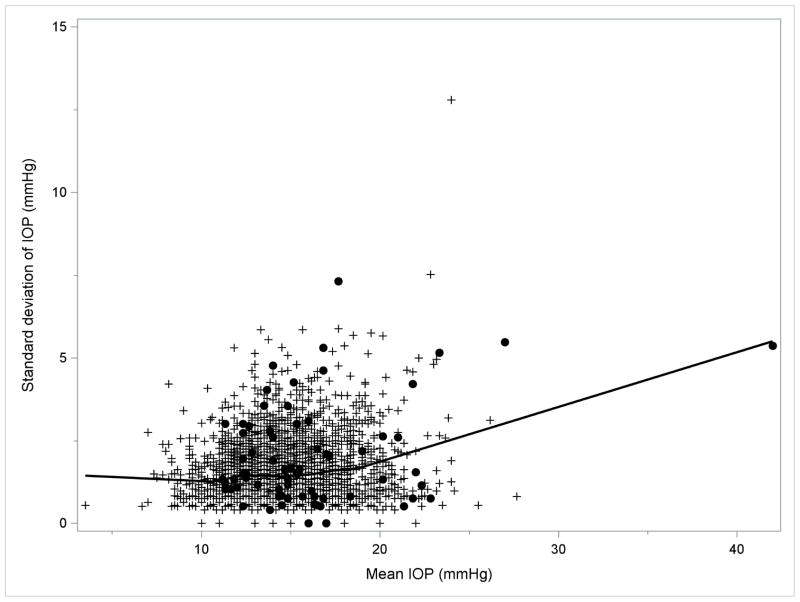
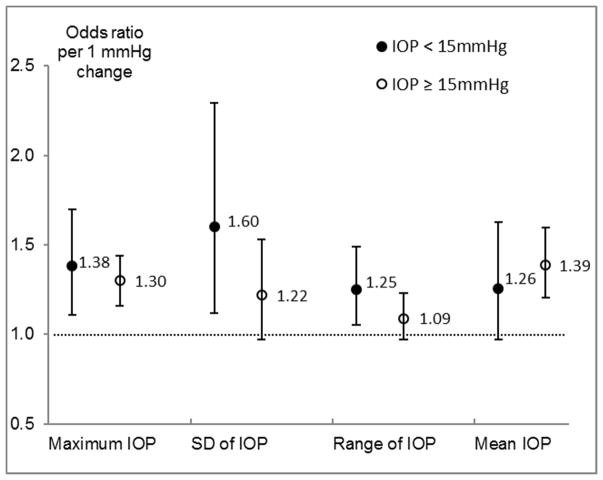
Maximum, SD, and range of IOP were all associated with risk of developing OAG, and SD and range of IOP remained significantly associated even after adjustment for mean IOP. Maximum IOP provided the best fit to the data and other IOP measures were not associated with OAG risk in the model that had included maximum IOP. The effect of IOP variation varied by the level of IOP. Among participants with higher IOPs (≥15 mm Hg), only higher levels of maximum IOP were associated with a higher OAG risk (P < .05), while SD and range of IOP were not associated with OAG risk. Among participants with lower IOPs (<15 mm Hg), higher levels of maximum, SD, and range of IOP were all associated with a higher risk of developing OAG (P < .05). Mean IOP was associated with OAG risk only in participants with higher IOPs and not in those with lower IOPs. Results were similar when participants were stratified as <18 and ≥18 mm Hg.
IOP variation was an independent risk factor for OAG. Maximum IOP was the most consistent IOP measure for predicting OAG risk across the entire spectrum of IOPs, possibly by capturing the effect of IOP variation among persons with relative lower IOPs as well as mean IOP effects in those with higher IOPs.
确定眼压(IOP)变化的测量值是否与开角型青光眼(OAG)的发病风险独立相关。
一项基于人群的纵向研究。
在洛杉矶拉丁裔眼研究的基线时,共有 3666 名无 OAG 的拉丁裔人接受了随访,随访时间为 4 年。从两次就诊中获得的 6 次读数中得出最大 IOP、IOP 的标准差(SD)、IOP 的范围和平均 IOP。每次就诊时的 OAG 诊断均基于专家的共识,这些专家可以访问该就诊时的所有临床检查数据。进行多变量逻辑回归。
最大 IOP、SD 和 IOP 范围均与发展为 OAG 的风险相关,并且即使在调整了平均 IOP 后,SD 和 IOP 范围仍然与 OAG 风险显著相关。最大 IOP 最能拟合数据,并且在包含最大 IOP 的模型中,其他 IOP 测量值与 OAG 风险无关。IOP 变化的影响因 IOP 水平而异。在较高 IOP(≥15mmHg)的参与者中,只有较高的最大 IOP 水平与较高的 OAG 风险相关(P<0.05),而 SD 和 IOP 范围与 OAG 风险无关。在较低 IOP(<15mmHg)的参与者中,较高的最大、SD 和 IOP 范围均与发展为 OAG 的风险增加相关(P<0.05)。仅在较高 IOP 的参与者中,平均 IOP 与 OAG 风险相关,而在较低 IOP 的参与者中则不相关。当参与者分层为<18 和≥18mmHg 时,结果相似。
IOP 变化是 OAG 的独立危险因素。最大 IOP 是预测整个 IOP 谱中 OAG 风险的最一致的 IOP 测量值,可能通过捕获相对较低 IOP 人群中 IOP 变化的影响以及较高 IOP 人群中平均 IOP 效应来实现。