Ralph M. Parsons Laboratory, Department of Civil and Environmental Engineering, Massachusetts Institute of Technology, 15 Vassar Street, Cambridge, USA.
Malar J. 2018 Jan 25;17(1):48. doi: 10.1186/s12936-018-2197-5.
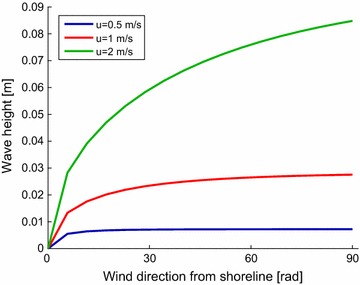
Wind conditions, as well as other environmental conditions, are likely to influence malaria transmission through the behaviours of Anopheles mosquitoes, especially around water-resource reservoirs. Wind-induced waves in a reservoir impose mortality on aquatic-stage mosquitoes. Mosquitoes' host-seeking activity is also influenced by wind through dispersion of [Formula: see text]. However, no malaria transmission model exists to date that simulated those impacts of wind mechanistically.
A modelling framework for simulating the three important effects of wind on the behaviours of mosquito is developed: attraction of adult mosquitoes through dispersion of [Formula: see text] ([Formula: see text] attraction), advection of adult mosquitoes (advection), and aquatic-stage mortality due to wind-induced surface waves (waves). The framework was incorporated in a mechanistic malaria transmission simulator, HYDREMATS. The performance of the extended simulator was compared with the observed population dynamics of the Anopheles mosquitoes at a village adjacent to the Koka Reservoir in Ethiopia.
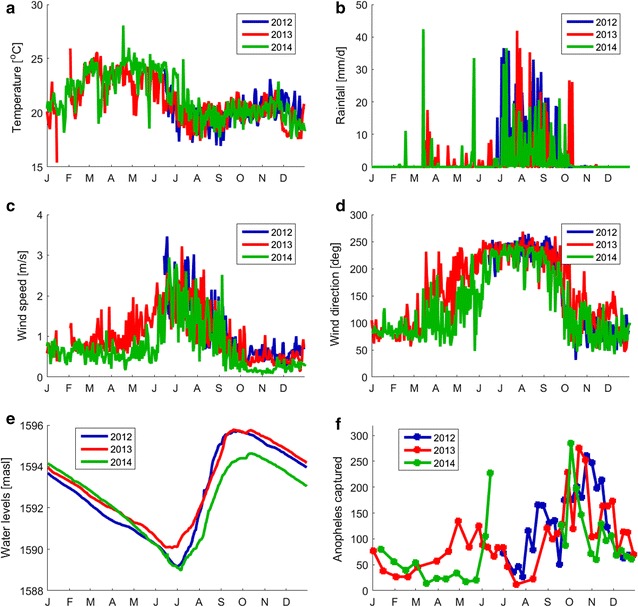
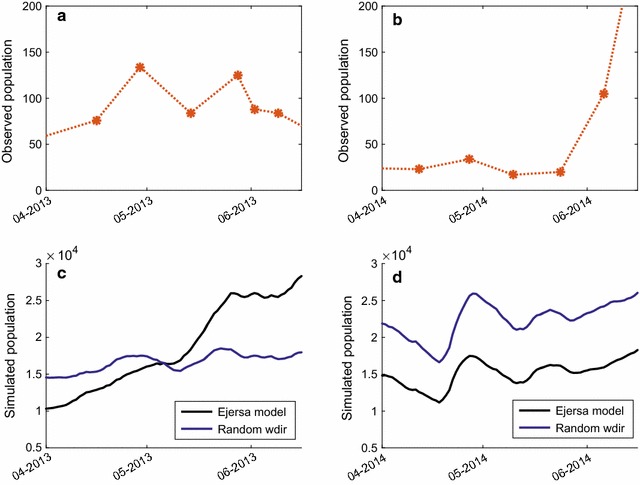
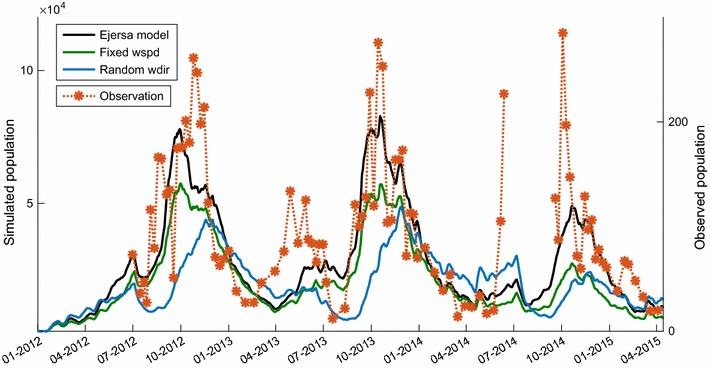
The observed population dynamics of the Anopheles mosquitoes were reproduced with some reasonable accuracy in HYDREMATS that includes the representation of the wind effects. HYDREMATS without the wind model failed to do so. Offshore wind explained the increase in Anopheles population that cannot be expected from other environmental conditions alone.
Around large water bodies such as reservoirs, the role of wind in the dynamics of Anopheles population, hence in malaria transmission, can be significant. Modelling the impacts of wind on the behaviours of Anopheles mosquitoes aids in reproducing the seasonality of malaria transmission and in estimation of the risk of malaria around reservoirs.
风况以及其他环境条件可能通过疟蚊的行为影响疟疾传播,尤其是在水源水库周围。水库中风引起的波浪会对水栖蚊造成死亡。风也会通过[Formula: see text]的扩散影响蚊子的宿主寻找活动。然而,迄今为止,还没有疟疾传播模型能够模拟这些风的影响。
开发了一个模拟风对蚊子行为的三个重要影响的建模框架:通过[Formula: see text]([Formula: see text]吸引)的扩散吸引成蚊、成蚊平流(平流)以及风引起的表面波导致的水栖期死亡(波浪)。该框架被纳入了一种机制性疟疾传播模拟器 HYDREMATS。扩展模拟器的性能与埃塞俄比亚科卡水库附近一个村庄的疟蚊种群动态的观测结果进行了比较。
在包含风效应表示的 HYDREMATS 中,以一定的合理性再现了观察到的疟蚊种群动态。而不包括风模型的 HYDREMATS 则无法做到这一点。离岸风解释了无法仅从其他环境条件预期的疟蚊种群增加。
在水库等大型水体周围,风在疟蚊种群动态中的作用,因此在疟疾传播中的作用可能非常重要。模拟风对疟蚊行为的影响有助于再现疟疾传播的季节性,并估计水库周围的疟疾风险。