Department of Epidemiology, Brown University, Providence, RI, USA.
Brown University School of Public Health, Box G-S121-3, Providence, RI, 02912, USA.
Environ Health. 2018 Mar 5;17(1):24. doi: 10.1186/s12940-018-0366-1.
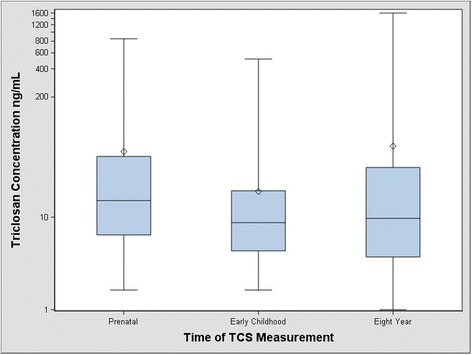
Triclosan is an antimicrobial agent that may affect the gut microbiome and endocrine system to influence adiposity. However, little data from prospective studies examining prenatal and childhood exposures exist. We investigated the relationship between multiple, prospective early life measure of triclosan exposure and child adiposity. METHODS: In a prospective cohort of 220 mother-child pairs from Cincinnati, OH (enrolled 2003-2006), we quantified triclosan in urine samples collected twice during pregnancy, annually from 1 to 5 years of age, and once at 8 years. We assessed child adiposity at age 8 years using body mass index (BMI), waist circumference, and bioelectric impedance. We estimated covariate-adjusted associations of child adiposity with a 10-fold increase in average prenatal, average early childhood (average of 1-5 years), and 8-year triclosan concentrations.
Among all children, there was no association between triclosan and child adiposity. While urinary triclosan concentrations at all three time periods were weakly, imprecisely, and inversely associated with all three measures of adiposity among girls, these associations did not differ significantly from those in boys (sex x triclosan p-values> 0.35). Among girls, the strongest associations were generally observed for prenatal triclosan when we adjusted for all three triclosan concentrations and covariates in the same model; BMI z-score (β: -0.13; 95% CI: -0.42, 0.15), waist circumference (β: - 1.7 cm; 95% CI: -4.2, 0.7), and percent body fat (β :-0.6; 95% CI: -2.7, 1.3). In contrast, the associations between triclosan concentrations and adiposity measures were inconsistent among boys.
We did not observe evidence of an association of repeated urinary triclosan concentrations during pregnancy and childhood with measures of child adiposity at age 8 years in this cohort.
三氯生是一种抗菌剂,可能会影响肠道微生物组和内分泌系统,从而影响肥胖。然而,目前很少有前瞻性研究检查产前和儿童时期的暴露情况。我们研究了多次前瞻性早期三氯生暴露测量值与儿童肥胖之间的关系。
在俄亥俄州辛辛那提的一项前瞻性队列研究中,我们对 220 对母婴进行了研究(2003-2006 年招募),在怀孕期间采集了两次尿液样本,在 1 至 5 岁时每年采集一次,在 8 岁时采集一次。我们在 8 岁时使用体重指数(BMI)、腰围和生物电阻抗来评估儿童肥胖情况。我们评估了 10 倍增加的产前、幼儿期(1-5 岁平均)和 8 岁时三氯生浓度与儿童肥胖的关系。
在所有儿童中,三氯生与儿童肥胖之间没有关联。虽然所有三个时间段的尿液三氯生浓度与所有三种肥胖指标之间呈弱、不精确和相反的关联,但这些关联在男孩和女孩之间没有显著差异(性别×三氯生 p 值>0.35)。在女孩中,当我们在同一模型中调整所有三种三氯生浓度和协变量时,通常观察到与产前三氯生最强的关联;BMI z 分数(β:-0.13;95%置信区间:-0.42,0.15),腰围(β:-1.7 厘米;95%置信区间:-4.2,0.7)和体脂百分比(β:-0.6;95%置信区间:-2.7,1.3)。相比之下,男孩中三氯生浓度与肥胖指标之间的关联不一致。
在本队列中,我们没有发现怀孕期间和儿童时期反复尿液三氯生浓度与 8 岁时儿童肥胖指标之间存在关联的证据。