Suchomel Petr, Kvitek Libor, Prucek Robert, Panacek Ales, Halder Avik, Vajda Stefan, Zboril Radek
Department of Physical Chemistry, Regional Centre of Advanced Technologies and Materials, Faculty of Science, Palacky University Olomouc, Slechtitelu 27, 783 71, Olomouc, Czech Republic.
Materials Science Division, Argonne National Laboratory, 9600 South Cass Avenue, Lemont, Illinois, 60439, USA.
Sci Rep. 2018 Mar 15;8(1):4589. doi: 10.1038/s41598-018-22976-5.
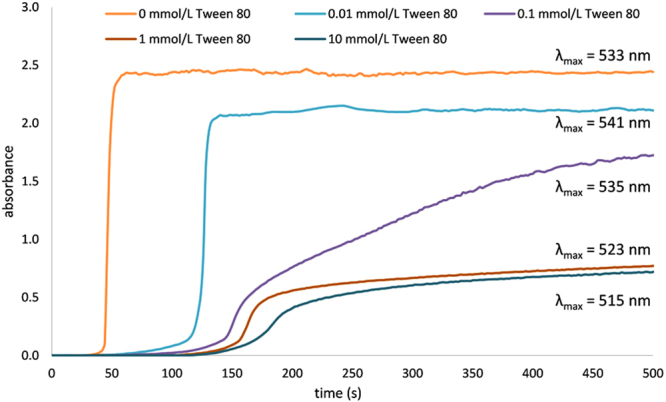
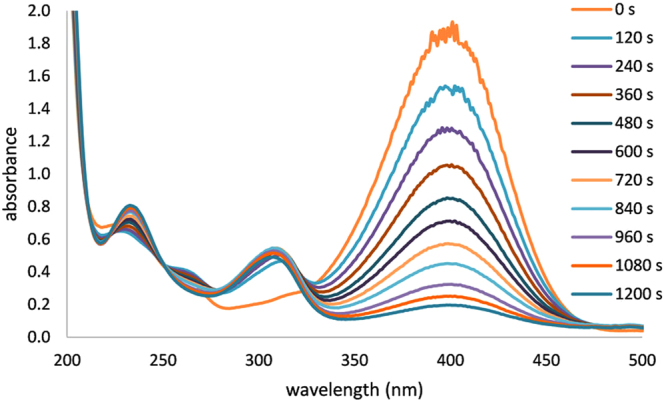
The controlled preparation of Au nanoparticles (NPs) in the size range of 6 to 22 nm is explored in this study. The Au NPs were prepared by the reduction of tetrachloroauric acid using maltose in the presence of nonionic surfactant Tween 80 at various concentrations to control the size of the resulting Au NPs. With increasing concentration of Tween 80 a decrease in the size of produced Au NPs was observed, along with a significant decrease in their size distribution. The size-dependent catalytic activity of the synthesized Au NPs was tested in the reduction of 4-nitrophenol with sodium borohydride, resulting in increasing catalytic activity with decreasing size of the prepared nanoparticles. Eley-Rideal catalytic mechanism emerges as the more probable, in contrary to the Langmuir-Hinshelwood mechanism reported for other noble metal nanocatalysts.
本研究探索了尺寸范围在6至22纳米的金纳米颗粒(NPs)的可控制备。通过在不同浓度的非离子表面活性剂吐温80存在下,用麦芽糖还原氯金酸来制备金纳米颗粒,以控制所得金纳米颗粒的尺寸。随着吐温80浓度的增加,观察到所制备的金纳米颗粒尺寸减小,同时其尺寸分布也显著降低。在硼氢化钠还原4-硝基苯酚的反应中测试了合成的金纳米颗粒的尺寸依赖性催化活性,结果表明所制备的纳米颗粒尺寸越小,催化活性越高。与报道的其他贵金属纳米催化剂的朗缪尔-欣谢尔伍德机制相反,埃利-里德机理似乎更有可能。