Department of Tissue Engineering, Nicolaus Copernicus University, Bydgoszcz, Poland.
Department of Obstetrics and Gynecology, Nicolaus Copernicus University, Bydgoszcz, Poland.
Med Sci Monit. 2018 Mar 24;24:1733-1741. doi: 10.12659/msm.905826.
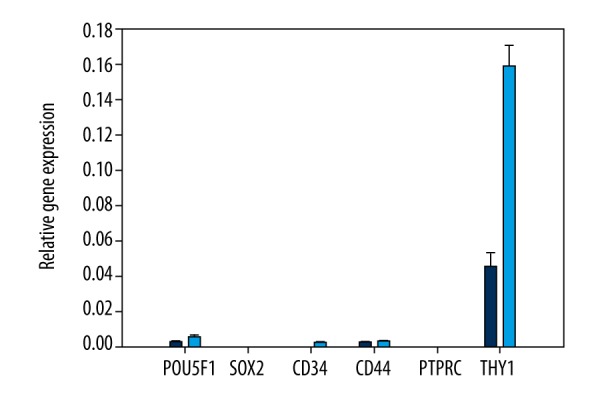
BACKGROUND Around the world, disabilities due to musculoskeletal disorders have increased and are a major health problem worldwide. In recent years, stem cells have been considered to be powerful tools for musculoskeletal tissue engineering. Human adipose-derived stem cells (hADSCs) and amniotic fluid-derived stem cells (hAFSCs) undergo typical differentiation process into cells of mesodermal origin and can be used to treat muscular system diseases. The aim of the present study was to compare the biological characteristic of stem cells isolated from different human tissues (adipose tissue and amniotic fluid) with respect to myogenic capacity and skeletal and smooth muscle differentiation under the same conditions. MATERIAL AND METHODS hAFSCs and hADSCs were isolated during standard medical procedures and widely characterized by specific markers expression and differentiation potential. Both cell types were induced toward smooth and striated muscles differentiation, which was assessed with the use of molecular techniques. RESULTS For phenotypic characterization, both stem cell types were assessed for the expression of OCT-4, SOX2, CD34, CD44, CD45, and CD90. Muscle-specific markers appeared in both stem cell types, but the proportion of positive cells showed differences depending on the experimental conditions used and the source from which the stem cells were isolated. CONCLUSIONS In this study, we demonstrated that hADSCs and hAFSCs have different capability of differentiation toward both muscle types. However, hADSCs seem to be a better source for myogenic protocols and can promote skeletal and smooth muscle regeneration through either direct muscle differentiation or by paracrine mechanism.
在全球范围内,由肌肉骨骼疾病引起的残疾有所增加,是一个全球性的主要健康问题。近年来,干细胞被认为是肌肉骨骼组织工程的有力工具。人脂肪来源的干细胞(hADSCs)和羊水来源的干细胞(hAFSCs)经历典型的向中胚层来源细胞的分化过程,可用于治疗肌肉系统疾病。本研究的目的是比较分离自不同人体组织(脂肪组织和羊水)的干细胞在相同条件下的成肌能力和骨骼及平滑肌分化的生物学特性。
在标准医疗程序中分离 hAFSCs 和 hADSCs,并通过特定标志物表达和分化潜能广泛表征。两种细胞类型均被诱导向平滑肌和横纹肌分化,并用分子技术评估。
为了进行表型特征分析,对两种干细胞类型的 OCT-4、SOX2、CD34、CD44、CD45 和 CD90 表达进行了评估。两种干细胞类型均出现了肌肉特异性标志物,但阳性细胞的比例因所用的实验条件和干细胞的来源而有所不同。
在这项研究中,我们证明 hADSCs 和 hAFSCs 向两种肌肉类型分化的能力不同。然而,hADSCs 似乎是更适合成肌方案的来源,通过直接的肌肉分化或旁分泌机制,可促进骨骼和平滑肌的再生。