CSIRO Agriculture & Food, St Lucia, QLD, Australia.
Livestock Systems and the Environment, International Livestock Research Institute (ILRI), Nairobi, Kenya.
Glob Chang Biol. 2018 Aug;24(8):3390-3400. doi: 10.1111/gcb.14158. Epub 2018 Apr 25.
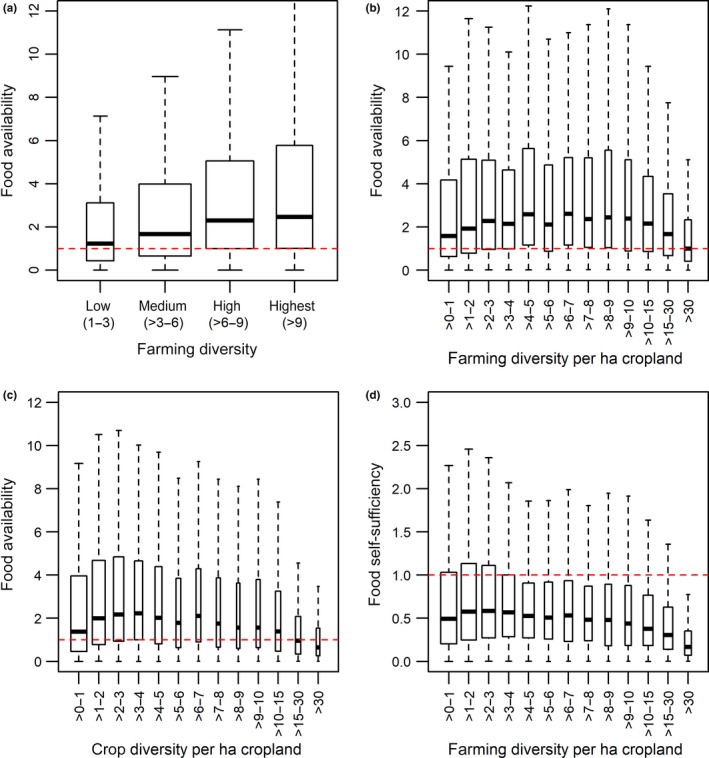
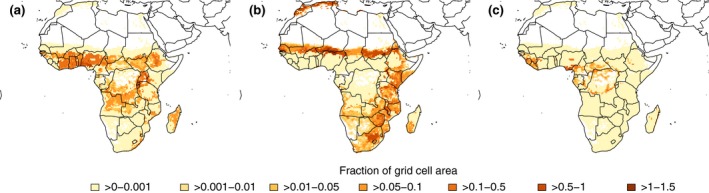
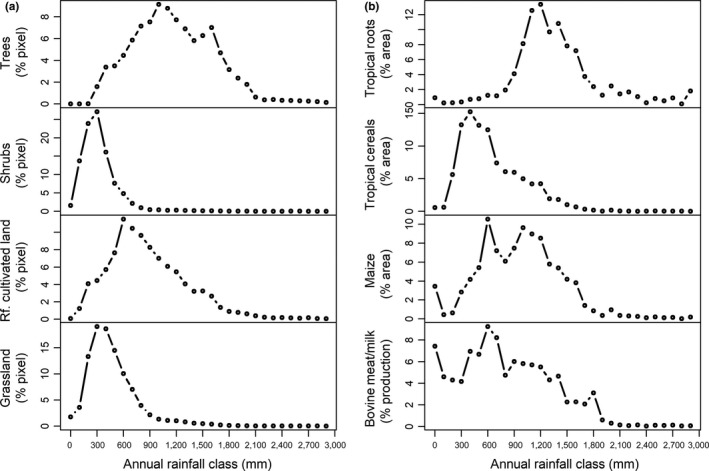
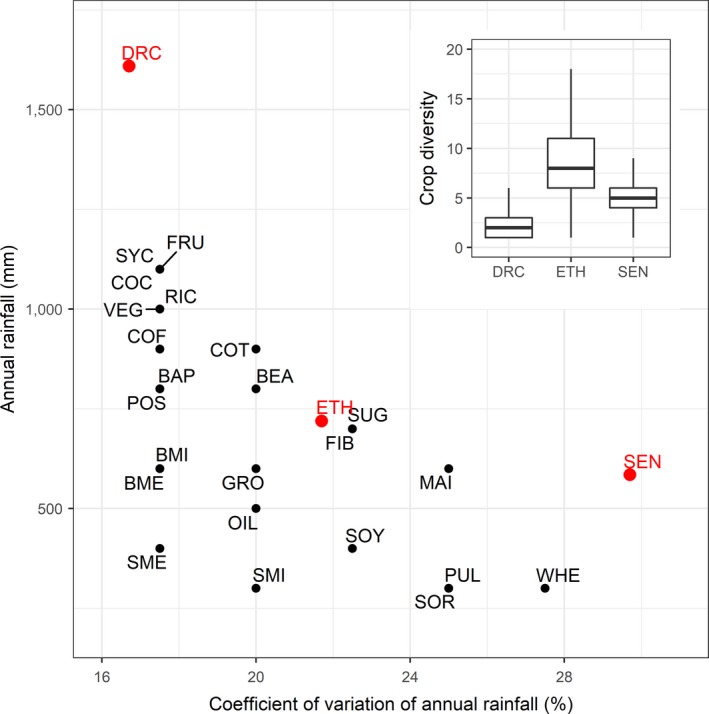
Farmers in Africa have long adapted to climatic and other risks by diversifying their farming activities. Using a multi-scale approach, we explore the relationship between farming diversity and food security and the diversification potential of African agriculture and its limits on the household and continental scale. On the household scale, we use agricultural surveys from more than 28,000 households located in 18 African countries. In a next step, we use the relationship between rainfall, rainfall variability, and farming diversity to determine the available diversification options for farmers on the continental scale. On the household scale, we show that households with greater farming diversity are more successful in meeting their consumption needs, but only up to a certain level of diversity per ha cropland and more often if food can be purchased from off-farm income or income from farm sales. More diverse farming systems can contribute to household food security; however, the relationship is influenced by other factors, for example, the market orientation of a household, livestock ownership, nonagricultural employment opportunities, and available land resources. On the continental scale, the greatest opportunities for diversification of food crops, cash crops, and livestock are located in areas with 500-1,000 mm annual rainfall and 17%-22% rainfall variability. Forty-three percent of the African cropland lacks these opportunities at present which may hamper the ability of agricultural systems to respond to climate change. While sustainable intensification practices that increase yields have received most attention to date, our study suggests that a shift in the research and policy paradigm toward agricultural diversification options may be necessary.
非洲的农民长期以来通过多样化农业活动来适应气候和其他风险。我们采用多尺度方法,探讨了农业多样化与粮食安全之间的关系,以及非洲农业的多样化潜力及其在家庭和大陆尺度上的限制。在家庭尺度上,我们使用了来自 18 个非洲国家的 28000 多个家庭的农业调查数据。在下一步中,我们利用降雨量、降雨量变化与农业多样化之间的关系,确定了在大陆尺度上农民可利用的多样化选择。在家庭尺度上,我们发现农业多样化程度更高的家庭在满足消费需求方面更为成功,但这种关系仅在一定程度上成立,即每公顷耕地的多样性达到一定程度,并且如果可以从农场外收入或农场销售中获得食物,这种关系就更有可能成立。更多样化的农业系统可以为家庭粮食安全做出贡献;但是,这种关系受到其他因素的影响,例如家庭的市场定位、牲畜所有权、非农业就业机会和可用土地资源。在大陆尺度上,粮食作物、经济作物和牲畜多样化的最大机会位于年降雨量为 500-1000 毫米且降雨量变化为 17%-22%的地区。目前,43%的非洲耕地缺乏这些机会,这可能会阻碍农业系统应对气候变化的能力。虽然提高产量的可持续集约化实践迄今为止受到了最多的关注,但我们的研究表明,可能需要将研究和政策范式从农业多样化选择转移。