Department of Biological Sciences, National University of Singapore, 14 Science Drive 4, Singapore 117543, Singapore; Department of Biology, Stanford University, Stanford, CA 94305, USA.
Department of Biological Sciences, National University of Singapore, 14 Science Drive 4, Singapore 117543, Singapore.
Curr Biol. 2018 Apr 23;28(8):1273-1280.e3. doi: 10.1016/j.cub.2018.02.054. Epub 2018 Apr 5.
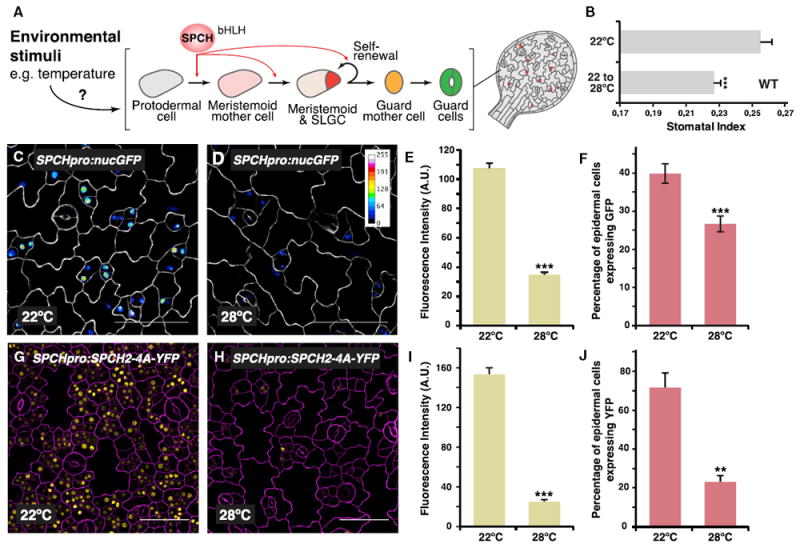
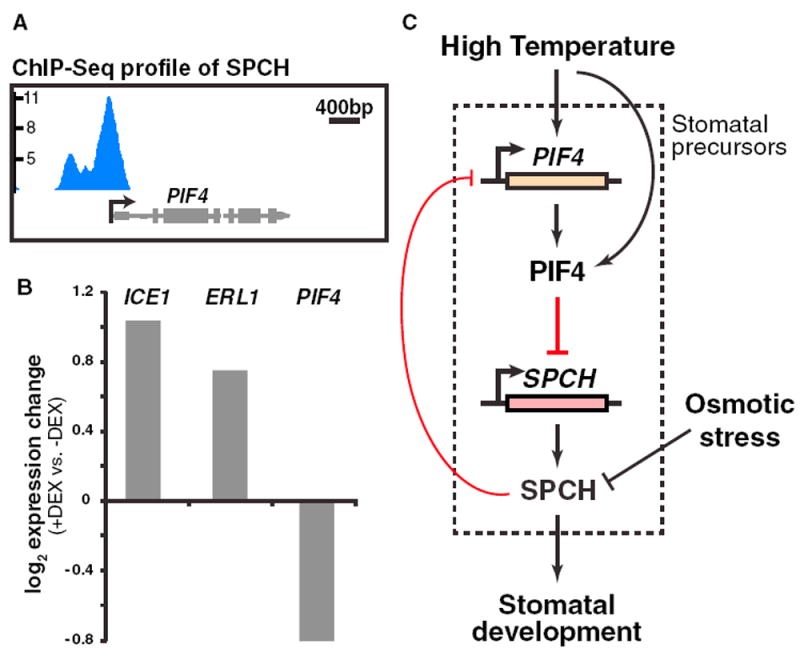
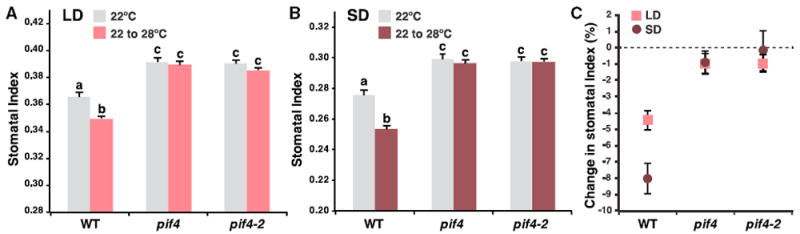
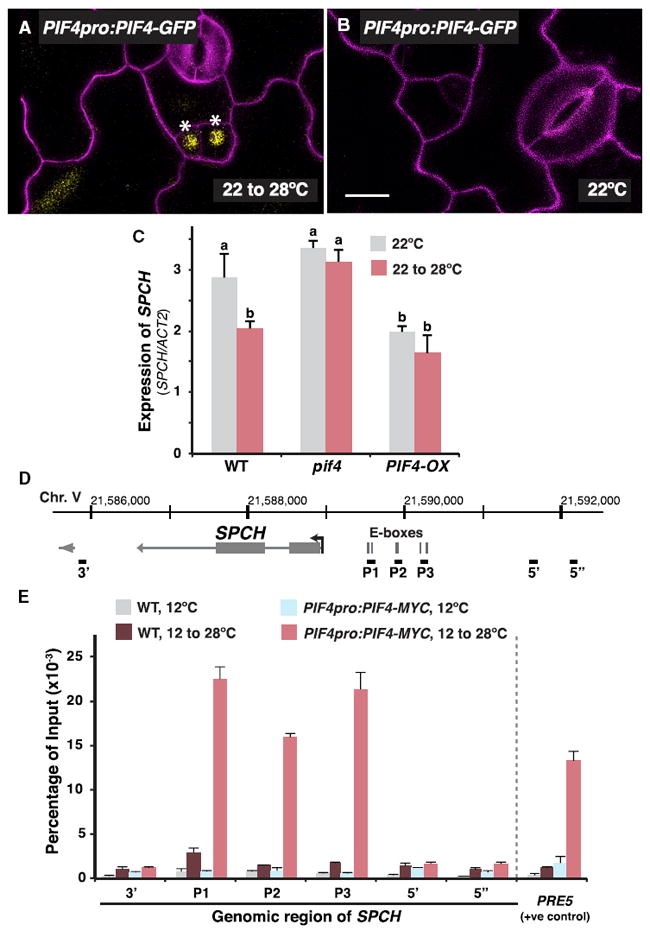
Environmental factors shape the phenotypes of multicellular organisms. The production of stomata-the epidermal pores required for gas exchange in plants-is highly plastic and provides a powerful platform to address environmental influence on cell differentiation [1-3]. Rising temperatures are already impacting plant growth, a trend expected to worsen in the near future [4]. High temperature inhibits stomatal production, but the underlying mechanism is not known [5]. Here, we show that elevated temperature suppresses the expression of SPEECHLESS (SPCH), the basic-helix-loop-helix (bHLH) transcription factor that serves as the master regulator of stomatal lineage initiation [6, 7]. Our genetic and expression analyses indicate that the suppression of SPCH and stomatal production is mediated by the bHLH transcription factor PHYTOCHROME-INTERACTING FACTOR 4 (PIF4), a core component of high-temperature signaling [8]. Importantly, we demonstrate that, upon exposure to high temperature, PIF4 accumulates in the stomatal precursors and binds to the promoter of SPCH. In addition, we find SPCH feeds back negatively to the PIF4 gene. We propose a model where warm-temperature-activated PIF4 binds and represses SPCH expression to restrict stomatal production at elevated temperatures. Our work identifies a molecular link connecting high-temperature signaling and stomatal development and reveals a direct mechanism by which production of a specific cell lineage can be controlled by a broadly expressed environmental signaling factor.
环境因素塑造多细胞生物的表型。气孔的产生——植物进行气体交换所需的表皮孔——具有高度的可塑性,为研究环境对细胞分化的影响提供了有力的平台[1-3]。气温升高已经在影响植物的生长,这种趋势预计在不久的将来会恶化[4]。高温会抑制气孔的产生,但其中的机制尚不清楚[5]。在这里,我们表明,高温会抑制 SPEECHLESS(SPCH)的表达,SPCH 是作为气孔谱系起始的主调控因子的碱性螺旋-环-螺旋(bHLH)转录因子[6,7]。我们的遗传和表达分析表明,SPCH 和气孔产生的抑制是由 bHLH 转录因子 PHYTOCHROME-INTERACTING FACTOR 4(PIF4)介导的,PIF4 是高温信号的核心组成部分[8]。重要的是,我们证明,在暴露于高温下时,PIF4 会在气孔前体中积累并与 SPCH 的启动子结合。此外,我们发现 SPCH 会对 PIF4 基因产生负反馈。我们提出了一个模型,即温暖温度激活的 PIF4 结合并抑制 SPCH 的表达,以限制在高温下的气孔产生。我们的工作确定了连接高温信号和气孔发育的分子联系,并揭示了一种直接的机制,即通过广泛表达的环境信号因子来控制特定细胞谱系的产生。