Ecole des Hautes Etudes en Sciences Sociales, 54 Boulevard Raspail, 75006, Paris, France.
Substance Abuse and Dependence Research Center, University of Social Welfare and Rehabilitation Sciences, Tehran, Iran; Department of Social Work, University of Social Welfare and Rehabilitation Sciences, Tehran, Iran.
Int J Drug Policy. 2018 Jun;56:121-127. doi: 10.1016/j.drugpo.2018.03.009. Epub 2018 Apr 9.
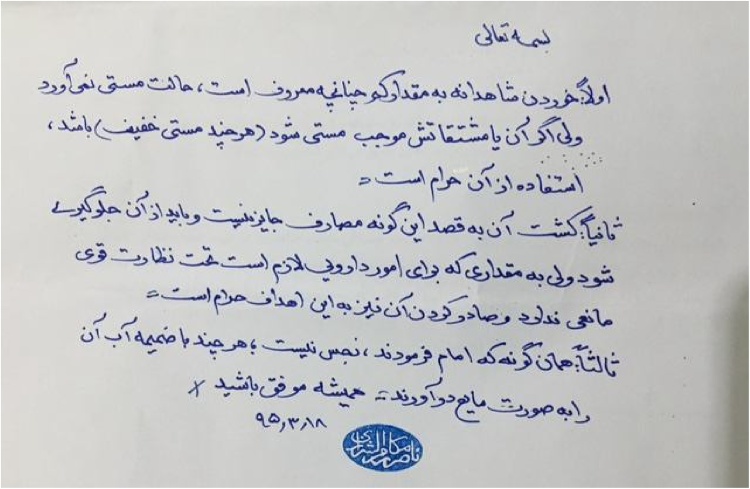
Iran is currently discussing cannabis and opium regulations, which could bring a legalisation of drug consumption through a state supervised system. The article engages with the question of cannabis by looking at the legal interpretation of religious authorities in the Islamic Republic of Iran. The choice of Iran is justified for several reasons: firstly, Iran has a long history of drug use and cannabis has been part of the country's intoxicant traditions since times immemorial; secondly, the Iranian state is unique in that it combines religious exegesis with political machination through official channels; finally, among all Middle East and Islamic countries, Iran is at the avant-garde in experimenting in the field of drugs policy which makes an excellent case for the study of cannabis regulation. The article is the result of a direct engagement with Iran's leading Shi'a authorities, the maraje'-e taqlid, 'source of emulation'. The authors redacted a list of eight questions (estefta'at) about the status of cannabis in Iranian society. It questioned cannabis' legality in Islam, its potential medical use, the feasibility of domestic production and other relevant aspects of its social-religious life. Based on the responses, the authors analysed the difference in opinions among the religious scholars and speculate on the possibility of policy reform. Given the dearth of scholarly work about illicit drugs in the Islamic world, about which many readers might not be familiar, the article opens with an overview of the place of cannabis in the history of Islamic societies. It discusses terminological ambiguities, references in religious texts and traditions, and the general interpretations within Muslim religious schools of thought. Then, it discusses the status of cannabis in contemporary Iran before tackling the responses provided by the religious scholars. Eventually, the paper puts forward reflections about the potential implications for future policy developments on cannabis.
伊朗目前正在讨论大麻和鸦片法规,这可能通过国家监管系统使毒品消费合法化。本文通过审视伊朗伊斯兰共和国宗教当局对大麻的法律解释来探讨大麻问题。选择伊朗有几个原因:首先,伊朗有着悠久的吸毒历史,大麻自古以来一直是该国致幻传统的一部分;其次,伊朗国家是独一无二的,它通过官方渠道将宗教注释与政治策略结合在一起;最后,在所有中东和伊斯兰国家中,伊朗在毒品政策领域的实验处于前沿地位,这为研究大麻法规提供了一个极好的案例。本文是与伊朗主要什叶派当局——马雷杰·塔利德(maraje'-e taqlid,“效仿之源”)直接接触的结果。作者拟定了关于大麻在伊朗社会地位的八个问题(estefta'at)清单。这些问题涉及大麻在伊斯兰教中的合法性、潜在的药用价值、国内生产的可行性以及其社会宗教生活的其他相关方面。基于这些答复,作者分析了宗教学者之间的意见分歧,并推测政策改革的可能性。鉴于伊斯兰世界关于非法毒品的学术著作匮乏,许多读者可能对此不熟悉,因此本文首先概述了大麻在伊斯兰社会历史中的地位。本文讨论了术语上的歧义、宗教文本和传统中的参考以及穆斯林宗教思想流派中的一般解释。然后,本文讨论了当代伊朗大麻的地位,然后再探讨宗教学者提供的答复。最终,本文就大麻未来政策发展的潜在影响提出了一些思考。