Jalem Randy, Kanamori Kenta, Takeuchi Ichiro, Nakayama Masanobu, Yamasaki Hisatsugu, Saito Toshiya
Japan Science and Technology Agency (JST), PRESTO, 4-1-8 Honcho Kawaguchi, Saitama, 332-0012, Japan.
National Institute for Materials Science - Global Research Center for Environment and Energy based on Nanomaterials Science (NIMS-GREEN), 1-1 Namiki, Tsukuba, 305-0044, Ibaraki, Japan.
Sci Rep. 2018 Apr 11;8(1):5845. doi: 10.1038/s41598-018-23852-y.
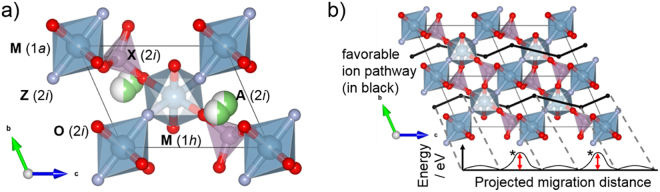
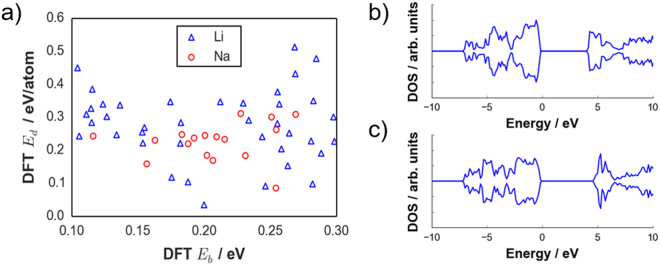
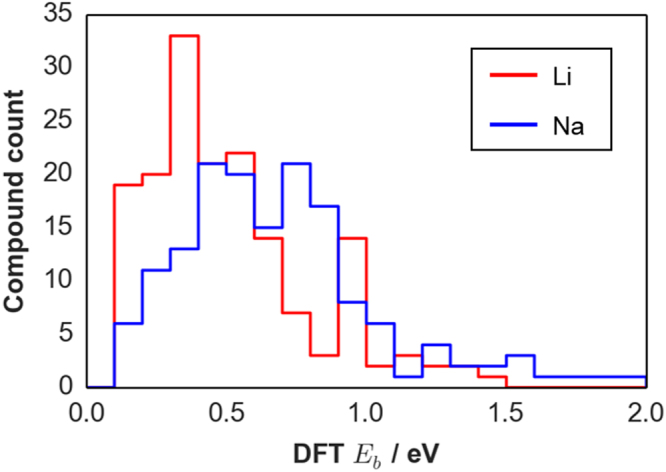
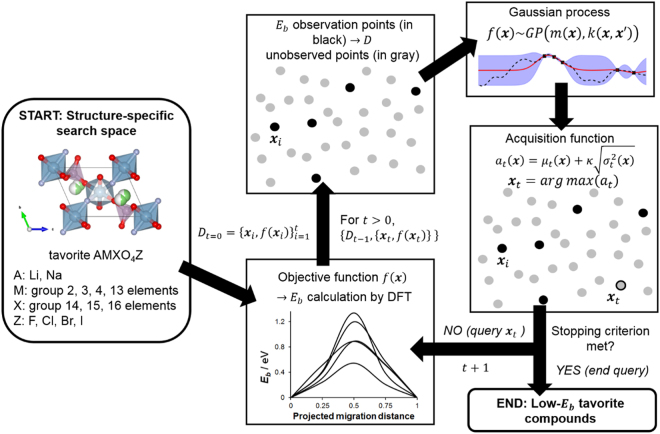
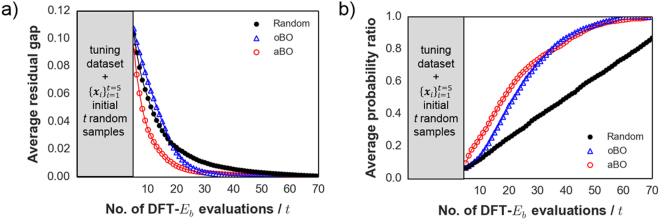
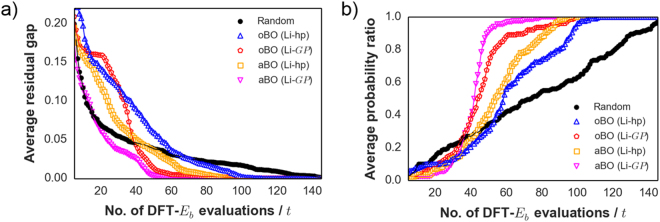
Safe and robust batteries are urgently requested today for power sources of electric vehicles. Thus, a growing interest has been noted for fabricating those with solid electrolytes. Materials search by density functional theory (DFT) methods offers great promise for finding new solid electrolytes but the evaluation is known to be computationally expensive, particularly on ion migration property. In this work, we proposed a Bayesian-optimization-driven DFT-based approach to efficiently screen for compounds with low ion migration energies ([Formula: see text]. We demonstrated this on 318 tavorite-type Li- and Na-containing compounds. We found that the scheme only requires ~30% of the total DFT-[Formula: see text] evaluations on the average to recover the optimal compound ~90% of the time. Its recovery performance for desired compounds in the tavorite search space is ~2× more than random search (i.e., for [Formula: see text] < 0.3 eV). Our approach offers a promising way for addressing computational bottlenecks in large-scale material screening for fast ionic conductors.
如今,电动汽车的电源迫切需要安全且耐用的电池。因此,人们对制造具有固体电解质的电池越来越感兴趣。通过密度泛函理论(DFT)方法进行材料搜索为寻找新型固体电解质提供了巨大的前景,但已知这种评估在计算上成本高昂,尤其是在离子迁移特性方面。在这项工作中,我们提出了一种基于贝叶斯优化驱动的DFT方法,以有效地筛选出具有低离子迁移能([公式:见原文])的化合物。我们在318种钛铁矿型含锂和钠的化合物上进行了验证。我们发现,该方案平均仅需约30%的总DFT-[公式:见原文]评估次数,就能在约90%的时间内找到最优化合物。在钛铁矿搜索空间中,其对所需化合物的恢复性能比随机搜索高出约2倍(即对于[公式:见原文]<0.3 eV)。我们的方法为解决快速离子导体大规模材料筛选中的计算瓶颈提供了一条有前景的途径。