Tovar Miguel, Weber Thomas, Hengoju Sundar, Lovera Andrea, Munser Anne-Sophie, Shvydkiv Oksana, Roth Martin
FEMTOprint SA, Via Industria 3, 6933 Muzzano, Switzerland.
Fraunhofer Institute for Applied Optics and Precision Engineering-IOF, Albert-Einstein-Str. 7, 07745 Jena, Germany.
Biomicrofluidics. 2018 Apr 3;12(2):024115. doi: 10.1063/1.5013325. eCollection 2018 Mar.
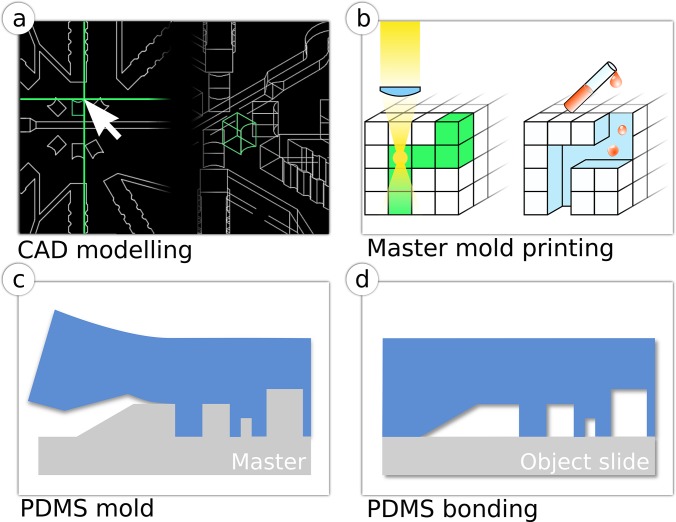
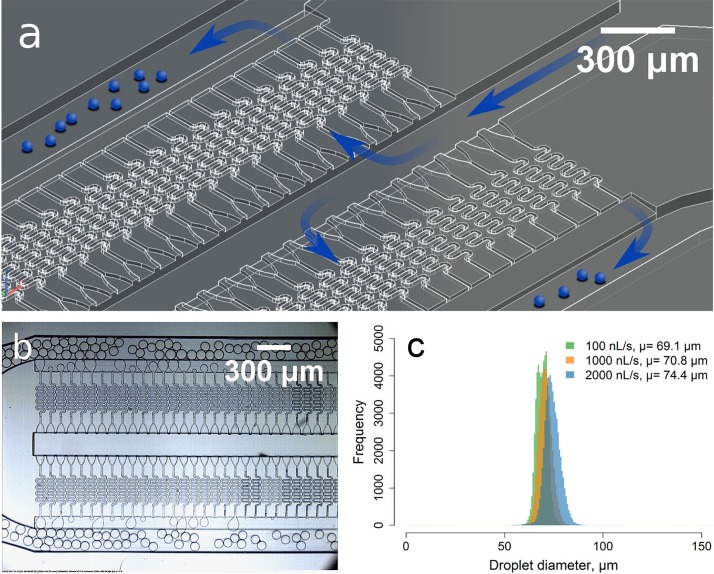
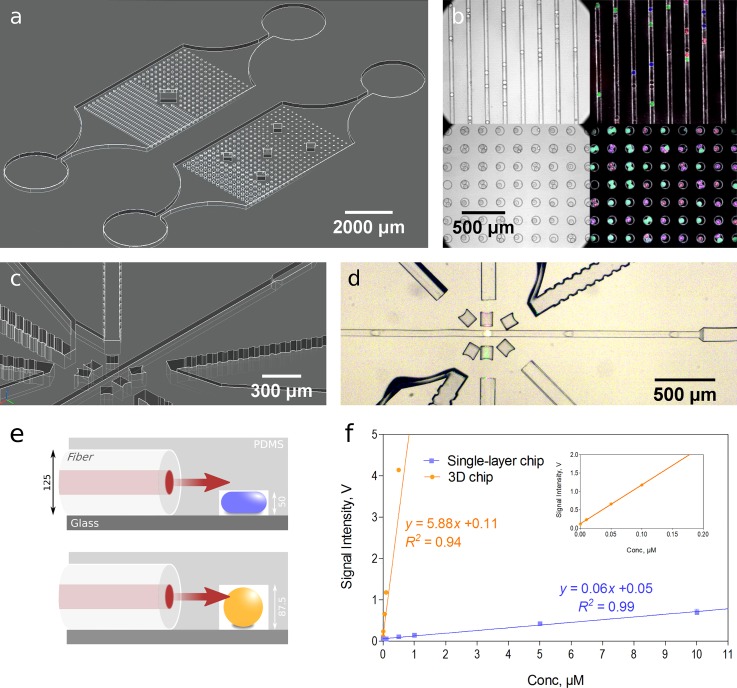
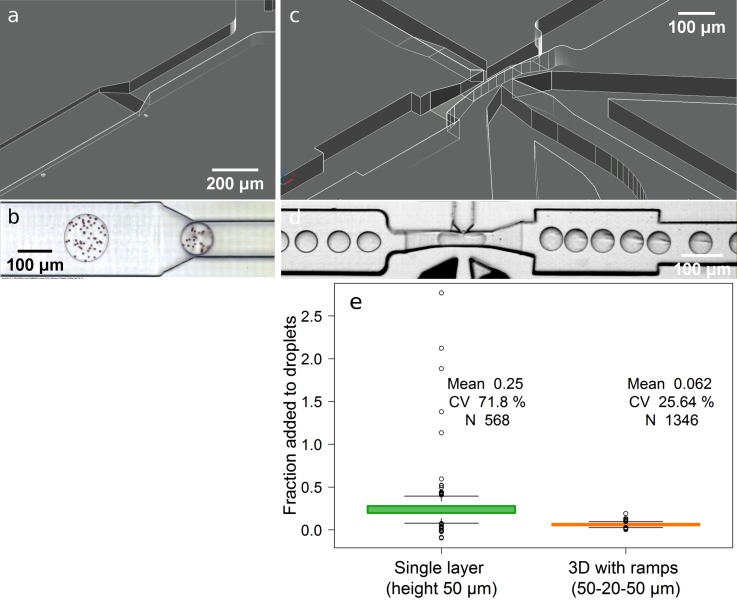
In order to leverage the immense potential of droplet microfluidics, it is necessary to simplify the process of chip design and fabrication. While polydimethylsiloxane (PDMS) replica molding has greatly revolutionized the chip-production process, its dependence on 2D-limited photolithography has restricted the design possibilities, as well as further dissemination of microfluidics to non-specialized labs. To break free from these restrictions while keeping fabrication straighforward, we introduce an approach to produce complex multi-height (3D) droplet microfluidic glass molds and subsequent chip production by PDMS replica molding. The glass molds are fabricated with sub-micrometric resolution using femtosecond laser machining technology, which allows directly realizing designs with multiple levels or even continuously changing heights. The presented technique significantly expands the experimental capabilities of the droplet microfluidic chip. It allows direct fabrication of multilevel structures such as droplet traps for prolonged observation and optical fiber integration for fluorescence detection. Furthermore, the fabrication of novel structures based on sloped channels (ramps) enables improved droplet reinjection and picoinjection or even a multi-parallelized drop generator based on gradients of confinement. The fabrication of these and other 3D-features is currently only available at such resolution by the presented strategy. Together with the simplicity of PDMS replica molding, this provides an accessible solution for both specialized and non-specialized labs to customize microfluidic experimentation and expand their possibilities.
为了充分利用液滴微流控技术的巨大潜力,简化芯片设计和制造过程很有必要。虽然聚二甲基硅氧烷(PDMS)复制模塑极大地革新了芯片生产工艺,但其对二维受限光刻技术的依赖限制了设计可能性,也阻碍了微流控技术向非专业实验室的进一步推广。为了在保持制造简单的同时摆脱这些限制,我们引入了一种方法来生产复杂的多高度(三维)液滴微流控玻璃模具,并通过PDMS复制模塑进行后续芯片生产。玻璃模具采用飞秒激光加工技术以亚微米分辨率制造,这使得能够直接实现具有多个层次甚至高度连续变化的设计。所提出的技术显著扩展了液滴微流控芯片的实验能力。它允许直接制造多级结构,如用于长时间观察的液滴捕获器以及用于荧光检测的光纤集成。此外,基于倾斜通道(斜坡)的新型结构的制造能够改进液滴再注入和皮升注射,甚至基于限制梯度的多并行液滴发生器。目前,只有通过所提出的策略才能以这种分辨率制造这些及其他三维特征。结合PDMS复制模塑的简单性,这为专业和非专业实验室定制微流控实验并扩展其可能性提供了一种可行的解决方案。