Department of Chemical and Biomolecular Engineering, University of California Berkeley, Berkeley, CA 94720, USA; These authors contributed equally to this work.
Department of Chemical and Biomolecular Engineering, University of California Berkeley, Berkeley, CA 94720, USA.
Trends Biotechnol. 2018 Sep;36(9):882-897. doi: 10.1016/j.tibtech.2018.03.009. Epub 2018 Apr 24.
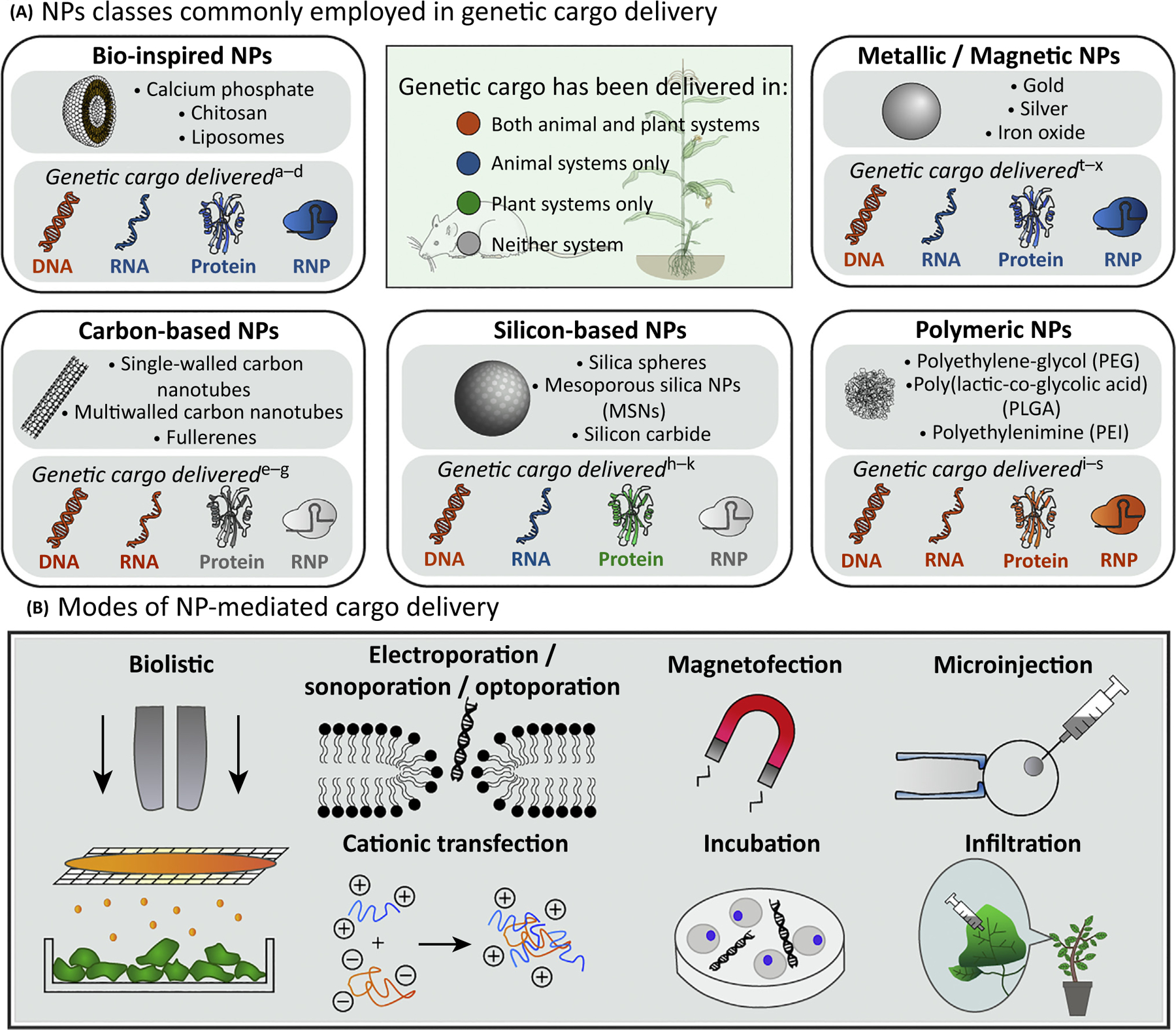
Genetic engineering of plants has enhanced crop productivity in the face of climate change and a growing global population by conferring desirable genetic traits to agricultural crops. Efficient genetic transformation in plants remains a challenge due to the cell wall, a barrier to exogenous biomolecule delivery. Conventional delivery methods are inefficient, damaging to tissue, or are only effective in a limited number of plant species. Nanoparticles are promising materials for biomolecule delivery, owing to their ability to traverse plant cell walls without external force and highly tunable physicochemical properties for diverse cargo conjugation and broad host range applicability. With the advent of engineered nuclease biotechnologies, we discuss the potential of nanoparticles as an optimal platform to deliver biomolecules to plants for genetic engineering.
通过赋予农业作物理想的遗传特性,植物的基因工程在应对气候变化和全球人口增长方面提高了作物的生产力。由于细胞壁是外源生物分子传递的障碍,因此植物的高效遗传转化仍然是一个挑战。传统的传递方法效率低下,对组织有损伤,或者只在有限数量的植物物种中有效。由于纳米颗粒具有在没有外力的情况下穿透植物细胞壁的能力,以及用于不同货物连接和广泛宿主范围适用性的高度可调物理化学性质,因此它们是生物分子传递的有前途的材料。随着工程核酸酶生物技术的出现,我们讨论了纳米颗粒作为将生物分子递送到植物中进行遗传工程的理想平台的潜力。