Department of Neurology, Medical University of Vienna, Währingergürtel 18-20, 1090, Vienna, Austria.
Department of Psychiatry and Psychotherapy Division of Social Psychiatry, University of Vienna, Vienna, Austria.
BMC Psychiatry. 2018 May 23;18(1):143. doi: 10.1186/s12888-018-1719-6.
The influence of personality on health-related quality of life in patients with multiple sclerosis has been the focus of previous studies showing that introversion and neuroticism were related with reduced health related quality of life. However, no data exist on the impact of temperament on quality of life in this patient group.
Between April 2014 and March 2016 139 multiple sclerosis patients were recruited from a specialized outpatient clinic of the general hospital of Vienna. Health-related quality of life was measured by "The Multiple Sclerosis International Quality of Life Questionnaire (MusiQol)", temperament by "Temperament Evaluation of Memphis, Pisa, Paris, and San Diego Questionnaire - Münster version" (briefTEMPS-M), and disability by the "Expanded disability status scale". All patients underwent a diagnostic psychiatric semi-structured interview (MINI).
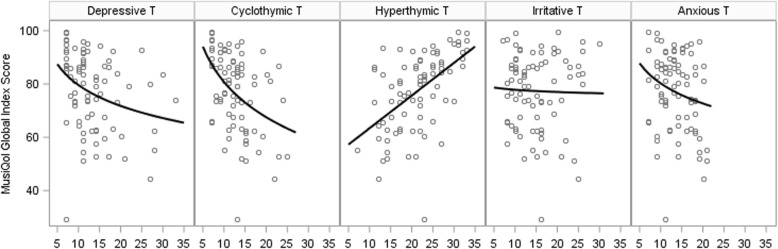
Known predictors (like disease duration, EDSS, psychiatric co-morbidities, immunomodulatory treatments) explain the proportion of variation in the outcome of MusiQol global index score in 30.9% in multi-variable linear regression analysis. It increased respectively to 40.3, 42.5, and 45.8% if adding the depressive, cyclothymic, or hyperthymic temperament to the list of variables. An increase of depressive and cyclothymic temperament scores significantly reduced global index score of MusiQol (p = 0.005, p = 0.002, respectively), while the hyperthymic temperament significantly raised it (p < 0.001).
In MS patients, the depressive and cyclothymic temperament predict a lower and hyperthymic temperament an increased health-related quality of life, independent of current disability status, immunomodulatory treatments, and affective co-morbidities.
个性对多发性硬化症患者健康相关生活质量的影响一直是之前研究的焦点,研究表明内向和神经质与健康相关生活质量下降有关。然而,目前尚无关于该患者群体中气质对生活质量影响的数据。
2014 年 4 月至 2016 年 3 月,从维也纳综合医院的专门门诊招募了 139 名多发性硬化症患者。健康相关生活质量采用“多发性硬化症国际生活质量问卷(MusiQol)”进行评估,气质采用“孟菲斯、比萨、巴黎和圣地亚哥问卷-明斯特版(briefTEMPS-M)”进行评估,残疾程度采用“扩展残疾状态量表(EDSS)”进行评估。所有患者均接受了诊断性精神科半结构式访谈(MINI)。
在多变量线性回归分析中,已知的预测因素(如疾病持续时间、EDSS、精神共病、免疫调节治疗)解释了 MusiQol 全球指数评分结果的 30.9%变化比例。如果将抑郁、环性或高活力气质添加到变量列表中,分别增加到 40.3%、42.5%和 45.8%。抑郁和环性气质评分的增加显著降低了 MusiQol 的全球指数评分(p=0.005,p=0.002),而高活力气质则显著升高了它(p<0.001)。
在多发性硬化症患者中,抑郁和环性气质预测健康相关生活质量较低,而高活力气质则预测健康相关生活质量较高,独立于当前残疾状况、免疫调节治疗和情感共病。