Geriatric Division, Department of Internal Medicine, Faculty of Medicine, Cipto Mangunkusumo Hospital, Universitas Indonesia, Jakarta, Indonesia.
Indonesia Hydration Working Group (IHWG), Faculty of Medicine, Universitas Indonesia, Jakarta, Indonesia.
Eur J Nutr. 2018 Jun;57(Suppl 3):89-100. doi: 10.1007/s00394-018-1740-z. Epub 2018 Jun 13.
To report daily total fluid intake (TFI) and fluid types in Indonesia according to age, sex, socio-economic status (SES) and geographic region, and compare TFI with the Indonesian adequate fluid intake (AI) recommendations.
Data were collected in 32 cities over nine regions from children (4-9 years, n = 388), adolescents, (10-17 years, n = 478) and adults (18-65 years, n = 2778) using a fluid intake 7-day record (Liq.In); socio-economic status was also recorded. The 7-day mean TFIs were compared with the AI of water set by the Ministry of Health of the Republic of Indonesia.
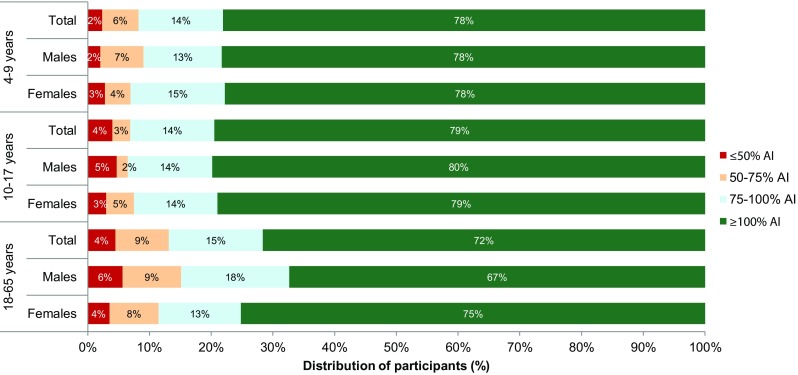
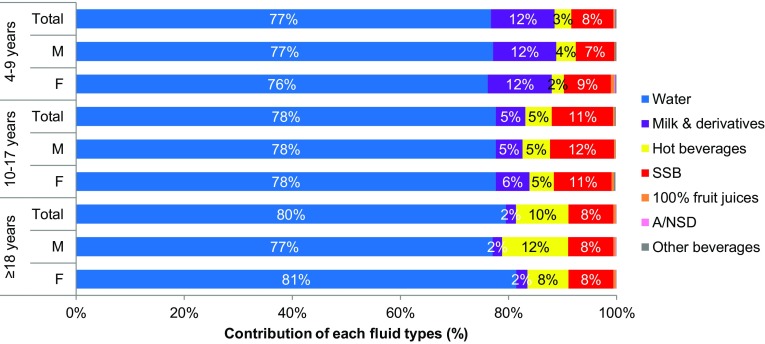
Total median fluid intakes for all age groups exceeded 2000 mL/day. At population level, TFI was associated with household income (P < 0.001), education (P < 0.001) and Indonesian geographical regions (P < 0.001). More than 67% of participants met the AI of water from fluids. A higher percentage of children and adolescents met the AI (78 and 80%, respectively), compared with adults (72%). Drinking water was the main contributor to TFI in all age groups (76-81%). Sugar-sweetened beverages (SSB) were consumed by 62% children, 72% adolescents and 61% of adults. An SSB intake ≥ 1 serving per day was observed for 24% children, 41% adolescents and 33% adults.
A high percentage of the population drank enough to meet the AI of water from fluids. Water was the most frequently consumed drink; however, many participants consumed at least one serving of SSB per day. This study provides data to help direct targeted intervention programs.
根据年龄、性别、社会经济地位(SES)和地理位置报告印度尼西亚的每日总液体摄入量(TFI)和液体类型,并将 TFI 与印度尼西亚充足液体摄入量(AI)建议进行比较。
使用液体摄入 7 天记录(Liq.In)在九个地区的 32 个城市收集了 4-9 岁儿童(n=388)、青少年(10-17 岁,n=478)和成年人(18-65 岁,n=2778)的数据;还记录了社会经济地位。将 7 天平均 TFI 与印度尼西亚卫生部设定的水 AI 进行比较。
所有年龄段的总中位数液体摄入量均超过 2000 毫升/天。在人群水平上,TFI 与家庭收入(P<0.001)、教育程度(P<0.001)和印度尼西亚地理位置(P<0.001)相关。超过 67%的参与者符合水 AI。与成年人(72%)相比,儿童和青少年符合 AI 的比例更高(分别为 78%和 80%)。在所有年龄段,饮用水均为 TFI 的主要来源(76-81%)。含糖饮料(SSB)在儿童中占 62%,在青少年中占 72%,在成年人中占 61%。观察到 24%的儿童、41%的青少年和 33%的成年人每天至少摄入一份 SSB。这项研究提供了数据,有助于指导有针对性的干预计划。
很大一部分人口的饮水量足以满足 AI 中液体的水摄入量。水是最常饮用的饮料;然而,许多参与者每天至少饮用一份 SSB。这项研究提供了数据,有助于指导有针对性的干预计划。