Belamkar Vikas, Guttieri Mary J, Hussain Waseem, Jarquín Diego, El-Basyoni Ibrahim, Poland Jesse, Lorenz Aaron J, Baenziger P Stephen
Department of Agronomy and Horticulture, University of Nebraska-Lincoln, Lincoln, NE 68583.
USDA, Agricultural Research Service, Center for Grain and Animal Health Research, Hard Winter Wheat Genetics Research Unit, Manhattan, KS 66502.
G3 (Bethesda). 2018 Jul 31;8(8):2735-2747. doi: 10.1534/g3.118.200415.
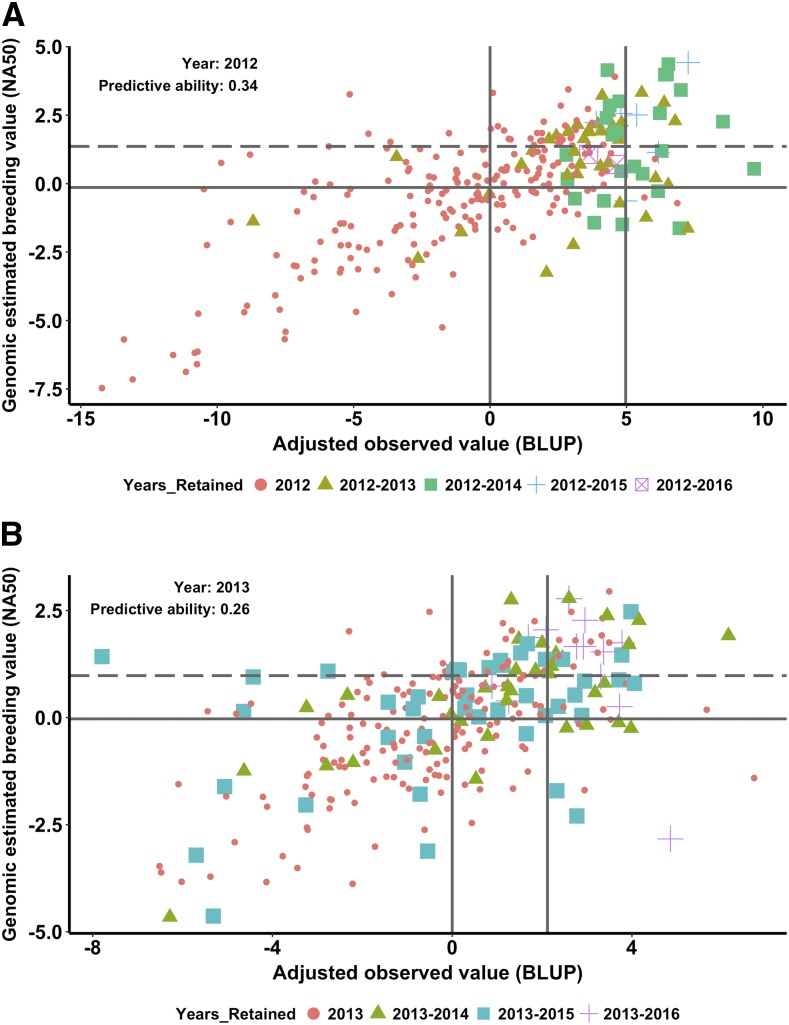
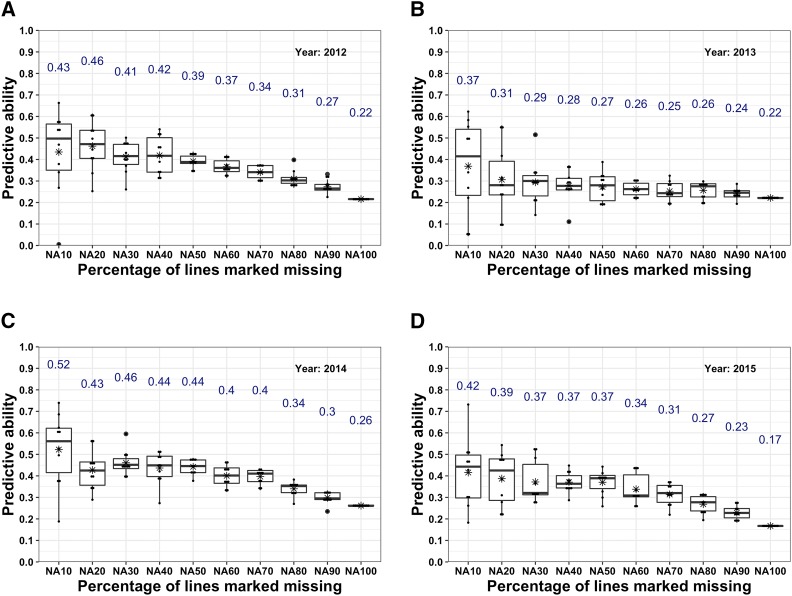
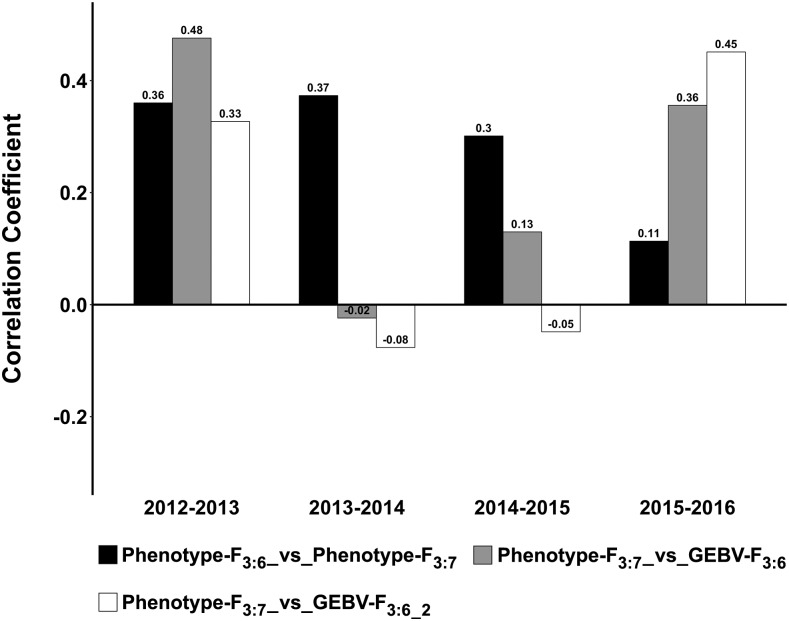
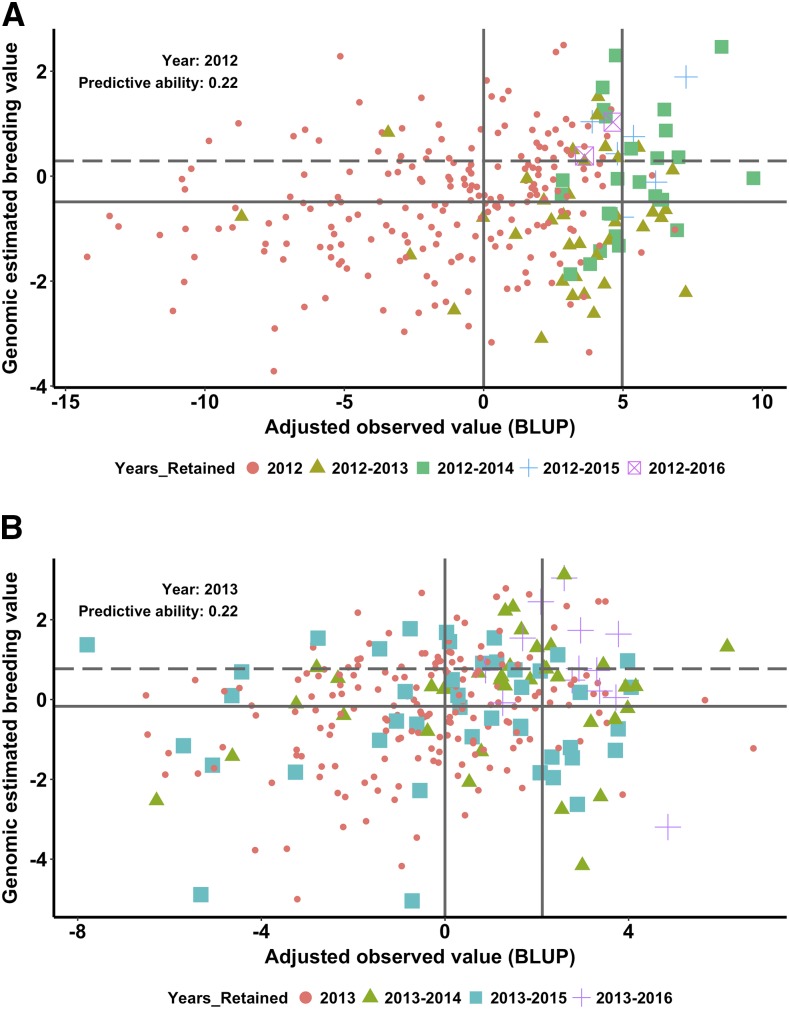
Genomic prediction (GP) is now routinely performed in crop plants to predict unobserved phenotypes. The use of predicted phenotypes to make selections is an active area of research. Here, we evaluate GP for predicting grain yield and compare genomic and phenotypic selection by tracking lines advanced. We examined four independent nurseries of F and F lines trialed at 6 to 10 locations each year. Yield was analyzed using mixed models that accounted for experimental design and spatial variations. Genotype-by-sequencing provided nearly 27,000 high-quality SNPs. Average genomic predictive ability, estimated for each year by randomly masking lines as missing in steps of 10% from 10 to 90%, and using the remaining lines from the same year as well as lines from other years in a training set, ranged from 0.23 to 0.55. The predictive ability estimated for a new year using the other years ranged from 0.17 to 0.28. Further, we tracked lines advanced based on phenotype from each of the four F nurseries. Lines with both above average genomic estimated breeding value (GEBV) and phenotypic value (BLUP) were retained for more years compared to lines with either above average GEBV or BLUP alone. The number of lines selected for advancement was substantially greater when predictions were made with 50% of the lines from the testing year added to the training set. Hence, evaluation of only 50% of the lines yearly seems possible. This study provides insights to assess and integrate genomic selection in breeding programs of autogamous crops.
基因组预测(GP)如今在农作物中已常规用于预测未观察到的表型。利用预测的表型进行选择是一个活跃的研究领域。在此,我们评估基因组预测用于预测谷物产量,并通过跟踪入选的品系来比较基因组选择和表型选择。我们研究了四个独立的F和F品系苗圃,每年在6至10个地点进行试验。使用考虑了实验设计和空间变异的混合模型对产量进行分析。通过测序获得了近27000个高质量单核苷酸多态性(SNP)。每年通过将品系按10%至90%的步长随机掩盖为缺失,并使用同一年的其余品系以及来自其他年份的品系作为训练集,估计的平均基因组预测能力在0.23至0.55之间。使用其他年份数据对新的一年估计的预测能力在0.17至0.28之间。此外,我们跟踪了四个F苗圃中每个苗圃基于表型入选的品系。与仅具有高于平均基因组估计育种值(GEBV)或表型值(BLUP)的品系相比,同时具有高于平均GEBV和BLUP的品系被保留的年份更多。当将测试年份50%的品系添加到训练集中进行预测时,入选推进的品系数量大幅增加。因此,每年仅评估50%的品系似乎是可行的。本研究为评估和整合基因组选择到自花授粉作物的育种计划中提供了见解。