• 文献检索
  • 文档翻译
  • 深度研究
  • 学术资讯
  • Suppr Zotero 插件Zotero 插件
  • 邀请有礼
  • 套餐&价格
  • 历史记录
应用&插件
Suppr Zotero 插件Zotero 插件浏览器插件Mac 客户端Windows 客户端微信小程序
定价
高级版会员购买积分包购买API积分包
服务
文献检索文档翻译深度研究API 文档MCP 服务
关于我们
关于 Suppr公司介绍联系我们用户协议隐私条款
关注我们

Suppr 超能文献

核心技术专利:CN118964589B侵权必究
粤ICP备2023148730 号-1Suppr @ 2026

文献检索

告别复杂PubMed语法,用中文像聊天一样搜索,搜遍4000万医学文献。AI智能推荐,让科研检索更轻松。

立即免费搜索

文件翻译

保留排版,准确专业,支持PDF/Word/PPT等文件格式,支持 12+语言互译。

免费翻译文档

深度研究

AI帮你快速写综述,25分钟生成高质量综述,智能提取关键信息,辅助科研写作。

立即免费体验

中国东部奉化市高中生近视和高度近视患病率上升:一项基于人群的15年调查。

The increasing prevalence of myopia and high myopia among high school students in Fenghua city, eastern China: a 15-year population-based survey.

作者信息

Chen Min, Wu Aimin, Zhang Lina, Wang Wei, Chen Xinyi, Yu Xiaoning, Wang Kaijun

机构信息

Eye Center, the 2nd Affiliated Hospital, Medical College of Zhejiang University, Hangzhou, China.

Zhejiang Provincial Key Lab of Ophthalmology, Hangzhou, China.

出版信息

BMC Ophthalmol. 2018 Jul 3;18(1):159. doi: 10.1186/s12886-018-0829-8.

DOI:10.1186/s12886-018-0829-8
PMID:29970057
原文链接:https://pmc.ncbi.nlm.nih.gov/articles/PMC6029024/
Abstract

BACKGROUND

Myopia is the leading cause of preventable blindness in children and young adults. Multiple epidemiological studies have confirmed a high prevalence of myopia in Asian countries. However, fewer longitudinal studies have been performed to evaluate the secular changes in the prevalence of myopia, especially high myopia in China. In the present study, we investigated trends in the prevalence of myopia among high school students in Fenghua city, eastern China, from 2001 to 2015.

METHODS

This was a population-based, retrospective study. Data were collected among 43,858 third-year high school students. Noncycloplegic autorefraction was used to determine refractive error, which was defined as low myopia, moderate myopia, high myopia and very high myopia according to the spherical equivalent from the worse eye of each participant. The prevalence of myopia was calculated and the annual percentage change (APC) was used to quantify the time trends. All analyses were conducted using the SPSS, Stata and Graphpad Prism software.

RESULTS

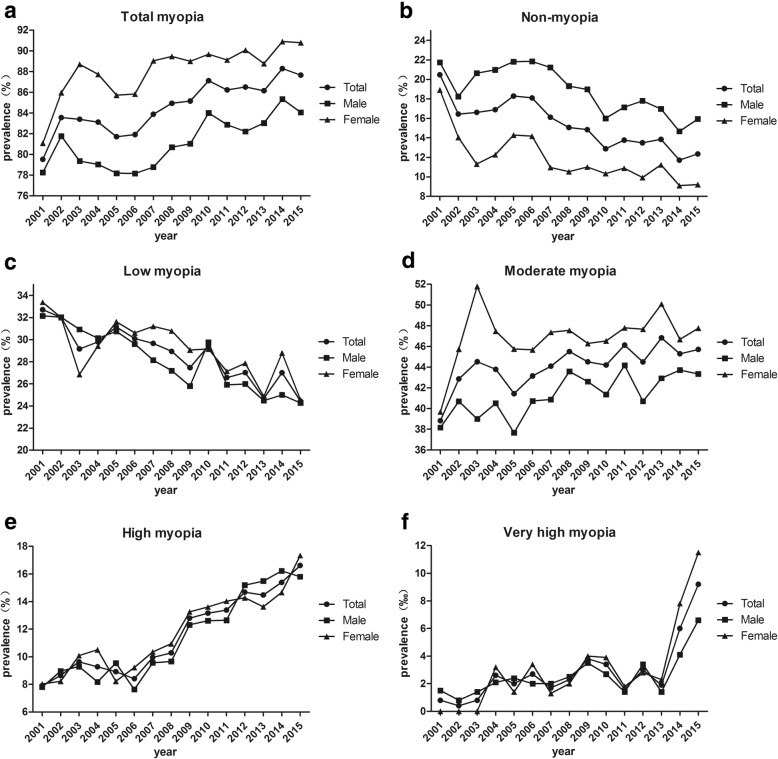
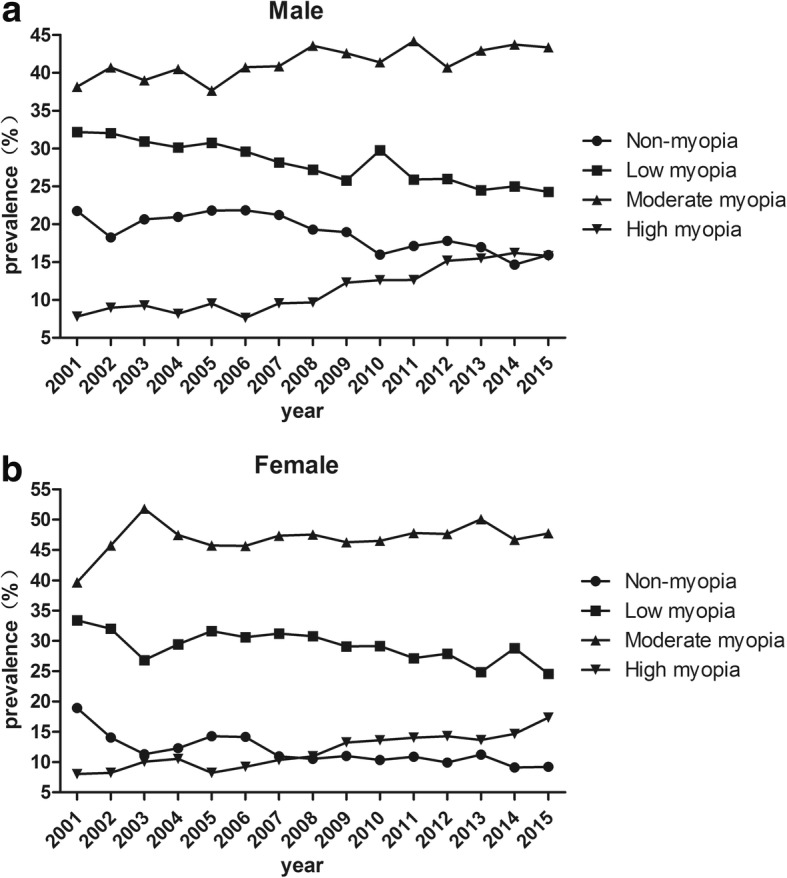
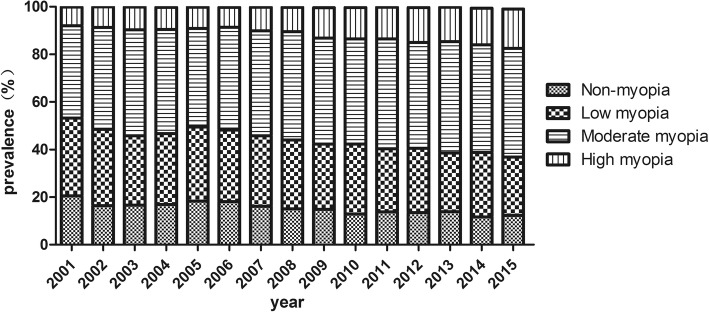
From 2001 to 2015, the prevalence of overall myopia increased from 79.5% to 87.7% (APC =0.59%), with a significant increase of moderate myopia (38.8% to 45.7%, APC = 0.78%), high myopia (7.9% to 16.6%, APC = 5.48%) and very high myopia (0.08% to 0.92%, APC = 14.59%), while the prevalence of low myopia decreased from 32.7% to 24.4% (APC = - 1.73%). High myopia and very high myopia contributed the major part of the increasing trend of myopia prevalence (contribution rate 27.00% and 69.07%, respectively).

CONCLUSIONS

During the 15-year period, there was a remarkable increase in the prevalence of high and very high myopia among high school students, which might become a serious public health problem in China for the next few decades.

摘要

背景

近视是儿童和青年可预防失明的主要原因。多项流行病学研究证实亚洲国家近视患病率很高。然而,较少有纵向研究评估近视患病率的长期变化,尤其是中国的高度近视。在本研究中,我们调查了2001年至2015年中国东部奉化市高中生近视患病率的趋势。

方法

这是一项基于人群的回顾性研究。收集了43858名高三学生的数据。使用非散瞳自动验光来确定屈光不正,根据每个参与者较差眼的等效球镜度将其定义为低度近视、中度近视、高度近视和超高度近视。计算近视患病率并使用年度百分比变化(APC)来量化时间趋势。所有分析均使用SPSS、Stata和Graphpad Prism软件进行。

结果

2001年至2015年,总体近视患病率从79.5%增至87.7%(APC = 0.59%),中度近视显著增加(从38.8%增至45.7%,APC = 0.78%),高度近视(从7.9%增至16.6%,APC = 5.48%)和超高度近视(从0.08%增至0.92%,APC = 14.59%),而低度近视患病率从32.7%降至24.4%(APC = -1.73%)。高度近视和超高度近视是近视患病率上升趋势的主要组成部分(贡献率分别为27.00%和69.07%)。

结论

在这15年期间,高中生中高度和超高度近视患病率显著增加,这可能在未来几十年成为中国严重的公共卫生问题。
https://cdn.ncbi.nlm.nih.gov/pmc/blobs/b764/6029024/6e9284cbe925/12886_2018_829_Fig4_HTML.jpg
https://cdn.ncbi.nlm.nih.gov/pmc/blobs/b764/6029024/4f82f69603c9/12886_2018_829_Fig1_HTML.jpg
https://cdn.ncbi.nlm.nih.gov/pmc/blobs/b764/6029024/9c57e44ee784/12886_2018_829_Fig2_HTML.jpg
https://cdn.ncbi.nlm.nih.gov/pmc/blobs/b764/6029024/bf39325e9b05/12886_2018_829_Fig3_HTML.jpg
https://cdn.ncbi.nlm.nih.gov/pmc/blobs/b764/6029024/6e9284cbe925/12886_2018_829_Fig4_HTML.jpg
https://cdn.ncbi.nlm.nih.gov/pmc/blobs/b764/6029024/4f82f69603c9/12886_2018_829_Fig1_HTML.jpg
https://cdn.ncbi.nlm.nih.gov/pmc/blobs/b764/6029024/9c57e44ee784/12886_2018_829_Fig2_HTML.jpg
https://cdn.ncbi.nlm.nih.gov/pmc/blobs/b764/6029024/bf39325e9b05/12886_2018_829_Fig3_HTML.jpg
https://cdn.ncbi.nlm.nih.gov/pmc/blobs/b764/6029024/6e9284cbe925/12886_2018_829_Fig4_HTML.jpg

相似文献

1
The increasing prevalence of myopia and high myopia among high school students in Fenghua city, eastern China: a 15-year population-based survey.中国东部奉化市高中生近视和高度近视患病率上升:一项基于人群的15年调查。
BMC Ophthalmol. 2018 Jul 3;18(1):159. doi: 10.1186/s12886-018-0829-8.
2
The increasing prevalence of myopia in junior high school students in the Haidian District of Beijing, China: a 10-year population-based survey.中国北京市海淀区初中生近视患病率上升:一项基于人群的10年调查
BMC Ophthalmol. 2017 Jun 12;17(1):88. doi: 10.1186/s12886-017-0483-6.
3
Prevalence of myopia among senior students in Fenghua, Eastern China, before and during the COVID-19 pandemic.中国东部奉化市高中生在 COVID-19 大流行前后近视患病率的变化。
Front Public Health. 2023 Jun 6;11:1180800. doi: 10.3389/fpubh.2023.1180800. eCollection 2023.
4
The influence of near work on myopic refractive change in urban students in Beijing: a three-year follow-up report.近距离工作对北京城市学生近视屈光变化的影响:一项三年随访报告
Graefes Arch Clin Exp Ophthalmol. 2016 Nov;254(11):2247-2255. doi: 10.1007/s00417-016-3440-9. Epub 2016 Jul 26.
5
Refractive status and prevalence of myopia among Chinese primary school students.中国小学生的屈光状态和近视患病率。
Clin Exp Optom. 2020 Mar;103(2):177-183. doi: 10.1111/cxo.12980. Epub 2019 Oct 31.
6
Low prevalence of myopia among school children in rural China.中国农村学龄儿童近视患病率低。
BMC Ophthalmol. 2018 Jun 11;18(1):140. doi: 10.1186/s12886-018-0808-0.
7
Design, methodology and baseline data of a school-based cohort study in Central China: the Anyang Childhood Eye Study.中国中部一项基于学校的队列研究的设计、方法及基线数据:安阳儿童眼病研究
Ophthalmic Epidemiol. 2013 Dec;20(6):348-59. doi: 10.3109/09286586.2013.842596. Epub 2013 Oct 25.
8
Incidence of myopia and biometric characteristics of premyopic eyes among Chinese children and adolescents.中国儿童和青少年近视的发病率及近视前期眼睛的生物特征
BMC Ophthalmol. 2018 Jul 20;18(1):178. doi: 10.1186/s12886-018-0836-9.
9
Outdoor activity and myopia among primary students in rural and urban regions of Beijing.北京城乡小学生户外活动与近视的关系
Ophthalmology. 2013 Feb;120(2):277-83. doi: 10.1016/j.ophtha.2012.07.086. Epub 2012 Oct 23.
10
Prevalence of myopia and vision impairment in school students in Eastern China.中国东部地区学生近视和视力损害的患病率。
BMC Ophthalmol. 2020 Jan 2;20(1):2. doi: 10.1186/s12886-019-1281-0.

引用本文的文献

1
The Impact of School Education on High Myopia in Children and Adolescents.学校教育对儿童青少年高度近视的影响
Int J Gen Med. 2025 Aug 31;18:4957-4964. doi: 10.2147/IJGM.S537179. eCollection 2025.
2
The impact of femtosecond laser small incision lenticule extraction on accommodative function.飞秒激光小切口基质透镜切除术对调节功能的影响。
Afr Health Sci. 2025 Jun;25(2):360-367. doi: 10.4314/ahs.v25i2.42.
3
Myopia and high myopia trends in Chinese children and adolescents over 25 years: a nationwide study with projections to 2050.

本文引用的文献

1
The increasing prevalence of myopia in junior high school students in the Haidian District of Beijing, China: a 10-year population-based survey.中国北京市海淀区初中生近视患病率上升:一项基于人群的10年调查
BMC Ophthalmol. 2017 Jun 12;17(1):88. doi: 10.1186/s12886-017-0483-6.
2
OVERVIEW OF THE COMPLICATIONS OF HIGH MYOPIA.高度近视并发症概述
Retina. 2017 Dec;37(12):2347-2351. doi: 10.1097/IAE.0000000000001489.
3
Current approaches to myopia control.当前的近视控制方法。
25年来中国儿童和青少年近视及高度近视的发展趋势:一项全国性研究及到2050年的预测
Lancet Reg Health West Pac. 2025 Jun 11;59:101577. doi: 10.1016/j.lanwpc.2025.101577. eCollection 2025 Jun.
4
Child Myopia Prevalence in Europe: A Systematic Review and Meta-Analysis.欧洲儿童近视患病率:一项系统评价与荟萃分析
Children (Basel). 2025 Jun 13;12(6):771. doi: 10.3390/children12060771.
5
Prevalence of Myopia and Axial Length Distribution in China: The Wuhu Children and Adolescents Eye Study.中国近视患病率及眼轴长度分布:芜湖儿童青少年眼病研究
Invest Ophthalmol Vis Sci. 2025 Jun 2;66(6):33. doi: 10.1167/iovs.66.6.33.
6
Association Between Inflammatory Cytokines and Refractive Errors: A Bidirectional Mendelian Randomization Study.炎症细胞因子与屈光不正之间的关联:一项双向孟德尔随机化研究。
Transl Vis Sci Technol. 2025 May 1;14(5):1. doi: 10.1167/tvst.14.5.1.
7
Comparative performance analysis of global and chinese-domain large language models for myopia.全球和中国领域用于近视研究的大语言模型的性能对比分析
Eye (Lond). 2025 Apr 13. doi: 10.1038/s41433-025-03775-5.
8
Asymmetric stress distribution on lamina cribrosa in glaucoma patients with high myopia.高度近视青光眼患者筛板上的不对称应力分布。
Graefes Arch Clin Exp Ophthalmol. 2025 Mar 26. doi: 10.1007/s00417-025-06809-6.
9
Prevalence and temporal trends in myopia and high myopia children in China: a systematic review and meta-analysis with projections from 2020 to 2050.中国儿童近视和高度近视的患病率及时间趋势:一项系统评价与荟萃分析,并对2020年至2050年进行预测
Lancet Reg Health West Pac. 2025 Jan 27;55:101484. doi: 10.1016/j.lanwpc.2025.101484. eCollection 2025 Feb.
10
Longitudinal measures of peripheral optical quality in young children.幼儿外周光学质量的纵向测量
Ophthalmic Physiol Opt. 2025 Mar;45(2):550-564. doi: 10.1111/opo.13438. Epub 2025 Jan 24.
Curr Opin Ophthalmol. 2017 May;28(3):267-275. doi: 10.1097/ICU.0000000000000367.
4
Epidemiology of Pathologic Myopia in Asia and Worldwide.亚洲及全球病理性近视的流行病学。
Asia Pac J Ophthalmol (Phila). 2016 Nov/Dec;5(6):394-402. doi: 10.1097/APO.0000000000000234.
5
Decreasing prevalence and time trend of gastroschisis in 14 cities of Liaoning Province: 2006-2015.辽宁省 14 个城市先天性腹裂的流行率和时间趋势变化:2006-2015 年。
Sci Rep. 2016 Sep 14;6:33333. doi: 10.1038/srep33333.
6
EPIDEMIC OF PATHOLOGIC MYOPIA: What Can Laboratory Studies and Epidemiology Tell Us?病理性近视的流行:实验室研究和流行病学能告诉我们什么?
Retina. 2017 May;37(5):989-997. doi: 10.1097/IAE.0000000000001272.
7
[Epidemiology of myopia].[近视流行病学]
Ophthalmologe. 2017 Jan;114(1):20-23. doi: 10.1007/s00347-016-0361-2.
8
Global Prevalence of Myopia and High Myopia and Temporal Trends from 2000 through 2050.全球近视和高度近视的患病率及 2000 至 2050 年的时间趋势。
Ophthalmology. 2016 May;123(5):1036-42. doi: 10.1016/j.ophtha.2016.01.006. Epub 2016 Feb 11.
9
Prevalence of Myopia in France: A Cross-Sectional Analysis.法国近视患病率:一项横断面分析。
Medicine (Baltimore). 2015 Nov;94(45):e1976. doi: 10.1097/MD.0000000000001976.
10
Hypertension and risk of cataract: a meta-analysis.高血压与白内障风险:一项荟萃分析。
PLoS One. 2014 Dec 4;9(12):e114012. doi: 10.1371/journal.pone.0114012. eCollection 2014.