Department of Biotechnology and Food Technology, Faculty of Science, University of Johannesburg, Doornfontein Campus, 2028 Gauteng, P.O. Box 17011, Johannesburg 2000, South Africa.
Nanotechnology and Water Sustainability Research Unit, College of Science, Engineering and Technology, University of South Africa, 1709 Johannesburg, Pretoria 0001, South Africa.
Toxins (Basel). 2018 Jul 16;10(7):294. doi: 10.3390/toxins10070294.
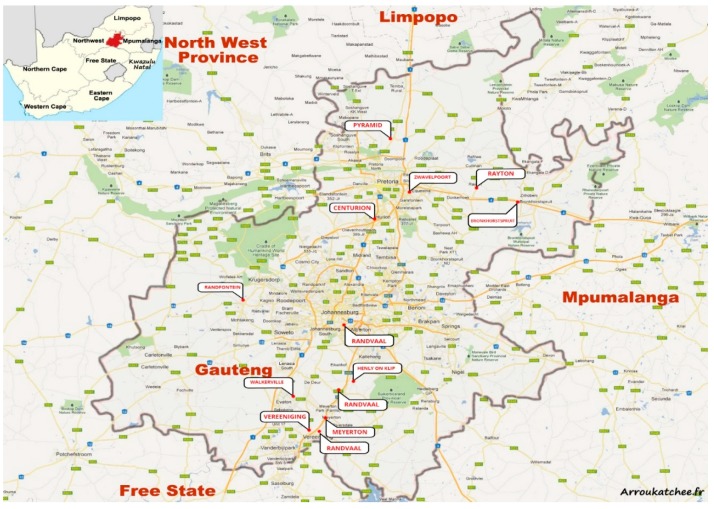
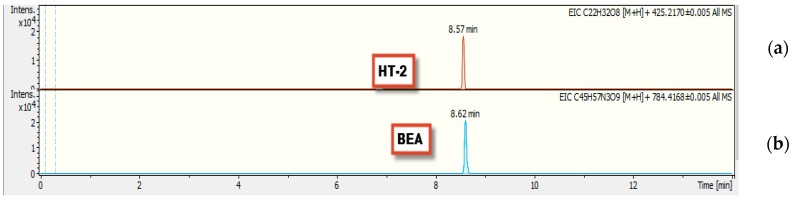
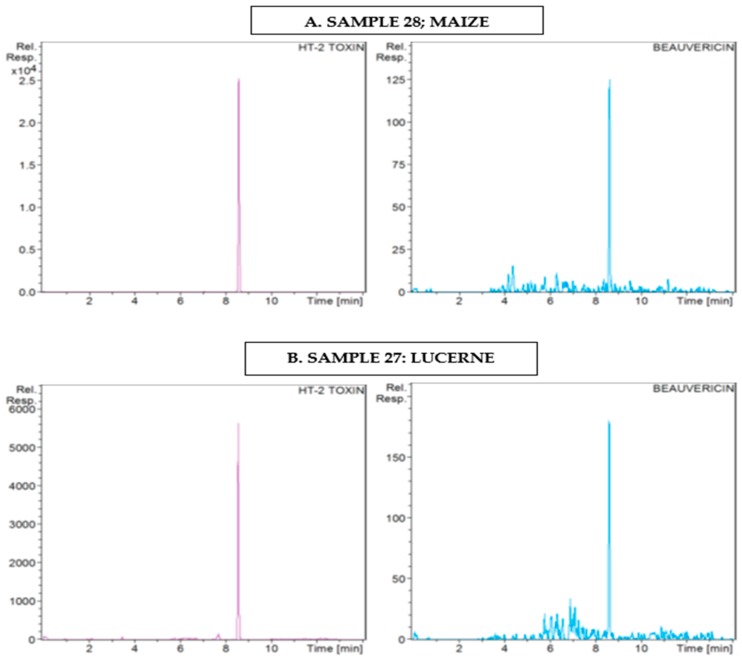
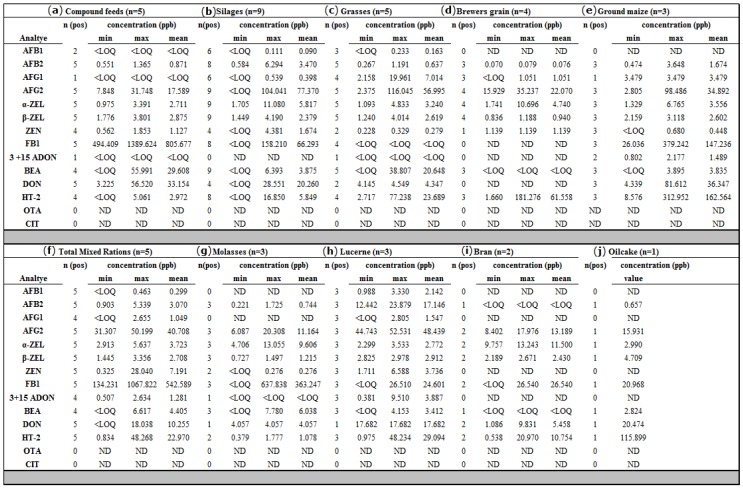
The indispensable nature of toxigenic fungi and mycotoxins in agricultural systems is of worldwide concern, hence the need for surveillance studies to preserve public health. Thirteen dairy farms were surveyed and 40 dairy feeds of varying nature collected and analyzed for mycotoxins. Estimated levels of aflatoxins (AFs), fumonisin B₁ (FB₁), ochratoxin A (OTA), citrinin (CIT), zearalenone (ZEN), α-zearalenol (α-ZEL), β-zearalenol (β-ZEL), deoxynivalenol (DON), 3- and 15-acetyl-deoxynivalenol (ADONs), HT-2 toxin (HT-2), and beauvericin (BEA) were established using liquid chromatography-tandem mass spectrometry. Highest frequencies (40/40) were found for AFG₂ (range: <LOQ-116.1 ppb), α-ZEL (range: 0.98⁻13.24 ppb), and β-ZEL (range: 0.73⁻4.71 ppb), followed by AFB₂ at 37/40 (range: <LOQ-23.88 ppb), BEA at 36/40 (range: <LOQ-55.99 ppb), HT-2 at 35/40 (range: <LOQ-312.95 ppb), and FB₁ at 34/40 (range: <LOQ-1389.62 ppb). Apart from samples exceeding regulatory limits for total AFs in dairy feeds due to the high amounts of AFG₂ and AFB₂, levels of other mycotoxins were regarded as safe for dairy production in South Africa. This is the first-time the natural occurrence of the cold climate HT-2 in South African feeds was documented. Persistent co-occurrence of multiple mycotoxins across samples, however, may elicit synergistic and/or additive effects in hosts, hence raising concerns about their impacts and how such interactions may affect the dairy livestock sector.
在农业系统中,产毒真菌和霉菌毒素的不可或缺性是全世界都关注的问题,因此需要进行监测研究来保护公众健康。对 13 个奶牛场进行了调查,并收集和分析了 40 种不同性质的奶牛饲料中的霉菌毒素。使用液相色谱-串联质谱法确定了黄曲霉毒素(AFs)、伏马菌素 B₁(FB₁)、赭曲霉毒素 A(OTA)、桔霉素(CIT)、玉米赤霉烯酮(ZEN)、α-玉米赤霉烯醇(α-ZEL)、β-玉米赤霉烯醇(β-ZEL)、脱氧雪腐镰刀菌烯醇(DON)、3- 和 15-乙酰基脱氧雪腐镰刀菌烯醇(ADONs)、HT-2 毒素(HT-2)和 beauvericin(BEA)的估计水平。发现 AFG₂(范围:<LOQ-116.1 ppb)、α-ZEL(范围:0.98-13.24 ppb)和β-ZEL(范围:0.73-4.71 ppb)的出现频率最高(40/40),其次是 AFB₂(范围:<LOQ-23.88 ppb),BEA(范围:<LOQ-55.99 ppb),HT-2(范围:<LOQ-312.95 ppb)和 FB₁(范围:<LOQ-1389.62 ppb)。除了由于 AFG₂和 AFB₂的高含量导致部分奶牛饲料中的总 AFs 超过监管限量的样本外,南非奶牛生产中其他霉菌毒素的水平被认为是安全的。这是首次记录南非饲料中寒冷气候 HT-2 的自然发生。然而,样本中多种霉菌毒素的持续共存可能会在宿主中引起协同和/或相加作用,因此人们对其影响以及这些相互作用如何影响奶牛养殖行业表示担忧。