Department of Pharmaceutical Technology and Chemistry, Faculty of Pharmacy and Nutrition, Universidad de Navarra, 31008 Pamplona, Spain.
Toxins (Basel). 2023 Feb 22;15(3):172. doi: 10.3390/toxins15030172.
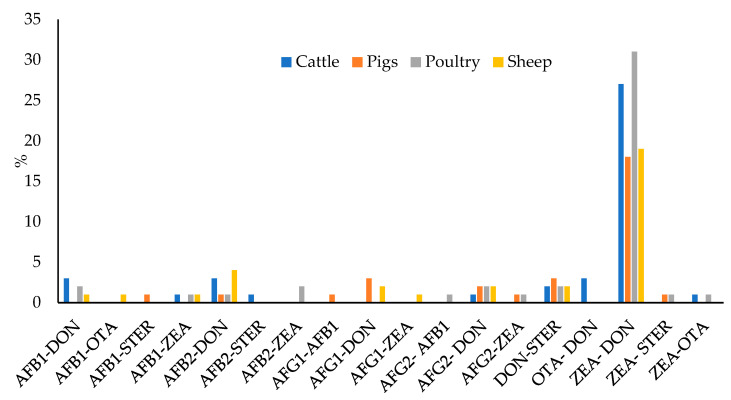
Mycotoxins, toxic compounds produced by fungi on raw materials, such as cereals, represent a serious health hazard. Animals are exposed to them mainly through the ingestion of contaminated feed. This study presents data about the presence and co-occurrence of nine mycotoxins: aflatoxins B1, B2, G1, and G2, ochratoxins A and B, zearalenone (ZEA), deoxynivalenol (DON), and sterigmatocystin (STER), in 400 samples of compound feed for cattle, pigs, poultry, and sheep (100 samples each) collected in Spain (2019-2020). Aflatoxins, ochratoxins, and ZEA were quantified using a previously validated HPLC method using fluorescence detection; whereas DON and STER were quantified using ELISA. Moreover, the obtained results were compared with those obtained in this country and published in the last 5 years. The mycotoxin presence in Spanish feed, especially for ZEA and DON, has been demonstrated. The maximum individual levels found were: AFB1: 6.9 µg/kg in a sample of feed for poultry; OTA: 65.5 µg/kg in a sample of feed for pigs, DON: 887 µg/kg in a sample of feed for sheep, and ZEA: 816 µg/kg in a sample of feed for pigs. Nevertheless, regulated mycotoxins appear, in general, at levels below those regulated by the EU; in fact, the percentage of samples containing concentrations above these limits was very low (from 0% for DON to 2.5% for ZEA). The co-occurrence of mycotoxins has also been demonstrated: 63.5% of the analyzed samples presented detectable levels of two to five mycotoxins. Due to the fact that the distribution of mycotoxins in raw materials can change greatly from year to year with climate conditions or market globalization, regular mycotoxin monitorization in feed is needed to prevent the integration of contaminated materials in the food chain.
真菌在原材料(如谷物)上产生的有毒化合物——霉菌毒素,对健康构成严重威胁。动物主要通过摄入受污染的饲料而接触到这些毒素。本研究提供了 400 份牛、猪、禽和羊用配合饲料(每种饲料 100 份)中 9 种霉菌毒素(黄曲霉毒素 B1、B2、G1、G2、赭曲霉毒素 A 和 B、玉米赤霉烯酮(ZEA)、脱氧雪腐镰刀菌烯醇(DON)和桔青霉素(STER))存在和共同出现的数据。使用先前经过验证的 HPLC 方法,通过荧光检测定量检测黄曲霉毒素、赭曲霉毒素和 ZEA;而 DON 和 STER 则通过 ELISA 定量检测。此外,还将获得的结果与西班牙本国在过去 5 年获得的结果和已发表的结果进行了比较。研究表明,西班牙饲料中存在霉菌毒素,尤其是 ZEA 和 DON。发现的最高个体水平为:黄曲霉毒素 B1:在一份禽用饲料中为 6.9 µg/kg;赭曲霉毒素 A:在一份猪用饲料中为 65.5 µg/kg;DON:在一份羊用饲料中为 887 µg/kg;ZEA:在一份猪用饲料中为 816 µg/kg。然而,受监管的霉菌毒素总体上出现在欧盟规定的水平以下;事实上,含有这些限量以上浓度的样品比例非常低(从 DON 的 0%到 ZEA 的 2.5%)。还证明了霉菌毒素的共同存在:分析的 63.5%的样品呈现出两种至五种霉菌毒素的可检测水平。由于霉菌毒素在原材料中的分布会随着气候条件或市场全球化而每年发生很大变化,因此需要对饲料进行定期的霉菌毒素监测,以防止受污染的材料进入食物链。