Department of Biotechnology and Food Technology, Faculty of Science, University of Johannesburg, P.O. Box 17011, Doornfontein Campus, Johannesburg, South Africa.
Agricultural Research Council, Onderstepoort Veterinary Institute, Toxicology and Ethnoveterinary Medicine, Public Health and Zoonoses, Private Bag X05, Onderstepoort, Pretoria North 0110, South Africa.
Toxins (Basel). 2019 Aug 2;11(8):452. doi: 10.3390/toxins11080452.
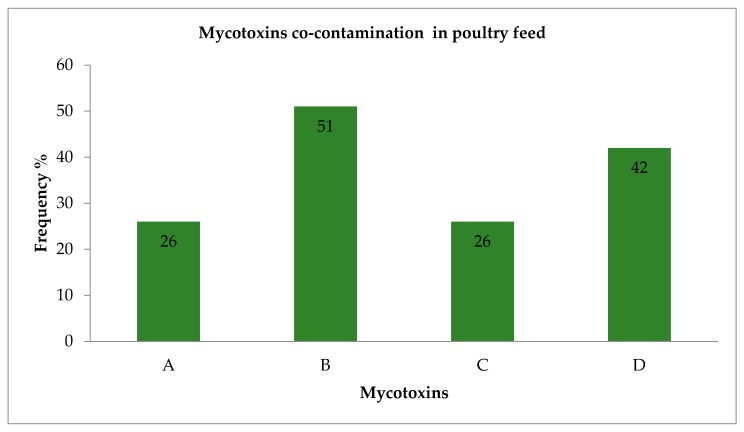
A total of 105 different types of poultry feed samples from South Africa were simultaneously analysed for the presence of 16 mycotoxins using ultra-high-performance liquid chromatography coupled to a triple quadrupole mass spectrometer (UHPLC-MS/MS). The data revealed the presence of 16 mycotoxins in the various poultry feed samples. Fumonisin B (FB) was the most dominant recovered from 100% of samples analysed at concentrations ranging between 38.7 and 7125.3 µg/kg. This was followed by zearalenone (ZEN) (range: 0.1-429 µg/kg) and deoxynivalenol (DON) (range: 2.5-154 µg/kg). Samples were also found to be contaminated with fumonisin B (FB) (range: 0.7-125.1 µg/kg), fumonisin B (FB) (range: 0.1-125.1 µg/kg), α-zearalenol (α-ZEL) (range: 0.6-20 µg/kg ), β-zearalenol (β-ZEL) (range: 0.2-22.1 µg/kg), 3-acetyldeoxynivalenol (3-ADON) (range: 0.1-12.9 µg/kg) and 15-acetyldeoxynivalenol (15-ADON) (range: 1.7-41.9 µg/kg). mycotoxin, i.e., Alternariol monomethyl ether (AME) was recovered in 100% of samples at concentrations that ranged from 0.3-155.5 µg/kg. Aflatoxins (AFs) had an incidence rate of 92% with generally low concentration levels ranging from 0.1-3.7 µg/kg. Apart from these metabolites, 2 type A trichothecenes (THs), i.e., HT-2 toxin (HT-2) (range: 0.2-5.9 µg/kg) and T-2 toxin (T-2) (range: 0.1-15.3 µg/kg) were also detected. Mycotoxin contamination in South African poultry feed constitutes a concern as correspondingly high contamination levels, such as those observed herein are likely to affect birds, which can be accompanied by severe health implications, thus compromising animal productivity in the country. Such exposures, primarily to more than one mycotoxin concurrently, may elicit noticeable synergistic and or additive effects on poultry birds.
本研究采用超高效液相色谱-三重四极杆串联质谱法(UHPLC-MS/MS)同时对南非的 105 种不同类型的家禽饲料样品进行了 16 种霉菌毒素的检测。结果显示,各种家禽饲料样品中均存在 16 种霉菌毒素。从 100%的分析样品中检测到的主要霉菌毒素是伏马菌素 B(FB),浓度范围为 38.7 至 7125.3 µg/kg。其次是玉米赤霉烯酮(ZEN)(浓度范围:0.1-429 µg/kg)和脱氧雪腐镰刀菌烯醇(DON)(浓度范围:2.5-154 µg/kg)。样品还被检测出存在伏马菌素 B(FB)(浓度范围:0.7-125.1 µg/kg)、伏马菌素 B(FB)(浓度范围:0.1-125.1 µg/kg)、α-玉米赤霉烯醇(α-ZEL)(浓度范围:0.6-20 µg/kg)、β-玉米赤霉烯醇(β-ZEL)(浓度范围:0.2-22.1 µg/kg)、3-乙酰脱氧雪腐镰刀菌烯醇(3-ADON)(浓度范围:0.1-12.9 µg/kg)和 15-乙酰脱氧雪腐镰刀菌烯醇(15-ADON)(浓度范围:1.7-41.9 µg/kg)。在所分析的样品中,100%的样品中均检测到霉菌毒素交替单甲醚(AME),浓度范围为 0.3-155.5 µg/kg。黄曲霉毒素(AFs)的检出率为 92%,浓度一般较低,范围为 0.1-3.7 µg/kg。除了这些代谢物外,还检测到 2 种类型 A 单端孢霉烯族化合物(THs),即 HT-2 毒素(HT-2)(浓度范围:0.2-5.9 µg/kg)和 T-2 毒素(T-2)(浓度范围:0.1-15.3 µg/kg)。南非家禽饲料中的霉菌毒素污染令人担忧,因为如此高的污染水平(如本文所观察到的)可能会影响鸟类,从而可能导致严重的健康问题,从而影响该国的动物生产力。这些暴露主要是同时接触多种霉菌毒素,可能会对家禽鸟类产生明显的协同和/或相加作用。