Department of Physical Education, Federal University of Piaui (UFPI), Piauí, Brazil.
Post Graduation Program on Physical Education, Catholic University of Brasilia (UCB), Brasília, Brazil,
Clin Interv Aging. 2018 Jul 31;13:1331-1340. doi: 10.2147/CIA.S164108. eCollection 2018.
The aim of the present study was to compare the acute effects of traditional resistance training (RT) versus high velocity RT (HVRT) on metabolic, cardiovascular, and psychophysiological responses in elderly hypertensive women.
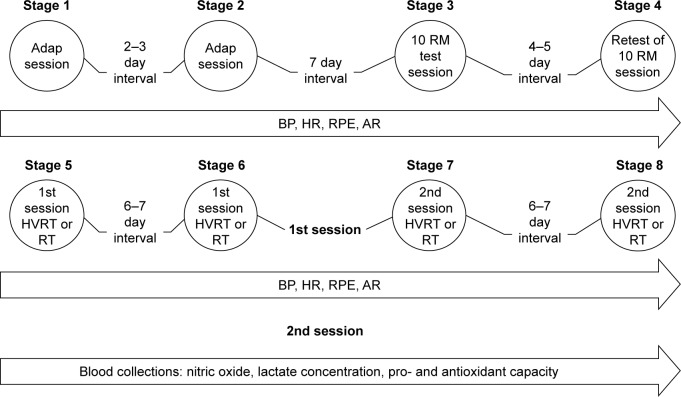
Fifteen elderly women (mean age ± standard deviation, 67.1±6.9 years) classified as having hypertension stage 1 or 2 were randomly allocated to complete traditional RT or HVRT; 1 week later, subjects allocated to RT completed the HVRT session and vice-versa. Heart rate, blood pressure, affective response, perceived effort, and blood samples analyzing lactate, nitrate, nitrite, oxidative damage (thiobarbituric acid reactive substances [TBARS]), and 6-hydroxy-2,5,7,8-tetramethylchroman-2-carboxylic acid equivalent antioxidant capacity (TEAC) collected before and after training sessions were assessed. Nutritional counseling was provided regarding nutrients that could affect cardiovascular and nitrate/nitrite analysis.
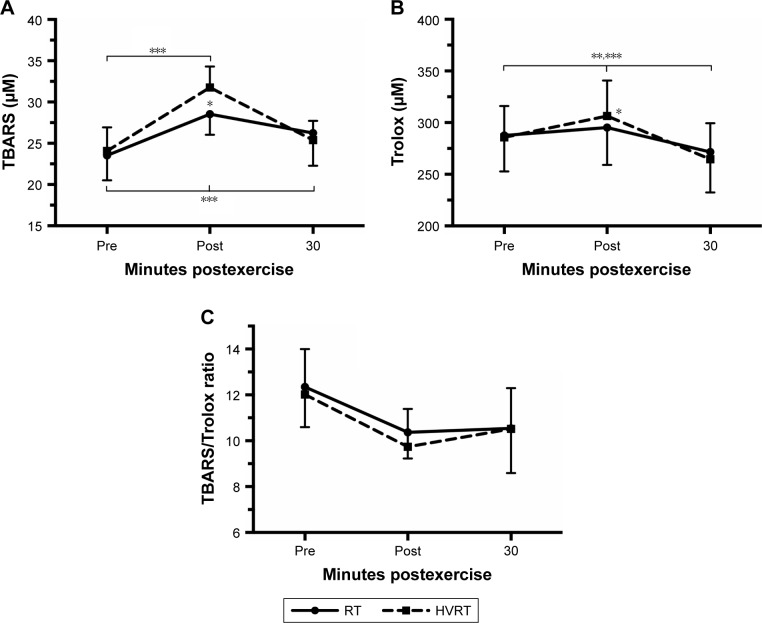
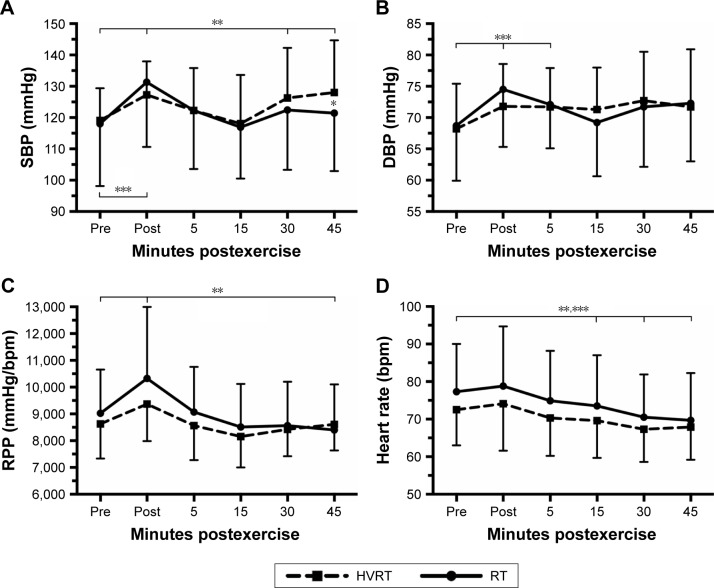
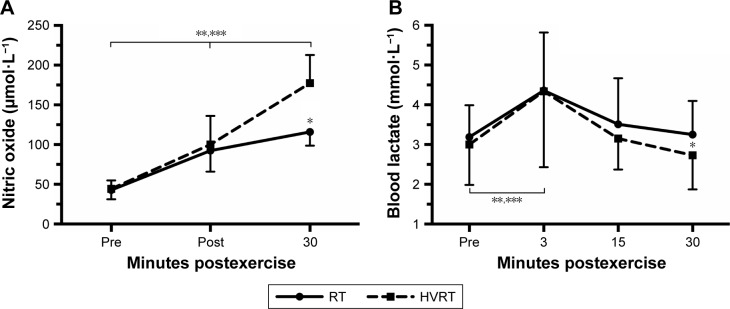
Systolic blood pressure was not statistically different (>0.05) between conditions at the beginning and during 30 minutes after sessions. Diastolic blood pressure, rate pressure product, and heart rate were not statistically different (>0.05) between conditions at the beginning and during 45 minutes after sessions. Nitric oxide was significantly higher (<0.0005) for HVRT compared to RT after 30 minutes of exercise. TBARS and TEAC were significantly higher (<0.05) for HVRT compared with RT only immediately after exercise. There were no differences for psychophysiological variables between protocols.
The acute cardiovascular and metabolic responses, including oxidative stress, are transient and within normal values. Taken together with the positive affective responses, both HVRT and RT with this intensity and volume seem to be safe for elderly hypertensive women under medication.
本研究旨在比较传统抗阻训练(RT)与高速抗阻训练(HVRT)对老年高血压女性代谢、心血管和心理生理反应的急性影响。
15 名老年女性(平均年龄±标准差,67.1±6.9 岁)被分类为 1 期或 2 期高血压,随机分配完成传统 RT 或 HVRT;一周后,接受 RT 的受试者完成 HVRT 课程,反之亦然。在训练前后评估心率、血压、情感反应、感知努力以及血液样本中分析的乳酸、硝酸盐、亚硝酸盐、氧化损伤(硫代巴比妥酸反应物质[TBARS])和 6-羟基-2,5,7,8-四甲基色满-2-羧酸当量抗氧化能力(TEAC)。提供了关于可能影响心血管和硝酸盐/亚硝酸盐分析的营养素的营养咨询。
收缩压在训练前后 30 分钟内各条件之间没有统计学差异(>0.05)。舒张压、心率乘积和心率在训练前后 45 分钟内各条件之间没有统计学差异(>0.05)。运动 30 分钟后,HVRT 组的一氧化氮明显高于 RT 组(<0.0005)。运动后立即,HVRT 组的 TBARS 和 TEAC 明显高于 RT 组(<0.05)。两种方案之间的心理生理变量没有差异。
急性心血管和代谢反应,包括氧化应激,是短暂的,处于正常范围内。综合积极的情感反应,这种强度和容量的 HVRT 和 RT 似乎对正在接受药物治疗的老年高血压女性是安全的。