Department of Infectious Disease Epidemiology, London School of Hygiene & Tropical Medicine, Keppel Street, London, WC1E 7HT, UK.
Epsom and St Helier University Hospitals NHS Trust, London, UK.
BMC Public Health. 2018 Aug 22;18(1):1052. doi: 10.1186/s12889-018-5962-z.
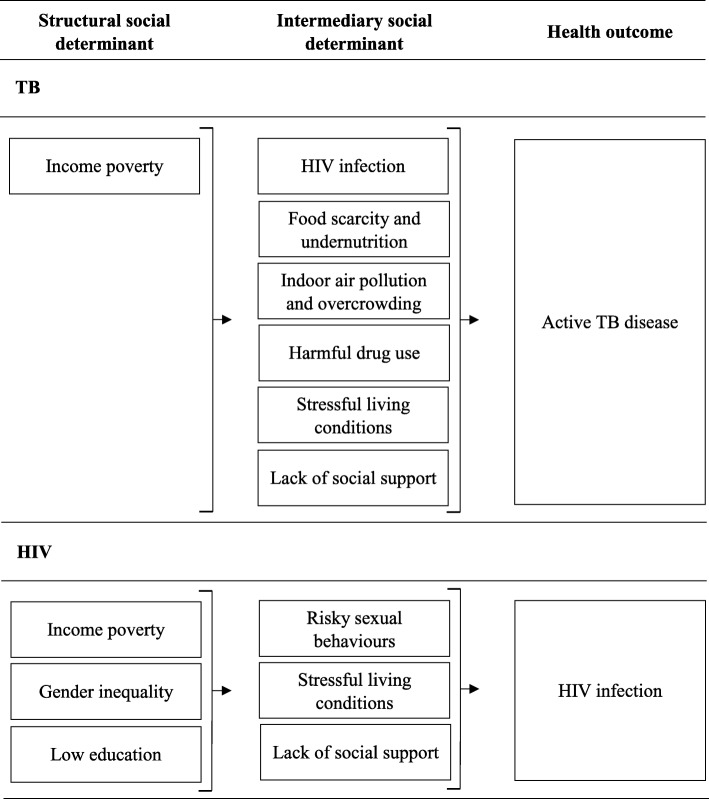
The World Health Organization prioritises a more holistic global response to end the tuberculosis (TB) epidemic by 2030. Based on experiences in the HIV response, social protection, and in particular cash transfers, show promise for contributing to this. Currently, individual-level evidence for the potential of cash transfers to prevent TB by addressing the structural social determinants of disease is lacking. To identify priority actions for the TB research agenda, we appraised efforts by the HIV response to establish the role of cash transfers in preventing HIV infection.
The HIV response has evaluated the effects of cash transfers on risky sexual behaviours and HIV incidence. Work has also evaluated the added effects of supplementing cash transfers with psychosocial support. The HIV response has focused research on populations with disproportionate HIV risk, and used a mix of explanatory evaluations, which use ideal conditions, and pragmatic evaluations, which use operational conditions, to generate evidence that is both causally valid and applicable to the real world. It has always collaborated with multiple stakeholders in funding and evaluating projects. Learning from the HIV response, priority actions for the TB response should be to investigate the effect of cash transfers on intermediary social determinants of active TB disease, and TB incidence, as well as the added effects of supplementing cash transfers with psychosocial support. Work should be focused on key groups in high burden settings, and look to build a combination of explanatory and pragmatic evidence to inform policy decisions in this field. To achieve this, there is an urgent need to facilitate collaborations between groups interested in evaluating the impact of cash transfers on TB risk.
The HIV response highlights several priority actions necessary for the TB response to establish the potential of cash transfers to prevent TB by addresing the structural social determinants of disease.
世界卫生组织优先考虑采取更全面的全球对策,以在 2030 年终结结核病(TB)流行。基于在艾滋病毒应对工作中取得的经验,社会保护,尤其是现金转移,显示出有可能为此做出贡献。目前,缺乏关于现金转移通过解决疾病的结构性社会决定因素来预防结核病的潜在作用的个体层面证据。为了确定结核病研究议程的优先行动,我们评估了艾滋病毒应对工作在确定现金转移在预防艾滋病毒感染方面的作用所做的努力。
艾滋病毒应对工作评估了现金转移对危险性行为和艾滋病毒感染率的影响。工作还评估了用心理社会支持补充现金转移的额外效果。艾滋病毒应对工作侧重于具有不成比例艾滋病毒风险的人群,并结合使用理想条件下的解释性评估和使用实际条件下的务实评估,以生成既具有因果有效性又适用于现实世界的证据。它始终与多个利益攸关方合作,为项目供资和进行评估。借鉴艾滋病毒应对工作的经验,结核病应对工作的优先行动应是调查现金转移对活动性结核病疾病和结核病发病率的中间社会决定因素的影响,以及用心理社会支持补充现金转移的额外效果。工作应侧重于高负担环境中的关键群体,并寻求建立解释性和务实性证据的结合,为这一领域的政策决策提供信息。要做到这一点,迫切需要促进有兴趣评估现金转移对结核病风险的影响的团体之间的合作。
艾滋病毒应对工作强调了结核病应对工作为确定现金转移通过解决疾病的结构性社会决定因素来预防结核病的潜力而必须采取的若干优先行动。