Young Bonnie N, Clark Maggie L, Rajkumar Sarah, Benka-Coker Megan L, Bachand Annette, Brook Robert D, Nelson Tracy L, Volckens John, Reynolds Stephen J, L'Orange Christian, Good Nicholas, Koehler Kirsten, Africano Sebastian, Osorto Pinel Anibal B, Peel Jennifer L
Department of Environmental and Radiological Health Sciences, Colorado State University, Fort Collins, Colorado.
Health Sciences, Gettysburg College, Gettysburg, Pennsylvania.
Indoor Air. 2019 Jan;29(1):130-142. doi: 10.1111/ina.12507. Epub 2018 Oct 15.
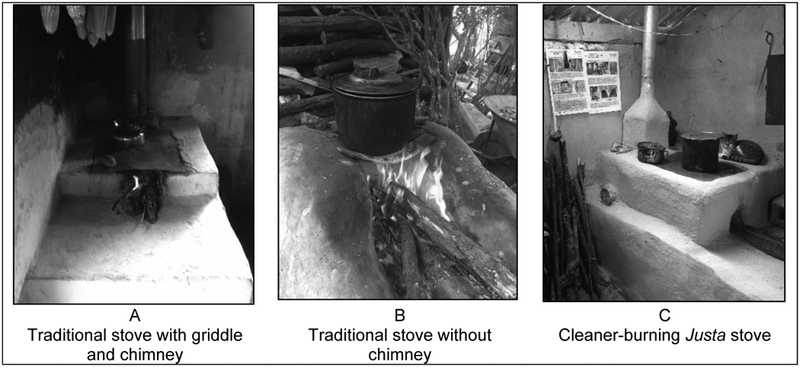
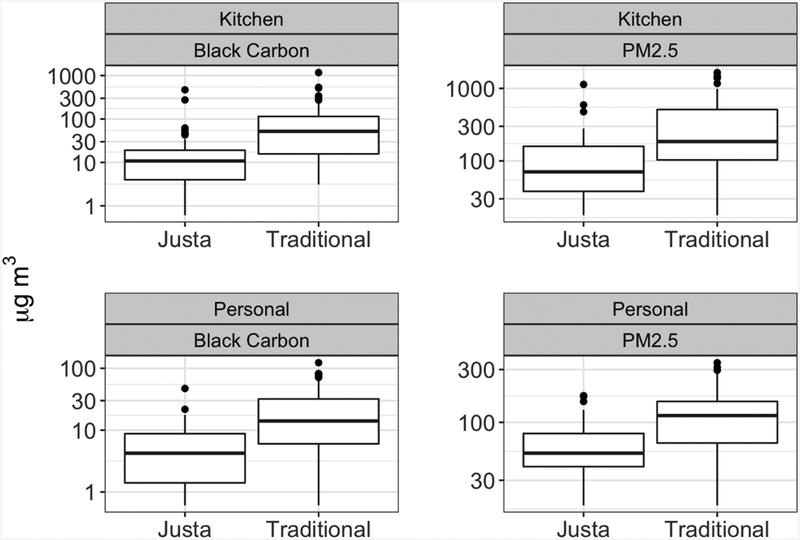
Growing evidence links household air pollution exposure from biomass cookstoves with elevated blood pressure. We assessed cross-sectional associations of 24-hour mean concentrations of personal and kitchen fine particulate matter (PM ), black carbon (BC), and stove type with blood pressure, adjusting for confounders, among 147 women using traditional or cleaner-burning Justa stoves in Honduras. We investigated effect modification by age and body mass index. Traditional stove users had mean (standard deviation) personal and kitchen 24-hour PM concentrations of 126 μg/m (77) and 360 μg/m (374), while Justa stove users' exposures were 66 μg/m (38) and 137 μg/m (194), respectively. BC concentrations were similarly lower among Justa stove users. Adjusted mean systolic blood pressure was 2.5 mm Hg higher (95% CI, 0.7-4.3) per unit increase in natural log-transformed kitchen PM concentration; results were stronger among women of 40 years or older (5.2 mm Hg increase, 95% CI, 2.3-8.1). Adjusted odds of borderline high and high blood pressure (categorized) were also elevated (odds ratio = 1.5, 95% CI, 1.0-2.3). Some results included null values and are suggestive. Results suggest that reduced household air pollution, even when concentrations exceed air quality guidelines, may help lower cardiovascular disease risk, particularly among older subgroups.
越来越多的证据表明,使用生物质炉灶导致的家庭空气污染与血压升高有关。我们评估了洪都拉斯147名使用传统炉灶或清洁燃烧的Justa炉灶的女性中,个人和厨房细颗粒物(PM)、黑碳(BC)24小时平均浓度以及炉灶类型与血压之间的横断面关联,并对混杂因素进行了校正。我们研究了年龄和体重指数对效应的修正作用。使用传统炉灶的人群个人和厨房24小时PM平均(标准差)浓度分别为126μg/m³(77)和360μg/m³(374),而使用Justa炉灶的人群暴露浓度分别为66μg/m³(38)和137μg/m³(194)。Justa炉灶使用者的BC浓度同样较低。经校正后,厨房PM浓度自然对数每增加一个单位,平均收缩压升高2.5mmHg(95%CI,0.7 - 4.3);在40岁及以上女性中结果更显著(升高5.2mmHg,95%CI为2.3 - 8.1)。经校正后,临界高血压和高血压(分类)的比值也升高(比值比 = 1.5,95%CI,1.0 - 2.3)。一些结果包含无效值且仅供参考。结果表明,减少家庭空气污染,即使浓度超过空气质量指南,也可能有助于降低心血管疾病风险,尤其是在老年亚组中。