Japan Advanced Institute of Science and Technology, Nomi-shi, Ishikawa, Japan.
Araya Inc., Minato-ku, Tokyo, Japan.
PLoS One. 2018 Sep 11;13(9):e0201126. doi: 10.1371/journal.pone.0201126. eCollection 2018.
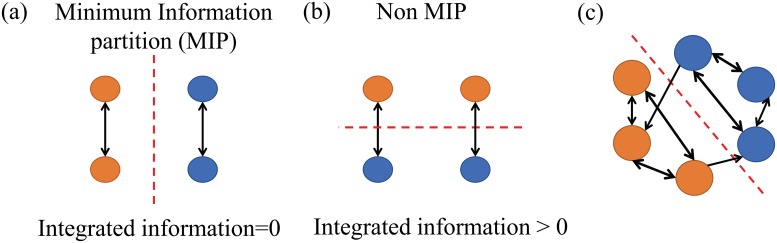
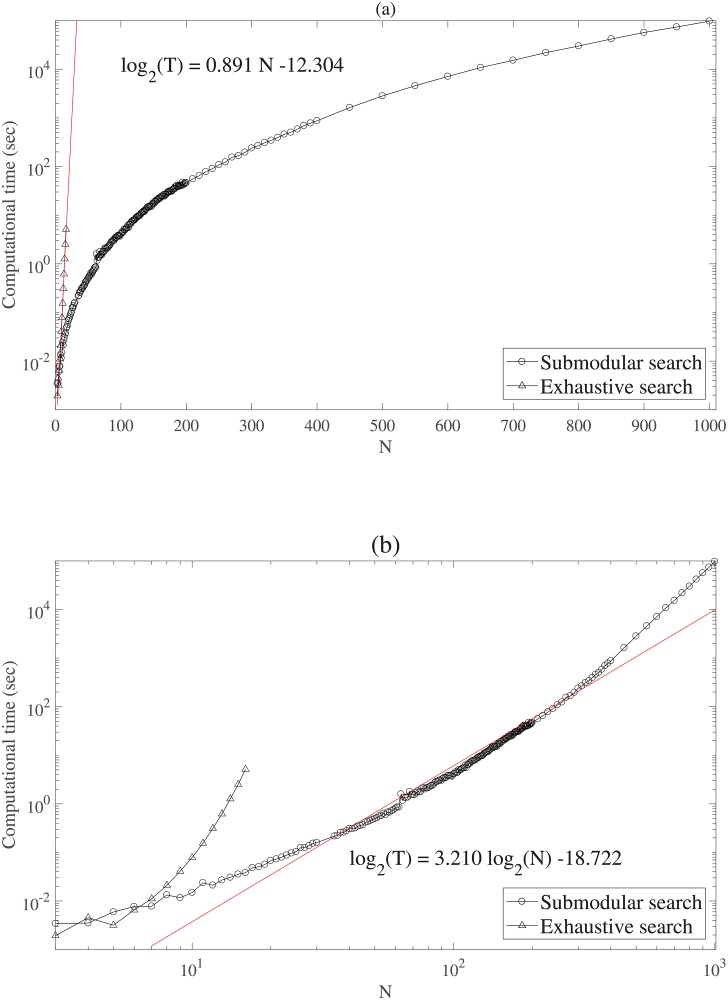
In analysis of multi-component complex systems, such as neural systems, identifying groups of units that share similar functionality will aid understanding of the underlying structures of the system. To find such a grouping, it is useful to evaluate to what extent the units of the system are separable. Separability or inseparability can be evaluated by quantifying how much information would be lost if the system were partitioned into subsystems, and the interactions between the subsystems were hypothetically removed. A system of two independent subsystems are completely separable without any loss of information while a system of strongly interacted subsystems cannot be separated without a large loss of information. Among all the possible partitions of a system, the partition that minimizes the loss of information, called the Minimum Information Partition (MIP), can be considered as the optimal partition for characterizing the underlying structures of the system. Although the MIP would reveal novel characteristics of the neural system, an exhaustive search for the MIP is numerically intractable due to the combinatorial explosion of possible partitions. Here, we propose a computationally efficient search to precisely identify the MIP among all possible partitions by exploiting the submodularity of the measure of information loss, when the measure of information loss is submodular. Submodularity is a mathematical property of set functions which is analogous to convexity in continuous functions. Mutual information is one such submodular information loss function, and is a natural choice for measuring the degree of statistical dependence between paired sets of random variables. By using mutual information as a loss function, we show that the search for MIP can be performed in a practical order of computational time for a reasonably large system (N = 100 ∼ 1000). We also demonstrate that MIP search allows for the detection of underlying global structures in a network of nonlinear oscillators.
在分析多组件复杂系统(如神经系统)时,识别具有相似功能的单元组将有助于理解系统的基本结构。为了找到这样的分组,可以通过评估系统被分成子系统时会丢失多少信息,以及子系统之间的相互作用被假设移除时会丢失多少信息来评估单元的可分离性或不可分离性。如果系统被分成子系统,并且子系统之间的相互作用被假设移除,那么两个独立的子系统的系统是完全可分离的,不会丢失任何信息,而强相互作用的子系统的系统则无法分离而不会丢失大量信息。在系统的所有可能分区中,信息损失最小的分区,称为最小信息分区(MIP),可以被认为是用于刻画系统基本结构的最佳分区。虽然 MIP 会揭示神经系统的新特征,但是由于可能分区的组合爆炸,对 MIP 的穷举搜索在数值上是不可行的。在这里,我们提出了一种计算效率高的搜索方法,可以通过利用信息损失度量的次模性来精确识别所有可能分区中的 MIP,当信息损失度量是次模性时。次模性是集合函数的数学性质,类似于连续函数中的凸性。互信息是这样的次模信息损失函数之一,是衡量成对随机变量之间统计相关性程度的自然选择。通过使用互信息作为损失函数,我们表明,对于相当大的系统(N = 100 ∼ 1000),可以按实际计算时间顺序执行 MIP 搜索。我们还证明了 MIP 搜索可以检测到非线性振荡器网络中的基本全局结构。