Department of Psychology, Carnegie Mellon University, Pittsburgh, Pennsylvania, United States of America.
School of Dental Medicine, University of Pittsburgh, Pittsburgh, Pennsylvania, United States of America.
PLoS One. 2018 Oct 3;13(10):e0203522. doi: 10.1371/journal.pone.0203522. eCollection 2018.
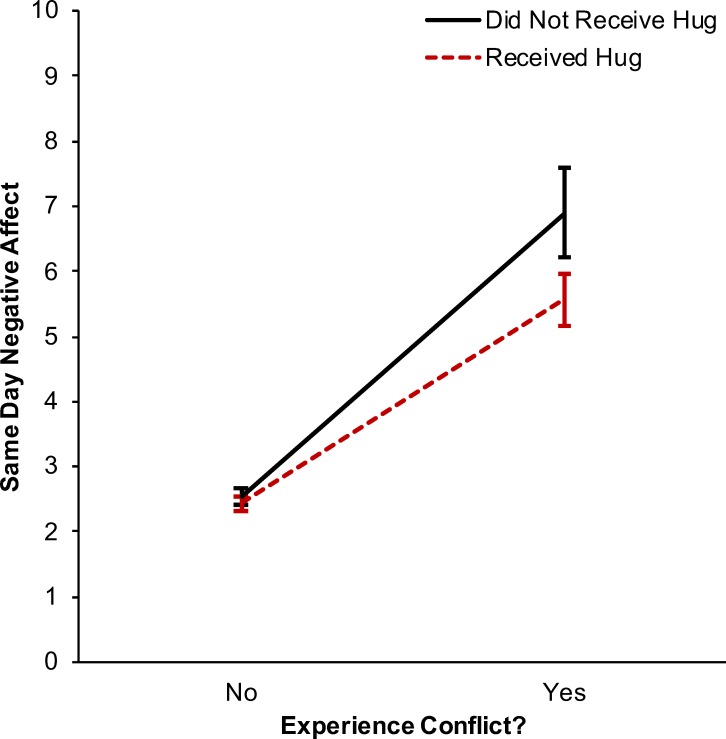
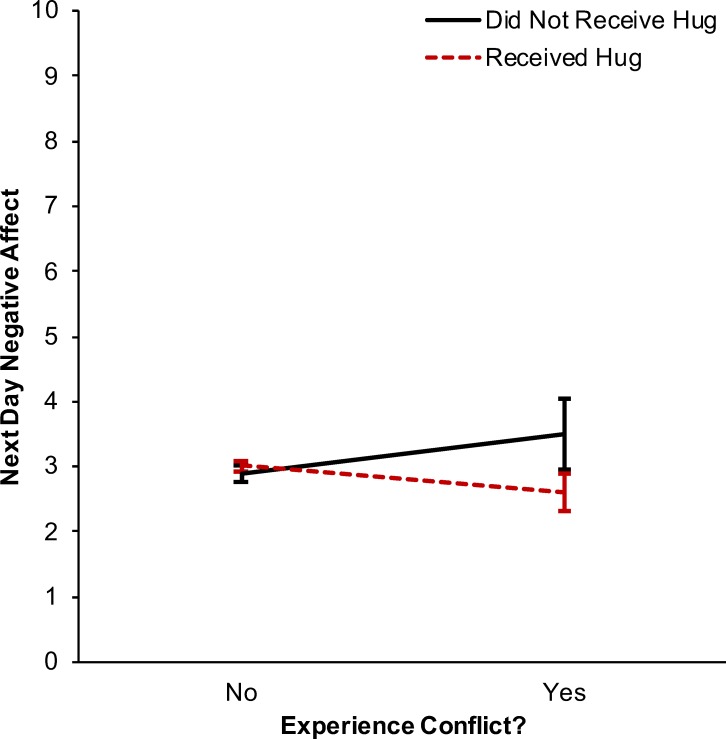
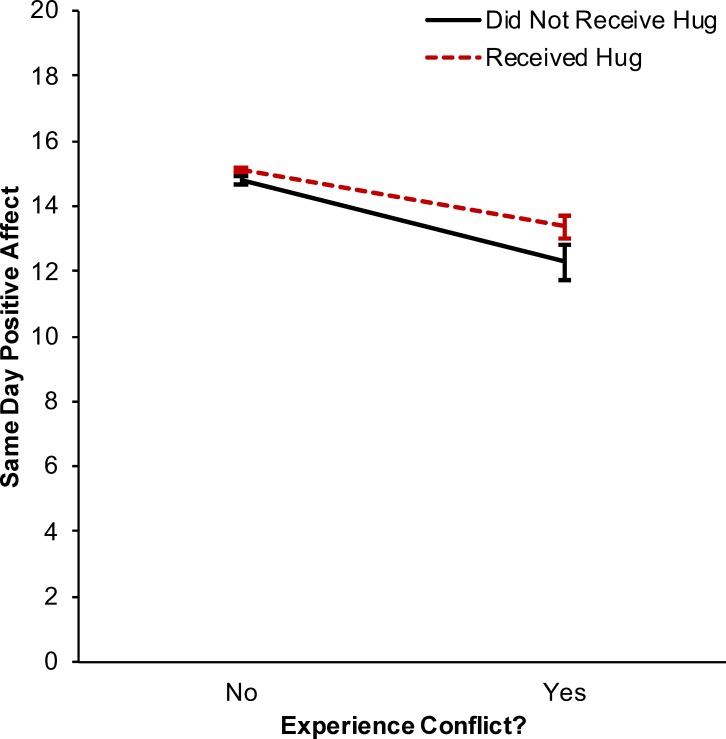
Interpersonal touch is emerging as an important topic in the study of adult relationships, with recent research showing that such behaviors can promote better relationship functioning and individual well-being. This investigation considers whether being hugged is associated with reduced conflict-related decreases in positive affect and increases in negative affect as well as whether these associations differ between women and men. A sample of 404 adults were interviewed every night for 14 consecutive days about their conflicts, hug receipt, and positive and negative affect. Results indicated that there was an interaction between hug receipt and conflict exposure such that receiving a hug was associated with a smaller conflict-related decrease in positive affect and a smaller conflict-related increase in negative affect when assessed concurrently. Hug receipt was also prospectively associated with a smaller conflict-related increase in next day negative affect but was not associated with next day positive affect. Associations between hug receipt and conflict-related changes in affect did not differ between women and men, between individuals who were married or in a marital-like relationship and those who were not, or as a function of individual differences in baseline perceived social support. While correlational, these results are consistent with the hypothesis that hugs buffer against deleterious changes in affect associated with experiencing interpersonal conflict. Possible mechanisms through which hugs facilitate positive adaptation to conflict are discussed.
人际接触正成为成人关系研究中的一个重要课题,最近的研究表明,这种行为可以促进更好的关系功能和个体幸福感。本研究考察了被拥抱是否与减少与冲突相关的积极情绪下降和增加消极情绪有关,以及这些关联是否因女性和男性而有所不同。一个由 404 名成年人组成的样本在连续 14 天的每天晚上接受关于他们的冲突、拥抱接受情况以及积极和消极情绪的访谈。结果表明,拥抱接受和冲突暴露之间存在交互作用,即当同时评估时,接受拥抱与积极情绪的冲突相关下降较小,与消极情绪的冲突相关增加较小有关。拥抱接受还与第二天的消极情绪的冲突相关增加呈前瞻性相关,但与第二天的积极情绪无关。拥抱接受与情绪相关的冲突变化之间的关联在女性和男性之间、已婚或类似婚姻关系的个体与未婚个体之间、以及个体基线感知社会支持的差异方面没有差异。虽然这些结果是相关的,但它们与拥抱缓冲与经历人际冲突相关的情绪恶化的假设一致。讨论了拥抱促进积极适应冲突的可能机制。