The Rowett Institute, University of Aberdeen, Foresterhill, Aberdeen, AB25 2ZD, UK.
Institute of Molecular, Cell and Systems Biology, College of Medical, Veterinary and Life Sciences, University of Glasgow, Glasgow, G12 8QQ, UK.
Sci Rep. 2018 Oct 22;8(1):15566. doi: 10.1038/s41598-018-34081-8.
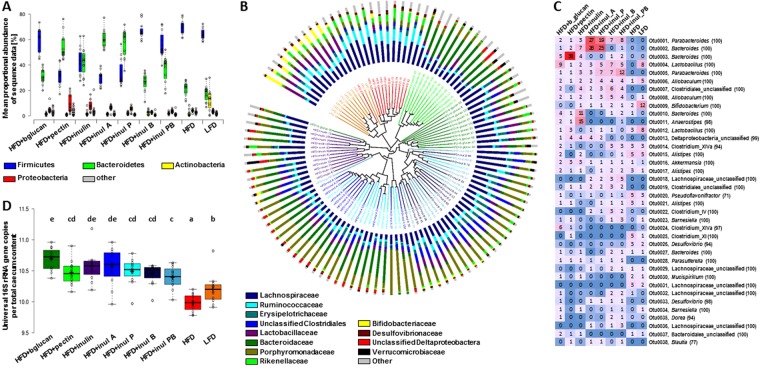
Dietary fibers (DF) can prevent obesity in rodents fed a high-fat diet (HFD). Their mode of action is not fully elucidated, but the gut microbiota have been implicated. This study aimed to identify the effects of seven dietary fibers (barley beta-glucan, apple pectin, inulin, inulin acetate ester, inulin propionate ester, inulin butyrate ester or a combination of inulin propionate ester and inulin butyrate ester) effective in preventing diet-induced obesity and links to differences in cecal bacteria and host gene expression. Mice (n = 12) were fed either a low-fat diet (LFD), HFD or a HFD supplemented with the DFs, barley beta-glucan, apple pectin, inulin, inulin acetate ester, inulin propionate ester, inulin butyrate ester or a combination of inulin propionate ester and inulin butyrate ester for 8 weeks. Cecal bacteria were determined by Illumina MiSeq sequencing of 16S rRNA gene amplicons. Host responses, body composition, metabolic markers and gene transcription (cecum and liver) were assessed post intervention. HFD mice showed increased adiposity, while all of the DFs prevented weight gain. DF specific differences in cecal bacteria were observed. Results indicate that diverse DFs prevent weight gain on a HFD, despite giving rise to different cecal bacteria profiles. Conversely, common host responses to dietary fiber observed are predicted to be important in improving barrier function and genome stability in the gut, maintaining energy homeostasis and reducing HFD induced inflammatory responses in the liver.
膳食纤维(DF)可预防高脂肪饮食(HFD)喂养的啮齿动物肥胖。其作用机制尚未完全阐明,但肠道微生物群已被牵连。本研究旨在确定七种有效预防饮食诱导肥胖的膳食纤维(大麦β-葡聚糖、苹果果胶、菊粉、菊粉醋酸酯、菊粉丙酸酯、菊粉丁酸酯或菊粉丙酸酯和菊粉丁酸酯的混合物)的影响,以及与盲肠细菌和宿主基因表达差异的联系。将 12 只小鼠(n=12)分别喂食低脂饮食(LFD)、HFD 或 HFD 补充大麦β-葡聚糖、苹果果胶、菊粉、菊粉醋酸酯、菊粉丙酸酯、菊粉丁酸酯或菊粉丙酸酯和菊粉丁酸酯的混合物 8 周。通过 Illumina MiSeq 测序 16S rRNA 基因扩增子来确定盲肠细菌。干预后评估宿主反应、身体成分、代谢标志物和基因转录(盲肠和肝脏)。HFD 小鼠表现出肥胖增加,而所有的 DF 都阻止了体重增加。观察到盲肠细菌的特定 DF 差异。结果表明,尽管不同的 DF 导致不同的盲肠细菌图谱,但它们可以预防 HFD 引起的体重增加。相反,观察到对膳食纤维的共同宿主反应预计对改善肠道屏障功能和基因组稳定性、维持能量平衡和减少肝脏中 HFD 诱导的炎症反应很重要。