Sampaio Jaime, Leser Roland, Baca Arnold, Calleja-Gonzalez Julio, Coutinho Diogo, Gonçalves Bruno, Leite Nuno
Research Centre in Sports Sciences, Health Sciences and Human Development, CIDESD, CreativeLab Research Community, Vila Real 5000, Portugal.
Sport Sciences Department, University of Trás-Os-Montes e Alto Douro, Vila Real 5000, Portugal.
J Sport Health Sci. 2016 Sep;5(3):375-380. doi: 10.1016/j.jshs.2015.01.011. Epub 2015 May 30.
Novel player tracking technologies can change the understanding of performance determinants in team sports by allowing to accurately measuring the activity demands. The aim of this study was to identify how the defensive pressure affects the time-motion variables and the technical actions in basketball.
Twenty international male players (age: 16.05 ± 2.09 years, weight: 73.13 ± 8.10 kg, height: 183.10 ± 5.88 cm) played two 10 min basketball quarters, where they used a man-to-man 1/4-court defense until the 4th min (F1/4), changed to man-to-man full court (FULL) for 3 min and, from the 7th to the 10th min returned to 1/4-court defense (S1/4). A computerized notational analysis was performed using Simi Scout and positional data were captured with the Ubisense Real Time Location System (mean sampling rate 3.74 ± 0.45 Hz per transmitter/player).
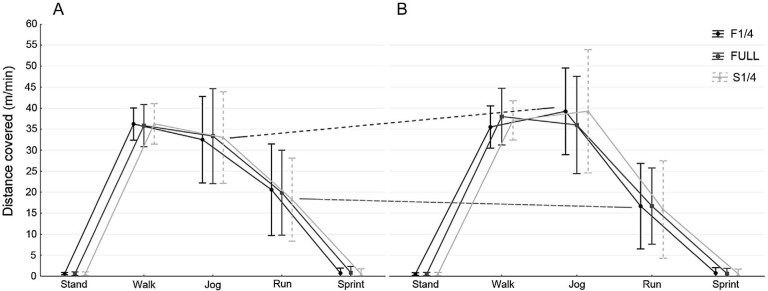
The time-motion variables presented similar results between defensive conditions, showing a total distance covered around 90 m/min. However, results suggested possible vertical jump impairments in S1/4 periods. There was more distance covered while jogging in the offensive court (38.15 ± 12.17 m/min offensive court 32.94 ± 10.84 m/min defensive court, < 0.05) and more distance covered while running in the defensive court (16.41 ± 10.27 m/min offensive court 19.56 ± 10.29 m/min defensive court, < 0.05).
These results suggest how to improve task representativeness during specific conditioning or game-based training situations and also to help coaches' strategic decisions during the games.
新型运动员追踪技术能够通过精确测量活动需求,改变人们对团队运动中表现决定因素的理解。本研究的目的是确定防守压力如何影响篮球运动中的时间 - 动作变量和技术动作。
20名国际男子运动员(年龄:16.05 ± 2.09岁,体重:73.13 ± 8.10千克,身高:183.10 ± 5.88厘米)进行了两个10分钟的篮球半场比赛,在第4分钟之前采用人盯人1/4场地防守(F1/4),在第4至7分钟改为全场人盯人防守(FULL),从第7至10分钟又回到1/4场地防守(S1/4)。使用Simi Scout进行计算机化记录分析,并通过Ubisense实时定位系统捕获位置数据(每个发射器/运动员的平均采样率为3.74 ± 0.45赫兹)。
时间 - 动作变量在不同防守条件下呈现出相似的结果,总距离覆盖约为90米/分钟。然而,结果表明在S1/4阶段可能存在垂直跳跃能力受损的情况。在进攻场地慢跑时覆盖的距离更多(进攻场地38.15 ± 12.17米/分钟 防守场地32.94 ± 10.84米/分钟,<0.05),在防守场地跑步时覆盖的距离更多(进攻场地16.41 ± 10.27米/分钟 防守场地19.56 ± 10.29米/分钟,<0.05)。
这些结果表明了如何在特定的体能训练或基于比赛的训练情境中提高任务代表性,同时也有助于教练在比赛中的战略决策。